Your legs and the motor are not taking turns — they are adding together. On an e-bike at a steady speed, the rider’s watts and the motor’s watts combine to meet exactly what the road is asking for. Grin Technologies, the Vancouver hub-motor builders behind the ebikes.ca motor simulator, put it plainly: “the output power of the motor plus the human is equal to the load line of the vehicle.” So the honest answer to “legs or motor” is both, in a ratio you control — and that ratio decides your range, your battery temperature and how the bike feels under you.
It is the number almost nobody checks before buying, and it explains why two riders on identical bikes get wildly different kilometres from the same battery. Here is how e-bike pedal assist power actually splits.
How much power do your legs actually add to an e-bike?
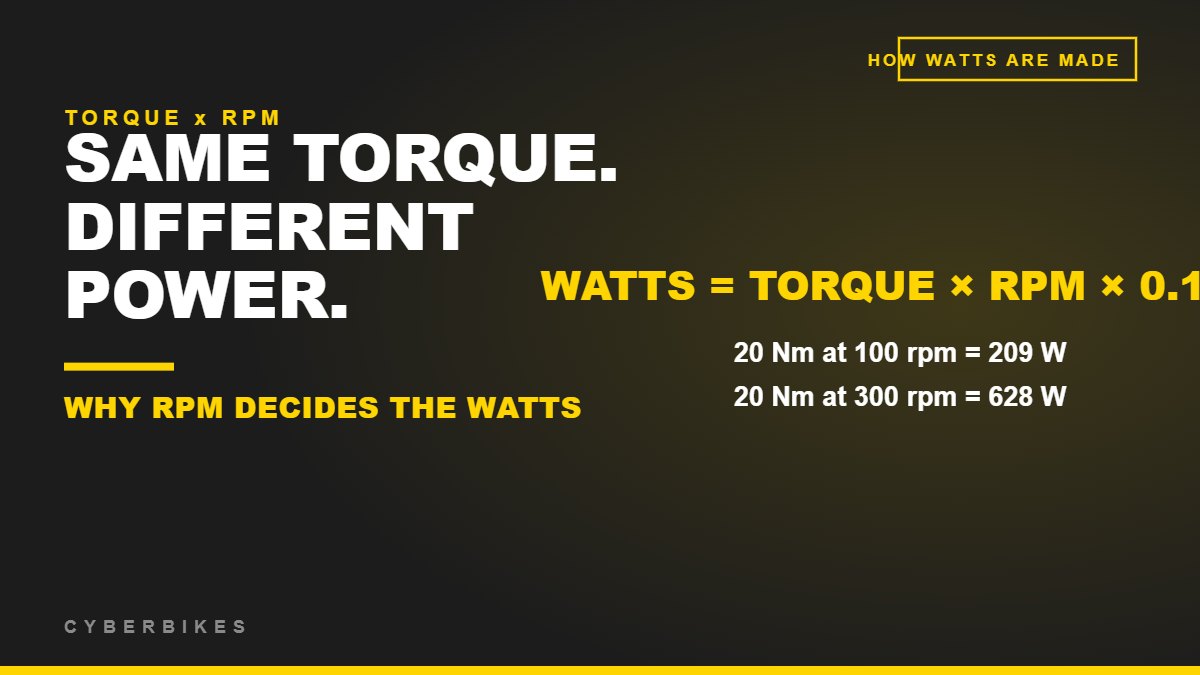
Your legs make power the same way the motor does: torque multiplied by speed. Grin’s power ratings explainer gives the formula directly — Power in Watts = Torque × RPM × 2π/60, which works out to roughly Torque × RPM × 0.104.
Run your own cranks through it. If you are turning the pedals at 60 rpm and averaging 20 Nm of torque, that is 20 × 60 × 0.104 = about 125 watts coming out of your legs. Push 30 Nm at the same cadence and you are at roughly 187 watts. Those are arithmetic from Grin’s own formula, not a lab claim — and they show how quickly a modest-feeling effort turns into real propulsion.
Peak torque is a different animal again. Grin’s pedal-assist page works a worked example: “A 60 kg person is standing with all their weight on a horizontal 165mm crank is producing (60 * 9.8 * 0.165) = 97 Nm of torque.” That is a big instantaneous number — but you cannot hold it, which is exactly why e-bike motors exist. The motor’s job is to turn your short bursts into something that lasts the whole ride up Johnston Street.
Why does rpm decide the watts, not just torque?
Because power is torque and speed together. Grin’s worked example: “A motor producing 20 Nm of torque and spinning at 100 rpm is generating 209 watts. That same motor producing 20 Nm of torque while spinning at 300 rpm is producing 628 watts.” Identical twisting force, triple the output — the only thing that changed is how fast it is turning.
This is why grinding slowly up a steep pinch is the hardest thing you can ask of a hub motor. You are demanding high torque at low rpm, which means low output power but high current — and current is what cooks copper. Grin is blunt about the failure mode: “it’s not the output power but the output torque of the motor which causes it to heat up and eventually fail.” Worse, heating does not rise in a straight line. Double the current and you “increase the amount of copper heat being generated by a factor of FOUR (the I²R relationship).”
The practical rule writes itself: your legs are most valuable exactly where the motor is weakest — slow, steep, loaded. A hundred watts from you on a 10% climb is a hundred watts the motor does not have to make as heat-generating low-rpm torque. For the full picture inside the hub, see our guide to how e-bike motors, sensors and controllers actually work.
How does your e-bike decide how much to help?
Two sensing approaches, and they split the legs-versus-motor ratio completely differently. Grin describes them as “basic PAS sensors which detect just the speed at which the cranks are turning, and torque sensors which also sense how hard the rider is pushing on the pedals.”
- Cadence (basic PAS): “the control electronics only knows how fast you are spinning the cranks, but it does not know how much force you are actually applying.” Spin the pedals gently and you still get the full preset assist — the motor’s share goes up, yours goes down.
- Torque sensing: “A torque based control directly couples the motor power to the rider’s power output.” Grin’s multiplier example is the clearest way to picture it: “for every watt of human power the motor puts out 2 watts.” Work harder, get more help; coast, get nothing.
- Constant power (autoPAS): a flat wattage regardless of effort — “With autoPAS set to 200watts, you would have receive the same 200 watts of boost.”
- Threshold settings: where assist kicks in is tunable. “With a low threshold of like 50 watts, the power would be present even with light pedaling, while a 200 watt threshold would provide no assist during normal riding.”
Why does torque sensing know your wattage at all? Because it measures the one thing cadence sensing cannot. As Grin puts it, that reading “is essential to know how much power the rider is putting out (which is torque*rpm).” If you are weighing the two systems for your own commute, we compared them in detail in torque or cadence sensor: which e-bike assist wins.
Does pedalling harder actually extend your e-bike range?
Yes — but not for the reason most people assume. It is not that one assist system is magically efficient. Grin is emphatic: “The range you get on an ebike fundamentally has nothing to do with what kind of control system you use, and everything to do with the average amount of power you draw.”
Every watt you contribute is a watt the battery does not spend. That is why Grin notes a torque-based setup “could help increase the share of propulsion power coming from your legs and result in better mileage from the battery.” The assist mode matters only because it changes your behaviour.
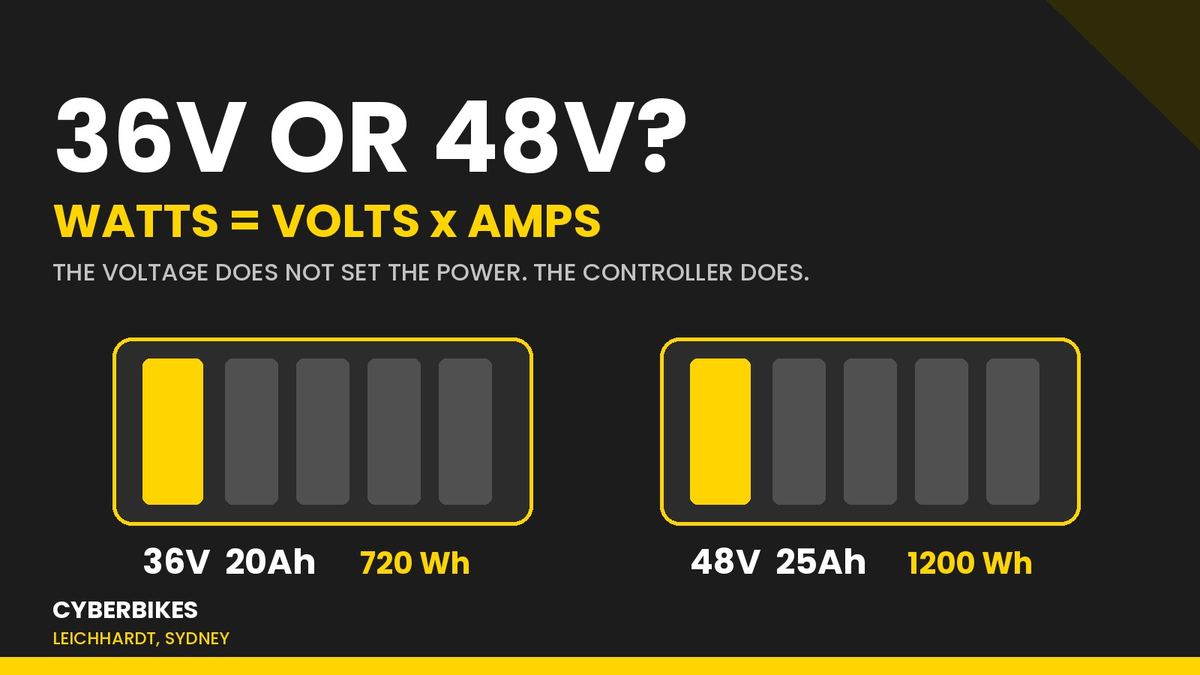
You can watch this on a trip computer. The useful metric is watt-hours per kilometre — the energy consumption figure Grin describes as “the Wh/km or Wh/mi as you would expect to see on the Cycle Analyst.” Pair it with your pack size and the maths is one line. The 2026 Centauro we sell at Leichhardt carries a 48 V 25 Ah Samsung battery, which is 48 × 25 = 1,200 Wh of nominal capacity. At a displayed 12 Wh/km that is 100 km; at 20 Wh/km it is 60 km. Same battery, same bike — the difference is how much of the work you took on. (Grin also flags that usable range “is based on the available battery capacity and not the nominal amp-hours,” so treat the nameplate figure as a ceiling, not a promise.) Our definitive guide to e-bike batteries and range covers how to read those numbers honestly.
What does NSW law say about the motor’s share?
New South Wales writes the legs-versus-motor ratio into the law itself. According to Transport for NSW, there are two permitted categories: power-assisted pedal cycles, with “a combined maximum power output of up to 200 watts”, and electrically power-assisted cycles, which have “a maximum continued rated power of up to 500 watts”.
The assistance rules are the part that matters for this article. Transport for NSW states the power must be “progressively reduced as the bicycle’s speed increases beyond 6km/h”, and must cut off when “your bicycle reaches a speed of 25km/h” or when “you stop pedalling and the speed exceeds 6km/h”. The governing principle is stated outright: “The rider must primarily propel these bikes — a motor can’t be the only source propelling it.”
In other words, the law has already decided that your legs are not optional. Bikes that do not meet these requirements are, in the page’s words, “illegal” on NSW roads and road-related areas. Full detail sits in our complete guide to e-bike laws in NSW.
Which setup suits a Sydney commute?
Sydney is not flat, and the gradient decides the split. Grin’s simulator illustrates typical operating points as “a 10% grade at 8kph, 5% grade at 19 kph, 3% at 28 kph” — the steeper it gets, the deeper the motor sits in its hot, low-rpm corner.
| Riding situation | Where the work lands | What helps most |
|---|---|---|
| Flat run along Parramatta Road | High rpm, modest torque — the motor’s comfortable zone | Lower assist; your legs cost you almost nothing in speed |
| Steep Inner West pinch | Low rpm, high torque, rising copper heat (I²R) | Gear down, add your own watts, keep the cranks turning |
| Loaded cargo run | Sustained torque demand at low speed | Torque sensing, so assist scales with your effort |
| Stop-start traffic | Repeated launches from zero rpm | Pedal through the launch rather than letting the motor haul from standstill |
That is the thinking behind how we spec the 2026 Cyberbikes Centauro full-suspension step-through: a 250 W rear hub motor paired with a 48 V 25 Ah Samsung battery and hydraulic brakes, with a welded rear rack for the cargo days. A 250 W rated motor sits comfortably inside the NSW 500 W ceiling, and the generous pack size means you are not forced into maximum assist to make a 20 km round trip work.
Frequently Asked Questions
Do your legs and the e-bike motor add together?
Yes. At a steady speed the two sources sum to meet the road load. Grin Technologies describes it as the output power of the motor plus the human being equal to the load line of the vehicle, so the split between legs and motor is a ratio you set with your assist level and your own effort.
How many watts does pedalling an e-bike produce?
Use the formula Grin publishes: watts equal torque multiplied by rpm multiplied by about 0.104. Pedalling at 60 rpm while averaging 20 Nm of crank torque works out to roughly 125 watts, and 30 Nm at the same cadence is about 187 watts.
How much power is a legal e-bike allowed in NSW?
Transport for NSW permits power-assisted pedal cycles with a combined maximum output of up to 200 watts, and electrically power-assisted cycles with a maximum continuous rated power of up to 500 watts. Assistance must cut off at 25 km/h, and the rider must primarily propel the bike.
Feel the split for yourself
Numbers only take you so far — the ratio between your legs and the motor is something you feel in the first hundred metres. Come and ride one. Cyberbikes is at 281 Parramatta Road, Leichhardt, open Tuesday and Thursday 10am–3pm, Wednesday and Friday 10am–5pm and Saturday 10am–4pm, closed Sunday, Monday and public holidays. Book a test ride on 0491 794 668 and bring the hill you actually have to climb — we will set the assist to match it.
#ebike #ebikesydney #CyberbikesLeichhardt #Centauro #pedalassist #torquesensor #ebikerange #hubmotor #SydneyCommute #electricbike