Neither number is a measurement. An e-bike motor’s “rated” watts are a label with no agreed standard behind them, and “peak” watts are almost always the controller’s electrical input — volts times amps — not the power that reaches the road. Grin Technologies, the Vancouver lab behind the motor simulator most of the industry quietly uses, puts it bluntly on its power ratings page: “There is NO SUCH THING as a ‘rated watt'” for a hub motor. So when you compare a 500W e-bike with a 1000W e-bike, you are usually comparing two marketing decisions, not two machines.
That matters in Sydney for one very practical reason: NSW law regulates the number nobody measures consistently. Here is what the watt figures on a spec sheet actually describe, what to compare instead, and how it plays out on a Leichhardt hill.
What does the watt number on an e-bike actually mean?
It means whatever the seller decided it means. Grin notes that “there is no standard or even consistent way” to give a watt rating, and that the same motor is sold as a 250W, a 500W and a 1000W unit by different vendors — each with a defensible justification. Some figures are simply “something stamped on the product for legal compliance.”
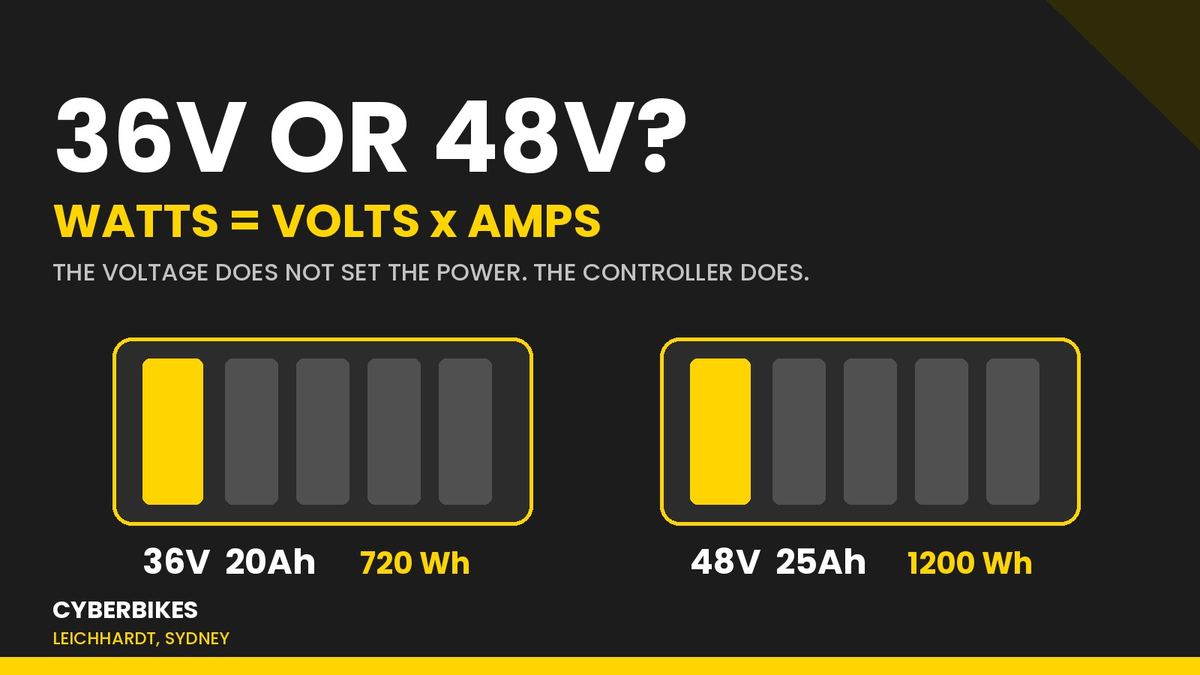
What a watt figure usually tracks is the electrical input the controller allows: watts = volts × amps. A 48V battery with a 20A controller is a 960W input system on paper. The output at the wheel is always lower, because some of that energy becomes heat in the windings and the controller. Grin’s example is a 72V pack with a 50A controller advertised as “3600 watts,” which in practice delivers roughly 2000W of output — and the page’s general rule is that claimed watts exceed real peak output “by at least ~30%.”
Grin’s own answer is to stop pretending precision: it publishes ranges like 250–500W and 600–1200W and treats a rated power as “some broad ballpark order-of-magnitude kind of thing.” If the lab that builds motor dynos won’t give you a single number, a listing that does should not impress you. We go deeper into how the whole drivetrain fits together in our guide to how e-bikes actually work — motors, sensors and controllers.
Rated or peak watts: which number should you compare?
Compare the system, not the sticker — the battery voltage and the controller’s current limit together set what the motor can peak at, and at what speed. Grin’s measured curves for one Crystalyte H3540 hub motor show how much the same motor changes with its electronics:
| System (same motor) | Nominal input | Measured peak output | Speed at peak |
|---|---|---|---|
| 36V, 20A controller | 744W | ~600W | 40 km/h |
| 36V, 40A controller | 1440W | ~1058W | 33 km/h |
| 52V, 20A controller | 1040W | ~840W | higher cruise |
Doubling the controller current from 20A to 40A lifted peak output by about 80% — and Grin’s point is that the bike does not feel 80% stronger at cruising speed, because at cruise you are nowhere near peak. The extra current mostly buys you acceleration and hill-holding, which is exactly where riders feel the difference. If you want to see where that current actually goes, our post on phase amps versus battery amps unpacks the two current limits separately.
Why does torque, not watts, decide if you climb a Leichhardt hill?
Because power is not a property of the motor — it is the product of torque and how fast the motor is turning. The relationship is Power = Torque × RPM × 0.104. Grin’s worked example: 20 Nm at 100 rpm is 209W, and the same 20 Nm at 300 rpm is 628W. Identical torque, three times the power, same motor.
Push that to the limit and the absurdity of watt labels is obvious: stall a motor completely and, as Grin writes, “it might be making a ton of torque but it’s producing zero output power.” A stalled motor is at its hottest and its least powerful at the same time. Which is why Grin argues “hub motors should be rated by how much torque they can produce rather than how many watts.”
This also explains why “continuous watts” slides around. A motor rated 500W continuous at 32 km/h (about 250 rpm in a 26-inch wheel) is at least 750W continuous at 48 km/h and only 250W at 16 km/h. Fit the same motor in a 20-inch wheel and the same 32 km/h reading becomes 650W rather than 500W. The hardware never changed; only the speed it was measured at did.
Why is heat the real limit on a long climb?
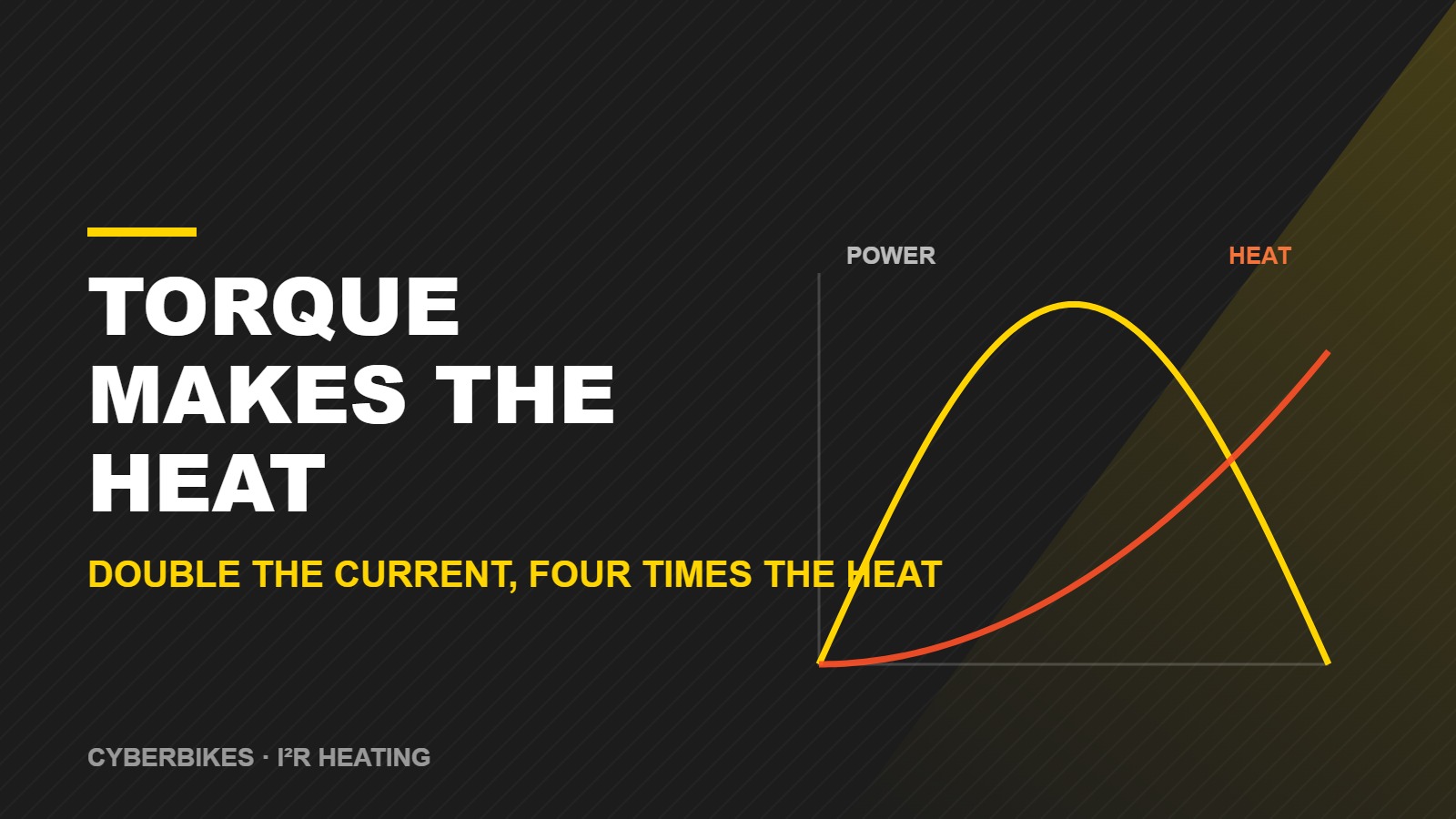
Because torque, not power, is what cooks a motor — and copper heating follows current squared. Grin’s I²R point is the one number every rider should internalise: double the winding current and you quadruple the heat. Four times, not twice. That heat has three ways to end your ride permanently: enamel insulation burning off the windings, nylon planetary gears softening and stripping, and magnets losing their magnetism.
Time is the saving grace. A motor takes “upwards of 1-2 hours” to reach its steady-state temperature, while a genuinely steep climb lasts 5–10 minutes. On a Sydney commute — Parramatta Road, a stretch of the Bay Run, one sharp pinch up to Norton Street — you never sit at the thermal limit long enough to find it. That is why a motor’s short-term capability usually matters more to a commuter than its continuous label.
- Headroom is real but finite. Better motors’ winding enamel survives excursions of 150–180 °C, though few makers would rate a core continuously that high.
- The label ignores the air. A 40 °C swing in ambient temperature changes the torque a motor can hold indefinitely, so any honest continuous rating needs a derating factor for a 35 °C Sydney afternoon.
- Cooling beats cubic inches. Grin measures roughly 40% more continuous power from ferrofluid (Statorade) in the air gap, with no change to peak power or efficiency — the same gain you would get from a 40% bigger core.
- Big numbers hide thin margins. A 45 mm stator motor “often sold as 5000 watt” hub motors reaches a 100 °C core at just 800W of output at 250 rpm.
What does NSW law actually measure?
Continuous rated power — the exact figure the industry has no standard method for. Read live from Transport for NSW, a legal e-bike in New South Wales must have 500W maximum continuous power (dropping to a maximum of 250W from 1 March 2029), a motor that provides no power above 25 km/h, and any throttle-only function cutting out at 6 km/h. From 1 March 2029, only EN 15194 certified e-bikes will be allowed on NSW roads. Critically, a bike that exceeds those limits is illegal “even if its power or speed is restricted by an app or switch.”
So the practical test is not the wattage printed on the hub, it is whether the manufacturer built and certified the bike to those limits. Our complete guide to e-bike laws in NSW walks through the rest, including where you can ride.
For comparison, the specs we read today from the 2026 Cyberbikes Centauro product page: a 250W continuous rear hub motor, pedal assist that stops at 25 km/h, a throttle limited to 6 km/h, UL 2849 certification for the e-bike system, UL 2271 for the battery and an ISO 4210 compliant 6061 aluminium frame. A quarter of the legal wattage ceiling, which tells you how little the ceiling says about how a bike rides.
How do watt-hours turn into range?
Watt-hours are the one number on a spec sheet with a fixed definition: Wh = volts × amp-hours. The Centauro’s 48V 25Ah Samsung pack is 1200 Wh, and that figure cannot be inflated by marketing because both inputs are physical. Divide watt-hours by your real consumption in Wh/km and you have range.
The product page states up to 120 km at 25 km/h, measured on a flat road with a 75 kg rider and no headwind — which works out to roughly 10 Wh/km, a reasonable figure for steady riding on the flat with a 250W motor. Hills, headwinds, heavier loads and higher assist levels all raise Wh/km and shorten that number, which is why we quote conditions rather than a single headline. There is a full breakdown in our definitive guide to e-bike batteries.
See the Centauro in action
Frequently asked questions
Is a 1000W e-bike legal in NSW?
No. Transport for NSW sets a 500W maximum continuous power limit, falling to 250W from 1 March 2029, with no motor power above 25 km/h and any throttle-only function cutting out at 6 km/h. A bike above those limits is illegal even if an app or a switch restricts it, so software limiting a 1000W motor does not make it road legal.
Does a higher-watt motor always climb better?
Not necessarily. Climbing is torque at low rpm, and torque is what heats a motor: doubling winding current quadruples the heat by the I²R relationship. A motor with a bigger watt label but worse cooling can overheat on a long climb, while a well-cooled motor holds its torque. Grin Technologies argues hub motors should be rated by torque rather than watts for exactly this reason.
How many watt-hours does the Cyberbikes Centauro have?
1200 watt-hours. The 2026 Centauro product page lists a 48V 25Ah Samsung lithium-ion battery, and 48 volts multiplied by 25 amp-hours gives 1200 Wh. The page quotes up to 120 km at 25 km/h on a flat road with a 75 kg rider and no headwind, which is about 10 Wh per kilometre.
Ride one before you believe any number
Watt labels are an argument; a hill is a measurement. Test rides at Cyberbikes Leichhardt are free — book a time or call 0491 794 668, then ride the Centauro up a real Sydney pinch at 281 Parramatta Road, Leichhardt and judge it with your legs instead of a spec sheet.
#ebike #ebikesydney #cyberbikes #centauro #leichhardt #ebikemotor #ebikebattery #electricbike #nswebikelaws #commutebybike