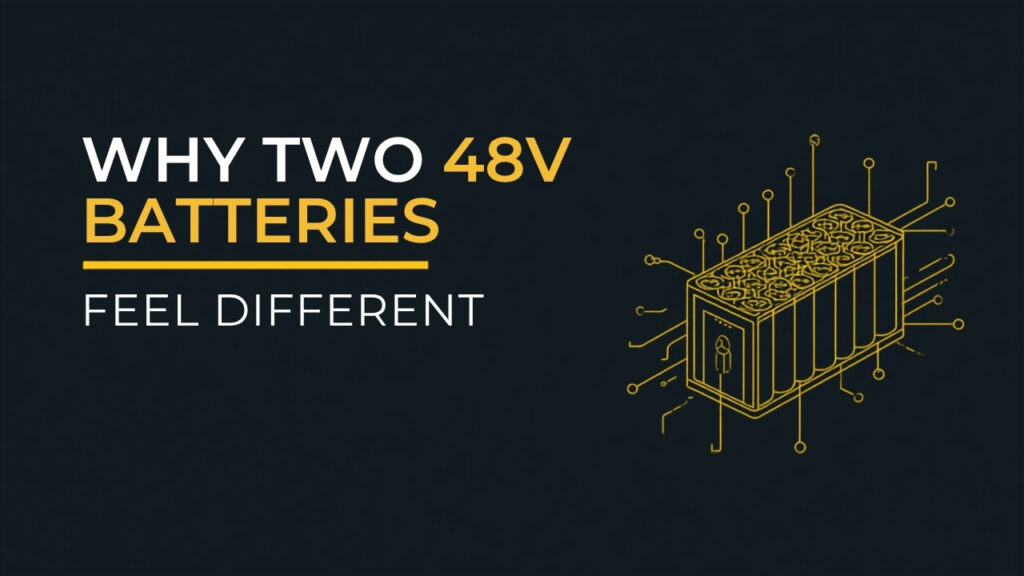
Two e-bikes can both carry a 48V e-bike battery and still behave nothing alike, because volts only set the pressure — the energy on board is watt-hours, and watt-hours are volts multiplied by amp-hours. A 48V 10Ah pack holds 480Wh. A 48V 25Ah pack, like the one in the Cyberbikes Centauro, holds 1,200Wh. Same badge, two and a half times the ride. Add the difference in how hard each pack sags when you ask for power, and you have two batteries that share a number and almost nothing else.
Here is what each number on the label actually controls, why the charger says 54.6V, why one pack wilts on a hill while another shrugs, and what NSW law allows the whole system to push. We answer these at the bench in Leichhardt most weeks, so this is the version we give riders in person.
What does “48V” actually mean on an e-bike battery?
A 48V pack is thirteen lithium cells wired in series. Grin Technologies at ebikes.ca lists its packs exactly that way — 36V as 10s, 48V as 13s, 52V as 14s, 72V as 20s — where the “s” is the number of cells in series. Each lithium cell sits near 3.7V nominal, which Grin gives as the standard figure for lithium chemistry. Thirteen of them at 3.7V is 48.1V, and that rounded 48 is the name printed on the case.
That is why your charger is labelled 54.6V rather than 48V. A lithium cell is full at about 4.2V, and thirteen full cells are 54.6V. Nominal voltage is the average the pack spends most of its life at; the charger has to reach the top of the window. Neither number is wrong — they are describing different moments in the same pack’s day.
Voltage is the part that decides how fast the motor wants to spin. It does not, on its own, tell you a single thing about how far you can go.
Why do watt-hours, not volts, decide how far you ride?
Range comes from stored energy, and stored energy is measured in watt-hours: Wh = volts × amp-hours. Amp-hours come from cells wired in parallel — more cells side by side, more capacity, same voltage. So a pack’s two headline numbers are doing completely different jobs: the series count sets the volts, the parallel count sets the amp-hours, and only their product tells you about distance.
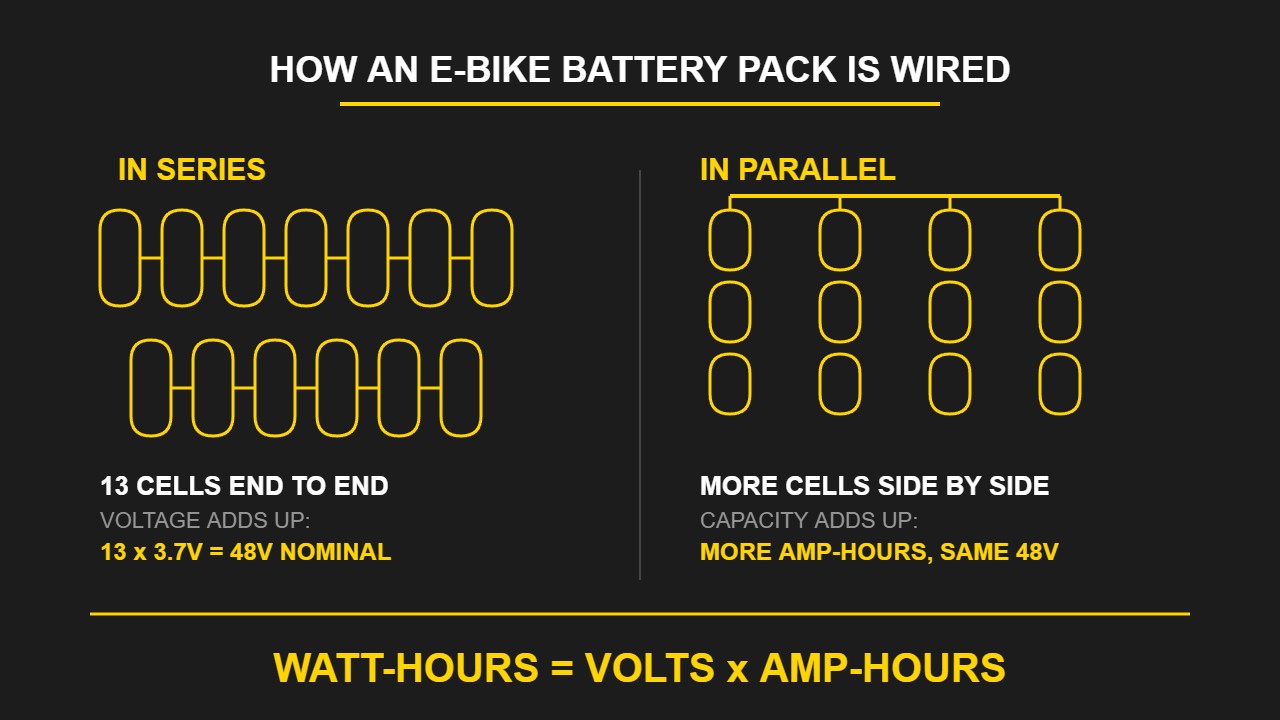
Run the arithmetic on real packs and the gap is obvious. A 48V 10Ah pack is 480Wh. A 52V 20Ah pack is 1,040Wh — higher voltage and more than double the energy. The 2026 Cyberbikes Centauro runs a 48V 25Ah Samsung pack, which is 1,200Wh. Grin sells packs from 36V through 72V and up to 1,500Wh, which is roughly the practical ceiling for something you still want to lift onto a bike.
How do you turn watt-hours into a real range figure?
Divide watt-hours by your energy use per kilometre. Wh/km is the honest unit, and it is the one Grin’s trip simulator is built around. A relaxed rider on flat ground sits low; a heavier rider pushing hard into a headwind on Parramatta Road sits much higher. Take your own Wh/km from a few real rides, divide it into the pack’s watt-hours, and you have a range number that belongs to you rather than to a marketing page. If you want the long version, our complete guide to e-bike batteries walks through capacity, chemistry and lifespan together.
Why does one 48V pack sag under load and another doesn’t?
Because every pack has internal resistance, and pulling current through resistance drops voltage and makes heat. That loss follows an I²R relationship — the same relationship Grin uses to explain motor heating on its power ratings page: “If you double the current through the windings… you increase the amount of copper heat being generated by a factor of FOUR.” The wiring and cells in a battery obey the same physics.
A pack with more cells in parallel splits the same current across more paths, so each cell works less, resistance is lower, the voltage holds up better under load and less energy is wasted as heat. This is why the bigger pack often feels stronger, not just longer-legged — it is delivering closer to its nominal voltage at the moment the motor is asking hardest.
The shorthand for how hard you are leaning on a pack is C-rate. Grin puts it plainly: “Suppose you have an 8 amp-hour pack. Then 1C would be 8 amps, 2C would be 16 amps, 0.25C would be 2 amps.” Draw 20A from a 10Ah pack and you are at 2C. Draw the same 20A from a 25Ah pack and you are at 0.8C — the identical demand, a far easier life for the cells.
Does the cell brand inside the pack actually matter?
It matters more than the sticker on the outside. Grin specifies “premium Panasonic, LG, or Samsung cells” in its packs, and reputable builders name the cell maker because that is where consistency, cycle life and safety margin come from. Two packs can both read 48V 20Ah on the label and be built from cells with very different real capacity and very different tolerance for heat.
The other half is certification. The Centauro’s pack is Samsung-celled and UL 2271-certified for battery safety, with the wider bike carrying UL 2849 for the electrical system and ISO 4210 for the frame. If a seller cannot tell you whose cells are inside or what the pack is certified to, that silence is the answer.
What does NSW law let that battery push?
The battery is only half the system; the law governs what the motor is allowed to do with it. Transport for NSW currently sets a maximum continuous rated power of 500 watts, with motor assistance that “does not provide power at speeds higher than 25km/h”, and any throttle-only function cutting out at 6km/h. From 1 March 2029 that tightens: 250W, and “only EN 15194 certified e-bikes will be allowed on NSW roads”.
Two things matter for anyone shopping on battery specs. First, Transport for NSW is explicit that bikes over those limits “are illegal, even if its power or speed is restricted by an app or switch” — a software limiter does not make a non-compliant bike legal. Second, since 21 August 2026 police and authorised officers have expanded powers to seize illegal e-bikes. A big battery is fine. A system built to exceed the legal ceiling is not.
The Centauro is built to sit inside that envelope: a 250W rear hub motor, assistance to 25km/h, throttle to 6km/h, EN 15194 for 250W continuous power — with a 1,200Wh battery behind it. Legal power, serious energy. Those are independent choices, and only one of them is capped.
What does the difference feel like on a Sydney hill?
Numbers on a page only go so far. Here is the Centauro’s power delivery on real Sydney gradients, where a pack that holds its voltage under load is the difference between smooth assistance and a bike that hesitates halfway up.
Charging behaviour is the other half of living with a big pack — if you are weighing up how quickly to put those watt-hours back, our comparison of a fast versus standard e-bike charger covers the trade-off between speed and cell life.
Frequently Asked Questions
Does a higher voltage e-bike battery give you more range?
Not by itself. Range comes from watt-hours, which is volts multiplied by amp-hours. A 52V 10Ah pack holds 520Wh, while a 48V 25Ah pack holds 1,200Wh — the lower-voltage pack carries more than twice the energy. Higher voltage raises the speed the motor wants to spin at, not the amount of energy stored.
Why does my e-bike charger say 54.6V when the battery is 48V?
Because 48V is the nominal average and 54.6V is the fully charged peak. A 48V pack is thirteen lithium cells in series; at about 3.7V nominal each that is 48.1V, and at about 4.2V each when full that is 54.6V. The charger has to reach the top of that window, so it is labelled with the higher figure.
Is a bigger e-bike battery legal in NSW?
Yes. NSW law limits motor power and assisted speed, not battery capacity. Transport for NSW sets a maximum continuous rated power of 500 watts, assistance cutting out at 25km/h and throttle-only cutting out at 6km/h, moving to 250W and mandatory EN 15194 certification from 1 March 2029. A 1,200Wh battery on a compliant 250W bike is perfectly legal.
Come and feel the difference yourself
Spec sheets are a starting point; a hill is the real test. Book a test ride at Cyberbikes, 281 Parramatta Road, Leichhardt and take a 1,200Wh Centauro up something steep — we will happily open the conversation about cells, certification and what the pack is actually doing under your right hand. Call 0491 794 668, Tuesday to Saturday, or browse the range at cyberbikes.com.
Data sources: Grin Technologies (ebikes.ca) for cell voltages, pack series counts, C-rate and I²R heating; Transport for NSW for e-bike law; Cyberbikes product page for Centauro specifications.
#Cyberbikes #EbikeSydney #48VBattery #EbikeBattery #WattHours #ElectricBikeLeichhardt #CentauroEbike #EbikeTech #InnerWest #NSWEbikeLaw