On the number everyone quotes, no. Australia’s electric car share hit 24.9% in August 2026, and Europe’s was 24% in July. We are level with the European average and ahead of Italy, Spain and Poland. The lag is real, but it is not where the headlines keep pointing.
A chart went around this week under the title “Electric cars are taking over Europe”, showing Norway at 98.7%, Denmark near 80%, Finland at 52% and the Netherlands at 48.9%. It is a genuinely remarkable chart. It is also the wrong chart to beat Australia up with, because on that metric we are doing fine. The problem is what the metric does not measure.
How does Europe’s electric car share actually compare with Australia’s?
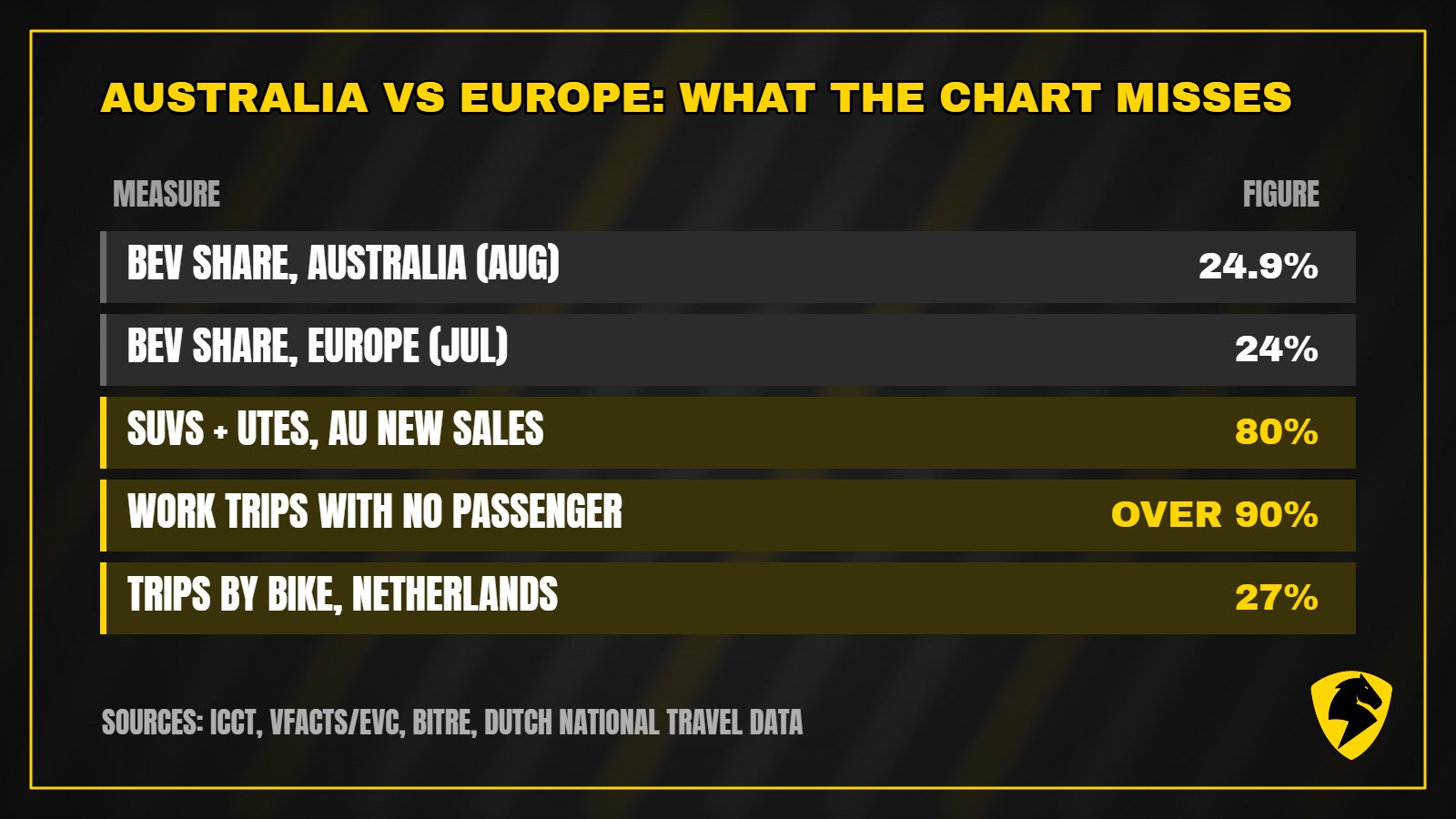
Take the verified numbers. The ICCT’s European Car Market Monitor for July 2026 put battery electric cars at a 24% share of all new registrations that month, and 22% across January to July, up 5 percentage points year on year. Germany sat at 26% and France at 29% for the year to July. Italy was at 8%, Spain 10%, Poland 5%.
Australia, in August 2026, recorded 27,078 battery electric sales, or 24.9% of the combined VFACTS and Electric Vehicle Council market. That is the highest monthly BEV total ever recorded here and roughly 171% up on August 2025. Add 10.5% plug-in hybrids and 18.5% conventional hybrids and more than half the market is now electrified in some form.
So the honest scoreboard reads: Australia is level with the European average, miles behind the Nordic and Benelux leaders, and comfortably ahead of southern and eastern Europe. Anyone telling you Australians refuse to buy electric cars stopped checking the data around 2023.
So what is Australia actually behind on?
Everything that happens after you choose the powertrain. Start with what we are buying. In 2025, SUVs took about 60% of the Australian market and utes another 20%. Passenger cars are down to roughly 13%, having collapsed from 592,122 sales in 2010 to 164,847 in 2025. We are not just keeping the car. We are steadily buying a bigger one.
Then look at how full it is. Average car occupancy in Australia has drifted down from 1.62 people per vehicle in 1990 to about 1.57. For the trip that shapes our peak hour it is far worse: more than 90% of car journeys to work carry no passengers in most Australian cities, and Melbourne’s household travel survey measured work-trip occupancy at 1.07.
Put those two facts together and you get the defining vehicle of Australian cities in 2026: a five-seat, two-tonne machine, bought to tow a boat twice a year, being used to move 1.07 people to the shops. Swapping its engine for a battery is a genuine improvement. It is not a solution to the thing that is actually wrong.
Why is a five-seat car the wrong tool for a two-kilometre errand?
Because almost none of the machine is doing the job. You are moving roughly 1,800 to 2,200 kilograms of steel, glass and battery to transport 80 kilograms of person and a bag of groceries. More than 95% of what you are accelerating, braking and parking is the vehicle, not you. No engineer designing from scratch would specify that. We only accept it because it is the default, and it is the default because we built a city where it is the only thing that works.
And the cost does not stay with the driver. That vehicle occupies road space three other people could be using, takes a parking bay that could be a tree or a bike corral, and brings a mass and bonnet height that make the same street measurably more dangerous for a kid on a scooter. An electric one still sheds tyre and brake particulates, still needs the same lane, still cannot be parked in a cupboard. The geometry does not care what is under the bonnet.
None of that is an argument against the people driving. It is an argument against a system that made the two-kilometre errand into a car trip and then acted surprised at the congestion. Nobody chose this individually. It was designed.
What do Norway, Denmark and the Netherlands do differently?
They did both things at once. The countries at the top of that European chart are not only electrifying fastest, they are also the countries that spent forty years removing short car trips altogether. In the Netherlands the bicycle carries around 27% of all trips nationwide and about 38% in Amsterdam. Denmark’s cycling numbers are in the same league.
That is the actual lesson, and it is the opposite of the one usually drawn from the chart. Those countries are not proof that the answer is a better car. They are proof that when you give people a safe, separated alternative for the short trip, they take it, and the car that remains gets used for the jobs a car is genuinely good at. Electrify the long trips. Delete the short ones.
Australia has done the first half enthusiastically and the second half barely at all. That is the gap. Not EV uptake, which is fine. The missing network, which is not.
What would closing the real gap look like in Sydney?
It looks like the trip, not the vehicle. If your week includes a school drop-off, a supermarket run and a trip to the station, none of those needs two tonnes. They need something that carries a kid and 30 kilograms of shopping, parks outside the shop and costs cents to charge.
That is what a cargo-capable e-bike is for. The Cyberbikes Centauro cargo and commuter e-bike runs a 250W rear hub motor and a 48V 25Ah (1200Wh) Samsung battery certified to UL 2271, on an ISO 4210 frame with a UL 2849 electrical system, rated to 150kg of rider and cargo with a rear rack good for 50kg. It is not a replacement for every car trip. It is a replacement for the ones that should never have been car trips.
Two things worth reading alongside this: our guide to car-free commuting in Sydney, and the reason this is urgent rather than merely tidy, which is that Australia holds 43 days of petrol and 33 of diesel and imports around 80 to 90% of it.
Where these numbers come from
European shares: the ICCT’s European Car Market Monitor for July 2026, published 28 August 2026. The August country-by-country chart circulating this week is credited to the ICCT’s European EV Market Monitor for August 2026. Australian sales: VFACTS and Electric Vehicle Council figures for August 2026. Fleet mix: Chasing Cars on 2025 VFACTS. Occupancy: BITRE, and census and household travel survey analysis collected at Charting Transport. Dutch cycling mode share: summary of Dutch national travel data.
Frequently Asked Questions
What percentage of new cars sold in Australia are electric?
Battery electric vehicles reached 24.9% of the Australian new car market in August 2026, with 27,078 units sold, the highest monthly total on record and up about 171% on August 2025. Plug-in hybrids added 10.5% and conventional hybrids 18.5%.
Is Australia behind Europe on electric cars?
Not on market share. The ICCT recorded a 24% battery electric share for Europe in July 2026 and 22% across January to July, so Australia is roughly level with the European average and ahead of Italy, Spain and Poland. Australia is far behind the leaders: Norway, Denmark, Finland, the Netherlands, Belgium and Sweden are all at 45% or higher.
Does switching to an electric car fix urban traffic?
No. An electric car takes the same road space, needs the same parking and carries the same average load as a petrol one. Australian car occupancy has fallen from 1.62 people per vehicle in 1990 to about 1.57, and more than 90% of car journeys to work carry no passenger at all. Electrifying the fleet changes what comes out of the exhaust, not how many square metres each person occupies.
Swap one car trip a week for an e-bike ride and see what changes. We are at Cyberbikes, 281 Parramatta Road, Leichhardt.
#ebikesydney #electriccars #EVs #urbanplanning #carfreesydney #Leichhardt #InnerWest #micromobility #modeshift #cyberbikes