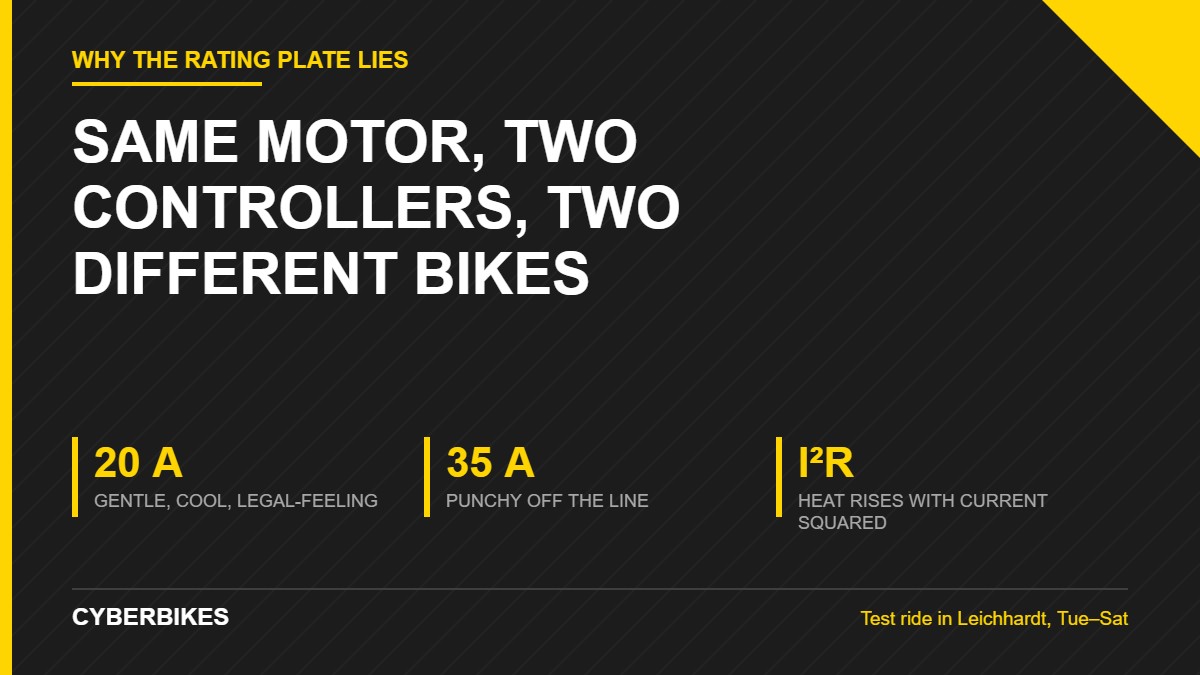
Controller amps decide your e-bike power far more than the watt number on the motor. Electrical power is simply volts × amps, and it is the controller — not the motor casing — that sets the maximum amps allowed to flow. Grin Technologies, the Vancouver motor lab behind ebikes.ca, demonstrates this with a single Crystalyte H3540 hub: run it at 36 V through a 20 A controller and it peaks near 600 W; run the same motor at 48 V through a 35 A controller and it peaks near 1100 W. Same steel, same copper, same badge — nearly double the power. That is why two e-bikes wearing identical motor stickers can feel like different machines on the climb out of Leichhardt.
What does watts actually measure on an e-bike motor?
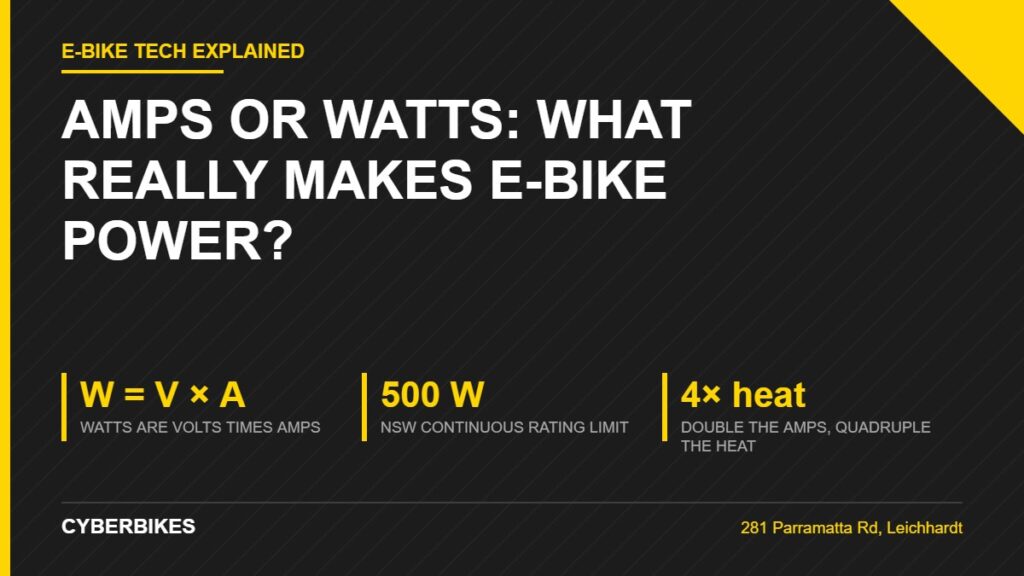
A watt is a rate of energy flow, and on an e-bike it comes from one deceptively simple equation: watts = volts × amps. A 48 V battery pushing 20 A into the motor is drawing 960 W of electrical power. Push 30 A through the same 48 V pack and you are drawing 1,440 W. Nothing about the motor changed — only the tap the controller opened.
The trap is that the number printed on a motor is a nominal or continuous rating, not a measurement of what the bike will do. Grin’s power-ratings page is blunt: there is no standardised method for rating e-bike motor power, and the same hub is legitimately sold as 250 W, 500 W or 1000 W depending on who writes the brochure. Many sellers also quote peak input power rather than mechanical output, which ebikes.ca notes can inflate the claim by 30–300%.
So the honest reading of a motor rating is: a thermal promise, not a performance spec. It tells you roughly how much power the motor can shed as heat indefinitely without cooking itself. It does not tell you how hard it will shove you up Norton Street.
Why do controller amps change how the bike feels?
Because amps make torque, and torque is what you feel. In a brushless hub motor, the magnetic force twisting the wheel is roughly proportional to the current in the windings. Double the amps and you roughly double the torque at the axle. Voltage, by contrast, mostly sets how fast the motor wants to spin before it runs out of headroom — it governs top speed more than shove.
This is why the controller’s battery-current limit is the single most under-discussed number in the industry. Two Centauro-class bikes on the same 48 V pack, one limited to 18 A and one to 25 A, differ by roughly 340 W of available electrical power at full throttle. From a standing start at the Parramatta Road lights, the 25 A bike simply goes first. Neither motor’s sticker mentions this.
Grin’s motor simulator lets you see it directly: set battery voltage, controller battery and phase current limits, hill grade, rider weight, wind and rolling resistance, and it plots power, efficiency, torque, motor temperature, cruising speed and Wh/km. Change only the controller current and watch the whole torque curve move.
Why does more current make so much more heat?
Because copper losses scale with the square of the current — the I²R relationship. ebikes.ca states it plainly: “If you double the current through the windings in order to have double the torque and power from the motor, then you increase the amount of copper heat being generated by a factor of FOUR.”
That single fact explains most of the complaints we see on the workshop bench:
- Power fade on long climbs. Torque, not power, is what overheats a motor. Grinding slowly up a steep pinch means high current at low rpm — maximum heat, minimum airflow, minimum useful output.
- Thermal cut-outs that feel random. A motor reaches thermal equilibrium over one to two hours, so a bike that is fine on a 20-minute commute can protest on a long Sunday ride.
- Voltage sag under load. Big current draws pull pack voltage down, and since watts = volts × amps, sagging volts quietly eat the power you thought you bought.
- Connector and wiring heat. I²R applies to every centimetre of cable and every plug, not just the windings.
ebikes.ca also notes that cooling modifications such as Statorade can lift a motor’s continuous output by roughly 40% while changing peak performance not at all — more evidence that a wattage rating is mostly a statement about heat management.
How does torque differ from power, and which should you care about?
Torque is twisting force; power is torque multiplied by rotational speed. ebikes.ca gives the clean example: a motor producing 20 Nm at 100 rpm is making 209 W, while the same 20 Nm at 300 rpm is making 628 W. Identical torque, triple the power — which is exactly why a maximum-torque figure quoted without an rpm cannot be converted into a watt rating.
For everyday riding the translation is simple:
- Torque is what gets you moving from the lights with panniers and a kid on the back, and what holds a steep driveway.
- Power is what sustains speed once you are rolling, mostly against air drag.
- Air resistance rises with the cube of speed, so the last few km/h cost far more watts than the first twenty.
If your riding is inner-west stop-start traffic, torque delivery and controller current matter more than headline watts. If you ride long flat runs along the Bay Run, efficiency and Wh/km matter more. For the full picture of how the motor, sensors and controller work together, our guide to how e-bikes actually work — motors, sensors and controllers is the deeper read, and what a 250W e-bike motor rating really means unpacks the label itself.
What does NSW law actually limit — watts or amps?
NSW law limits the motor’s continuous rating, not the controller’s current. Transport for NSW sets the legal e-bike ceiling at “a maximum continuous rated power of 500 watts”, with motor assistance that must not provide power above 25 km/h and throttle-only operation that cuts out at 6 km/h. From 1 March 2029 that tightens: only EN 15194 certified e-bikes will be allowed on NSW roads, with a maximum of 250 W.
Transport for NSW is also explicit that software does not save you: e-bikes exceeding those limits “are illegal, even if its power or speed is restricted by an app or switch”. A 1000 W hub dialled down in a menu is still a 1000 W hub in the eyes of the law.
This is where the amps-versus-watts distinction stops being trivia and starts being your licence to ride legally. A compliant bike keeps the rated motor inside 500 W continuous while using sensible controller current for real-world responsiveness. The 2026 Cyberbikes Centauro is built to that brief: its product page lists a 250 W rear hub motor, a 48 V 25 Ah (1200 Wh) Samsung lithium-ion pack, 25 km/h PAS and 6 km/h throttle, a 150 kg maximum rider-and-cargo load, and UL 2849, UL 2271, ISO 4210 and EN 15194 certification — already meeting the standard NSW will require in 2029.
How do volts and amp-hours turn into real range?
Capacity uses the same arithmetic in a different unit: watt-hours = volts × amp-hours. The Centauro’s listed 48 V 25 Ah pack is 1,200 Wh of stored energy, which the product page states directly.
To convert that into kilometres, divide by your consumption in Wh/km — the figure Grin’s simulator outputs for any bike, rider weight and terrain. The honest version of the range question is never “how many km?” but “how many Wh/km do you ride at?”. Heavier rider, steeper hills, higher assist, a headwind up Victoria Road and low tyre pressure all push Wh/km up and range down, so two riders on the same 1,200 Wh pack can legitimately see very different numbers.
The four numbers worth checking before you buy
- Motor continuous rating — must be within the NSW 500 W limit today, 250 W plus EN 15194 from March 2029.
- Battery voltage and amp-hours — multiply them for Wh, the only honest measure of tank size.
- Controller current limit — the number that actually sets acceleration. Ask for it; a shop that knows it is a shop that has opened the bike.
- Certification — UL 2271 and UL 2849 for the battery and electrical system, ISO 4210 for the frame, EN 15194 for the pedelec standard.
Watts sell bikes. Amps, watt-hours and certificates are what you actually ride home.
Frequently Asked Questions
Does a higher wattage motor always mean a faster e-bike?
No. Power is volts multiplied by amps, so a motor’s actual output depends on battery voltage and the controller’s current limit, not the wattage printed on the casing. ebikes.ca shows the same Crystalyte H3540 hub peaking near 600 W on a 36 V 20 A system and near 1100 W on a 48 V 35 A system. In NSW, top speed is capped separately: motor assistance must stop at 25 km/h regardless of wattage.
Why does my e-bike lose power on long steep hills?
Because heat rises with the square of current. According to ebikes.ca, doubling winding current to double torque increases copper heat by a factor of four. Climbing slowly demands high torque at low rpm, which means high current, poor airflow and rising winding temperature, so the controller reduces output to protect the motor. Using a lower assist level and a lighter gear at higher cadence keeps current and heat down.
What is the legal power limit for an e-bike in NSW?
Transport for NSW sets the limit at a maximum continuous rated power of 500 watts, with motor assistance cutting out at 25 km/h and throttle-only operation cutting out at 6 km/h. From 1 March 2029 only EN 15194 certified e-bikes with a maximum of 250 W will be allowed on NSW roads. Transport for NSW states that bikes exceeding these limits are illegal even if restricted by an app or switch.
Watch: why 500 W is the number that matters
Come and feel the difference in Leichhardt
Spec sheets argue. Bikes don’t. Book a test ride at Cyberbikes, 281 Parramatta Road, Leichhardt and we will show you on the road what controller current actually feels like — from a standing start, up a real hill, with real weight on the rack. We’re open Tuesday to Saturday; call 0491 794 668 or browse the range at cyberbikes.com. If you’d rather ride now and pay as you go, our rent-to-own plan starts from $99.99 per week.
#Cyberbikes #EbikeSydney #ElectricBikeLeichhardt #CentauroEbike #EbikeTech #ControllerAmps #NSWEbikeLaw #RentToOwnEbike #SydneyCommute #InnerWestSydney