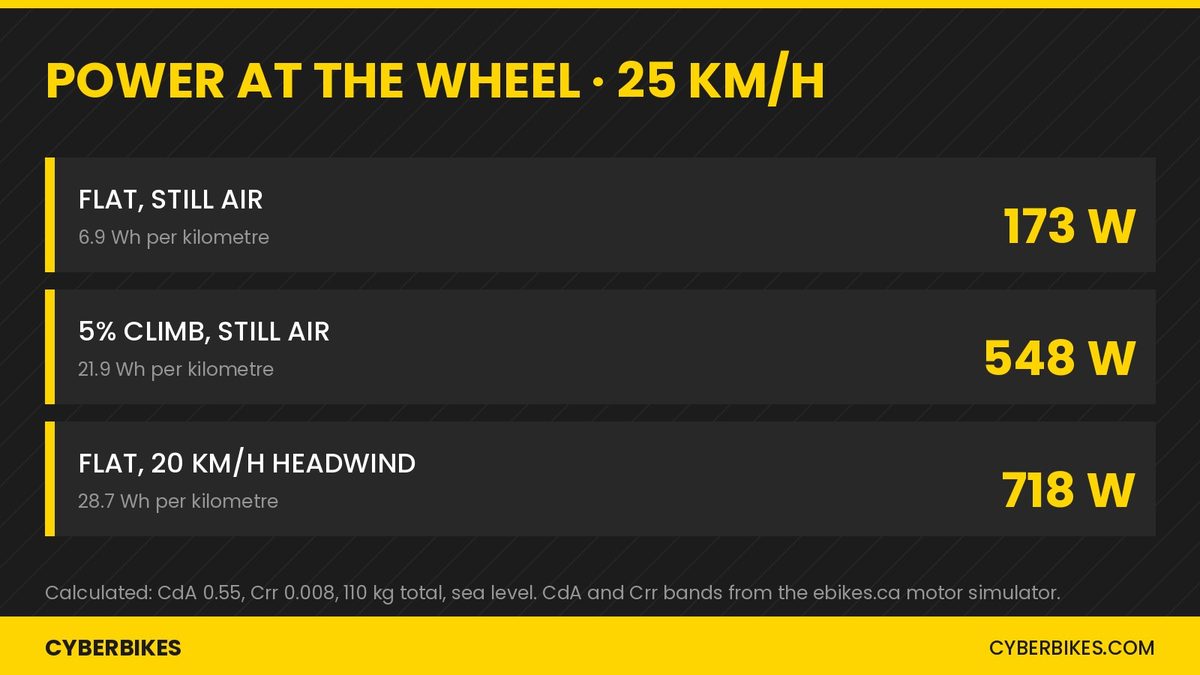
A headwind almost always costs more e-bike range than a hill of the same journey length. On our numbers, riding a loaded commuter at 25 km/h into a 20 km/h headwind needs roughly 718 watts at the wheel, against 548 W on a 5% climb at the same speed and just 173 W on the flat in still air. The hill is brutal but it ends. The wind follows you the whole way home — and that is why it wins.
That one comparison hides four questions every rider actually asks, so we will work through all of them: why wind punishes speed so much harder than gravity does, what a climb really costs in watt-hours, whether slowing down beats dropping an assist level, and what any of it means on a real ride between Leichhardt and the Sydney CBD. If you want the underlying component behaviour first, our definitive guide to e-bike batteries covers capacity, voltage and ageing in depth.
Headwind or hill: which one actually costs more?
Three forces take energy off you on a bike: air, rolling resistance, and gravity. Only two of them care about the weather. We modelled a realistic Sydney commuter — 110 kg all-up for bike, rider and a work bag, an upright riding position with a CdA of 0.55, and a rolling drag coefficient of 0.008. Those last two are not invented numbers: Grin Technologies’ motor simulator puts CdA between “0.2 for a fairly streamlined recumbent up to 0.8 for a wide upright mountain bike”, and bike tyres between “0.004 for a high pressure road slick, up to 0.012 for a low pressure knobby wheel”. We sat in the middle of both bands.
| Condition at 25 km/h | Power at the wheel | Energy per km |
|---|---|---|
| Flat, still air | 173 W | 6.9 Wh/km |
| 3% climb, still air | 398 W | 15.9 Wh/km |
| 5% climb, still air | 548 W | 21.9 Wh/km |
| Flat, 20 km/h headwind | 718 W | 28.7 Wh/km |
| Flat, 30 km/h headwind | 1,261 W | 50.4 Wh/km |
Read the last two rows again. Going from a 20 km/h headwind to a 30 km/h headwind — one step on the Bureau’s scale, the difference between an ordinary breezy afternoon and a southerly change — adds 543 watts. That single step costs more than the entire 5% hill did. Wind is the most underrated number in e-bike range, and almost nobody puts it on a spec sheet.
Why does a headwind punish speed so much harder than a hill?
Because aerodynamic drag rises with the cube of your speed through the air, while a hill only rises in proportion to it. The power you spend pushing air is roughly ½ × air density × CdA × (your speed relative to the air)³. The power you spend climbing is mass × gravity × speed × gradient — a straight line, no cube.
That exponent is the whole story. Double your speed against still air and you need eight times the aero power. And a headwind does not just add to your speed problem, it adds to the number being cubed: pedalling at 25 km/h into a 20 km/h headwind means the air is hitting you at 45 km/h. Cube 45 instead of 25 and you get 5.8 times the aero load, which is exactly why 113 W becomes 658 W in our table.
Rolling resistance, meanwhile, barely moves. It stays near 60 W in every flat row above, because it scales only with weight and speed. If you have been blaming your tyres for a windy-day range collapse, the maths says the tyres are innocent — though they do matter on their own terms, which we covered in our breakdown of fat tyres and rolling resistance.
What does a hill really cost in watt-hours?
About 30 watt-hours for every 100 metres of elevation you gain, at 110 kg all-up — and that figure does not change no matter how fast or how slowly you ride up. Climbing energy is mass × gravity × height, full stop. Ride up a 10% wall or grind up a 3% drag; if you finish 100 m higher, you spent the same 30 Wh getting there.
That is a genuinely useful thing to carry in your head, because it makes hills budgetable in a way wind never is. Watt-hours are just volts × amp-hours, so the Cyberbikes Centauro‘s 48V 25Ah Samsung pack — 1,200 Wh, as stated on its product page — swallows a 100 m climb for roughly 2.5% of the battery. Ten such climbs in a day is a quarter of your pack. Riders consistently overestimate this and underestimate the wind.
What hills do punish is the motor, not the battery. Grin’s page on motor power ratings makes the point that “it’s not the output power but the output torque of the motor which causes it to heat up”, and that heating follows I²R — so doubling the current quadruples the copper losses inside the windings. A long climb holds high current for minutes at a time, and Grin notes that motors take “1-2 hours” to reach thermal equilibrium while a typical hill climb lasts “5-10 minutes”. That gap is why a sensibly-ridden motor survives Sydney’s hills; it is also why the same motor can cook on a sustained fire trail.
Does slowing down beat dropping an assist level?
Slowing down wins, and it is not close. Because of that cube, speed is the single most powerful lever you have. Ease off from 25 km/h to 18 km/h into the same 20 km/h headwind and the wheel demand falls from 718 W to 439 W — a 39% saving for seven kilometres per hour. In still air, the same change takes you from 173 W to just 85 W: you halve your consumption.
Assist level is a blunter instrument, because on a torque-sensing bike the assist setting mostly decides how much of the total the motor covers rather than how big the total is. Drop from high assist to low at the same 25 km/h and the air still demands its 658 W — you have simply moved the bill from the battery to your legs. Useful if your legs have it. Useless if they don’t.
There is a legal ceiling working in your favour here too. In NSW, Transport for NSW requires a compliant e-bike to have “a maximum continuous rated power of 500 watts” and “a motor that does not provide power at speeds higher than 25km/h”, with throttle-only assistance cutting out at 6 km/h. A 250W maximum and mandatory EN 15194 certification arrive from 1 March 2029. Bikes that exceed those limits are illegal “even if the power or speed is restricted by software (app, switch or code)” — so the honest answer to “can I just ride faster into the wind” is that the motor stops helping at 25 km/h regardless, and everything past that is your quadriceps against a cube law.
Do tailwinds and descents give the energy back?
Partly — and hills give back far more reliably than wind does. A descent returns stored potential energy: you coast, the motor draws nothing, and you recover a real fraction of that 30 Wh per 100 m simply by not spending anything. An out-and-back ride over a hill is therefore much cheaper than the climb alone suggests.
A tailwind is a weaker refund. It lowers the number being cubed, which helps enormously, but the cube works against you on the way out and only mildly for you on the way back, because drag at low relative air speed is already small. Ride 10 km into a 20 km/h headwind and 10 km home with it, and you do not break even — you finish well down. Anyone who commutes along Parramatta Road on a blustery spring afternoon has felt this without doing the arithmetic.
What does this mean for a real Sydney commute?
Three practical rules fall out of the numbers. First, budget your battery by wind, not by hills: check the forecast wind speed before you check the elevation profile. Second, the cheapest range upgrade is five km/h slower, and it costs nothing. Third, size the pack for the worst day, not the average one — a still-air commute that sips 7 Wh/km can demand four times that in a southerly, and a pack chosen for the good days will strand you on the bad ones.
Here is what that looks like on the road rather than on a spreadsheet — a Centauro doing the CBD-to-Leichhardt run:
At Cyberbikes Leichhardt we build and service bikes for exactly this city — the Centauro runs a 250W rear hub motor on that 1,200 Wh Samsung pack, with a UL 2271-certified battery, UL 2849 system certification and an ISO 4210 MTB-compliant 6061 aluminium frame, rated to a 150 kg combined rider-and-cargo load. That headroom is the point: the wind does not negotiate, so the battery has to be honest.
Frequently asked questions
Does a headwind or a hill drain an e-bike battery faster?
A headwind, in most real commutes. At 25 km/h with a 110 kg total load, a 20 km/h headwind demands about 718 watts at the wheel against 548 watts for a 5% climb and 173 watts on the flat in still air. The hill ends after a few minutes; the headwind lasts the entire ride, so it takes far more total energy out of the pack.
How much battery does climbing 100 metres use on an e-bike?
Roughly 30 watt-hours at a 110 kg all-up weight, because climbing energy is mass times gravity times height and does not depend on your speed. On a 1,200 Wh pack such as the Cyberbikes Centauro’s 48V 25Ah battery, that is about 2.5% of full charge for every 100 metres of elevation gained.
Why does riding slower save so much e-bike range?
Because aerodynamic drag scales with the cube of your speed through the air. Easing from 25 km/h to 18 km/h in still air drops the power needed from about 173 watts to about 85 watts — roughly half — and into a 20 km/h headwind the same change saves about 39%. No component upgrade comes close to that for free.
Want to feel the difference instead of reading about it? Book a test ride at Cyberbikes, 281 Parramatta Road, Leichhardt — take a Centauro up a hill and into the wind on the same run and you will never trust a “50 km range” claim again. We are open Tuesday to Saturday; call 0491 794 668 or browse the range at cyberbikes.com.
#EbikeSydney #CyberbikesLeichhardt #EbikeRange #CentauroEbike #ElectricBikeSydney #EbikeTech #SydneyCommute