Watts tell you how fast an e-bike can go; newton-metres tell you how hard it pulls away from the lights and up a hill — and on their own, neither number is comparable between two brands. Grin Technologies, the Vancouver engineering lab behind ebikes.ca, says it plainly: “there is no standard or even consistent way to provide a numeric ‘watts rating’” for an e-bike motor. The same hub sells as a 250 W, 500 W or 1000 W motor depending on who wrote the brochure. Compare e-bike watts vs Nm on a spec sheet and you are usually comparing two marketing departments, not two motors.
What is the difference between watts and Nm on an e-bike?
Newton-metres (N·m) measure twisting force — how hard the motor turns the wheel. Watts measure the rate at which it does work. They are locked together by how fast the wheel spins.
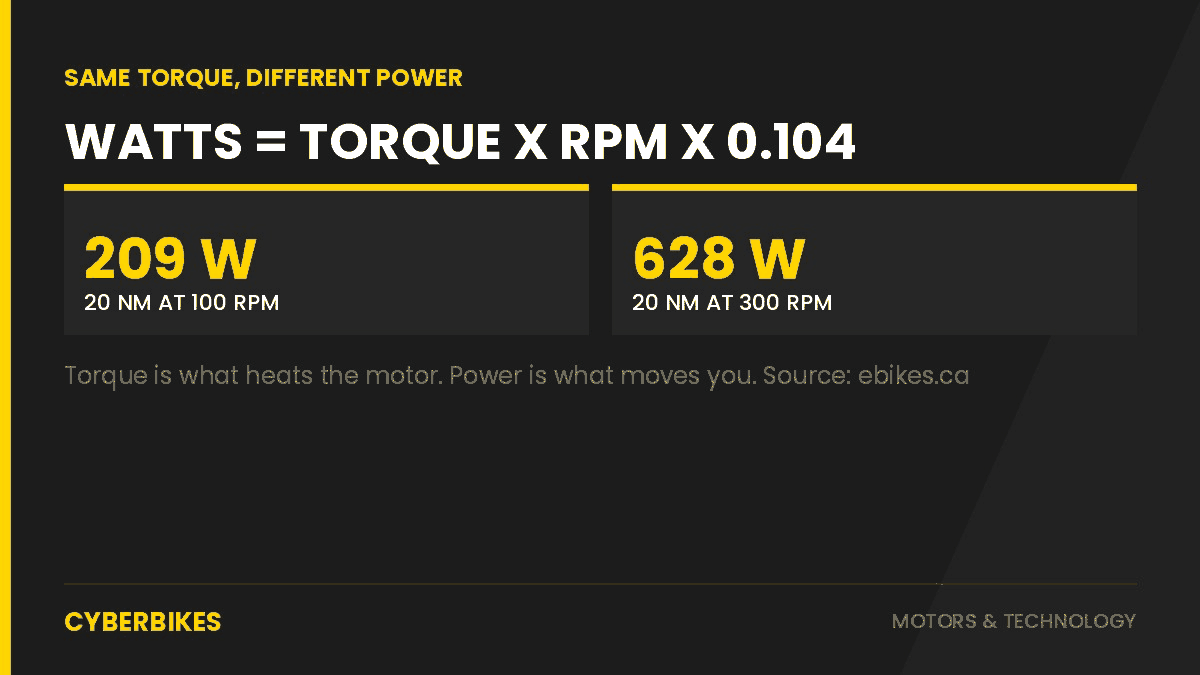
Grin gives the formula outright: Power = Torque × RPM × 0.104. Run the numbers and the point lands hard. A motor making 20 N·m at 100 rpm produces about 209 W. The exact same 20 N·m at 300 rpm produces about 628 W. Identical torque, triple the watts, because the wheel is turning three times faster.
Translate that to Parramatta Road. A 26 × 2.4 wheel rolls roughly 2.1 m per turn, so at the NSW assist limit of 25 km/h it spins at about 200 rpm, where 20 N·m is worth roughly 416 W. Crawl up a driveway at 5 km/h and the same 20 N·m is worth about 83 W — while the motor works just as hard. That one fact sits underneath every argument about power ratings, and underneath our guide to how e-bike motors, sensors and controllers actually work.
Does more Nm make an e-bike faster?
No. Torque is what accelerates you and holds you on a gradient; top speed is set by power against wind and rolling drag — and in NSW it is capped by law long before physics gets a say.
Grin’s Motor Simulator makes the distinction useful. It notes that torque “increases as the wheel slows down until reaching the controller phase current limit, at which point it is at a maximum”, and that thrust “is most convenient for estimating the climbing capacity of the vehicle, and it is what most people actually mean when they talk about ‘torque’.” Its rule of thumb is beautifully simple: the thrust needed to climb a hill is weight × %grade.
Put a 95 kg rider-plus-bike-plus-groceries on an 8% pinch up from Rozelle. Weight × grade gives about 7.6 kgf, or roughly 75 N of thrust just to resist gravity — about 25 N·m at a 26-inch wheel before rolling resistance or air. That is the number that matters on a hill, and it has nothing to do with whether the sticker says 250 W or 750 W.
Why do two 250W e-bike motors feel completely different?
Because nominal wattage describes what a motor can sustain thermally, not what it delivers — and what it delivers is set by the controller and battery voltage behind it.
Grin’s worked example is a Crystalyte H3540. On a 36V/20A controller it peaks at about 600 W. On a 36V/35A controller the same motor peaks at about 1100 W. One motor, nearly double the output, zero change to the hub. Worse, Grin points out that many vendors quote “peak INPUT power (volts × amps)” rather than actual mechanical output, sometimes inflating the figure by two to three times the sustainable power.
Peak watts mislead about feel, too. Grin notes a 36V/40A setup peaking at 1058 W can feel weaker than a 52V/20A setup peaking at 840 W, because the higher-voltage system holds power across a wider speed range. If you have wondered what a 250W e-bike motor rating actually means, that is the whole answer.
Is a 500W e-bike legal in NSW?
Yes, for now. Transport for NSW sets the current limit at “a maximum continuous rated power of 500 watts”, with “a motor that does not provide power at speeds higher than 25km/h” and a throttle-only function that “cuts out at 6km/h”. From 1 March 2029 that drops to a maximum of 250 W and “only EN 15194 certified e-bikes will be allowed on NSW roads”. And the line every rider should read twice: e-bikes over those limits “are illegal, even if its power or speed is restricted by an app or switch.” A big Nm number on a machine that breaches the power rule is not a feature. It is a defect.
Why doesn’t a mid-drive’s 85 Nm beat a hub motor’s 45 Nm?
Because the two numbers are measured in different places. A mid-drive’s N·m figure is taken at the bottom bracket, before the chain. A hub motor’s is taken at the wheel, where it actually pushes you.
Between the crank and the wheel sits your gearing, and it multiplies or divides that torque. With a 34-tooth chainring and a 51-tooth bottom sprocket, an 85 N·m mid-drive delivers roughly 85 × 51/34 = 127 N·m at the wheel. Shift to an 11-tooth sprocket and the same motor delivers 85 × 11/34 = about 28 N·m at the wheel. Same motor, same headline spec, a 4.5-fold swing depending on which gear you happen to be in.
A hub motor has no such lottery. Its 45 N·m is 45 N·m at the wheel in every gear — including the moment you pull away in whatever gear you left it in last night.
For scale, Grin’s pedal assist page points out that “a 60 kg person is standing with all their weight on a horizontal 165mm crank, producing (60 * 9.8 * 0.165) = 97 Nm of torque.” A 60 kg rider standing on one pedal already out-torques a headline 85 N·m mid-drive — at the crank. Nobody sells that rider as a 97 N·m motor, and nobody should sell you a bike on a crank figure either.
Why does high torque cook an e-bike motor?
Heat is made by current, and current is what makes torque — so torque, not power, is what eventually destroys a motor. Grin is explicit: “it’s not the output power but the output torque of the motor which causes it to heat up.”
The relationship is I²R: double the current and you quadruple the heat. The dangerous case is not a fast flat run at 25 km/h but a long, slow, heavily loaded grind where torque is high, rpm is low, and the motor makes very little useful power for all the heat. Grin treats 100°C as a conservative threshold, notes quality motors survive excursions of 150–180°C, and reports that ferrofluid cooling lifts continuous torque by roughly 40% without changing the motor at all — which tells you how thermally limited these things are.
Practical version for Sydney: short steep pinches are fine. The loaded 20-minute crawl is what turns a healthy hub into a warranty claim.
Which e-bike number should you actually check?
Watt-hours. Watt-hours are the one spec that cannot be inflated, because they are simple arithmetic: Wh = volts × amp-hours.
The Cyberbikes Centauro product page lists a 48V 25Ah (1200Wh) Samsung lithium-ion battery — and 48 × 25 does indeed equal 1200, which is more than you can say for some spec sheets. The same page lists a “Super 250W rear hub motor”, UL 2271 battery and UL 2849 system certification, ISO 4210 for the frame, EN 15194 for 250 W continuous power and speed, and a 150 kg maximum rider-and-cargo load.
Note what is not on that page: no N·m headline and no claimed kilometre range. That is the honest position: range belongs to a bike plus a rider, a hill and a headwind. Measure your own Wh/km on the display and divide — at 12 Wh/km a 1200 Wh pack is worth about 100 km; at 20 Wh/km, closer to 60 km. Grin’s Trip Simulator will model a real route for you, and our definitive guide to e-bike batteries and range walks through the rest.
Watch: how a geared hub motor turns rpm into torque
A small, light hub motor makes respectable wheel torque because of the reduction gearing hidden inside it — the mechanical version of the rpm-versus-torque trade above. Here is what that looks like in the workshop.
Frequently asked questions
Is 40 Nm enough torque for an e-bike in Sydney?
For most Inner West riding, yes, if that 40 newton-metres is measured at the wheel. Grin Technologies notes that the thrust needed to climb a hill is simply weight multiplied by the percentage grade, so a 95 kg rider-and-bike on an 8 percent climb needs roughly 75 newtons of thrust, which is about 25 newton-metres at a 26-inch wheel before rolling resistance and air drag. A hub motor delivering 40 newton-metres at the wheel has headroom on that climb. A mid-drive quoting 40 newton-metres at the crank may deliver much less at the wheel in a high gear.
Do watts or Nm matter more when buying an e-bike?
Neither in isolation. Grin Technologies states there is no standard or consistent way to give a motor a numeric watts rating, and torque figures are quoted at different points on different bikes, so the two headline numbers are rarely comparable between brands. The specs that cannot be inflated are watt-hours of battery capacity, calculated as volts times amp-hours, and the certifications the bike holds. Everything else is best settled by a test ride on a hill you actually climb.
Why does my e-bike motor get hot on hills but not on the flat?
Because heat comes from current, and current makes torque. Grin Technologies explains that it is the output torque rather than the output power that causes a motor to heat up, and the relationship is I squared R, so doubling the current quadruples the heat. On a slow, steep, loaded climb the motor draws high current while turning slowly, producing lots of heat for very little useful power. Grin treats 100 degrees Celsius as a conservative threshold and notes quality motors tolerate excursions of 150 to 180 degrees.
Settle it on a hill, not on a spec sheet
The only honest way to compare e-bike watts vs Nm is to ride two bikes up the same climb with the same load. Book a test ride at Cyberbikes, 281 Parramatta Road, Leichhardt, or call 0491 794 668, Tuesday to Saturday — bring your usual shopping, and we will point you at a gradient that tells the truth. Not ready to buy? The Centauro is available rent-to-own from $99.99 a week with maintenance included, so you can test the numbers for a month instead of a morning.
#eBikeSydney #Cyberbikes #CentauroEbike #EbikeTorque #MotorWatts #ElectricBikeLeichhardt #HubMotor #NSWEbikeLaws