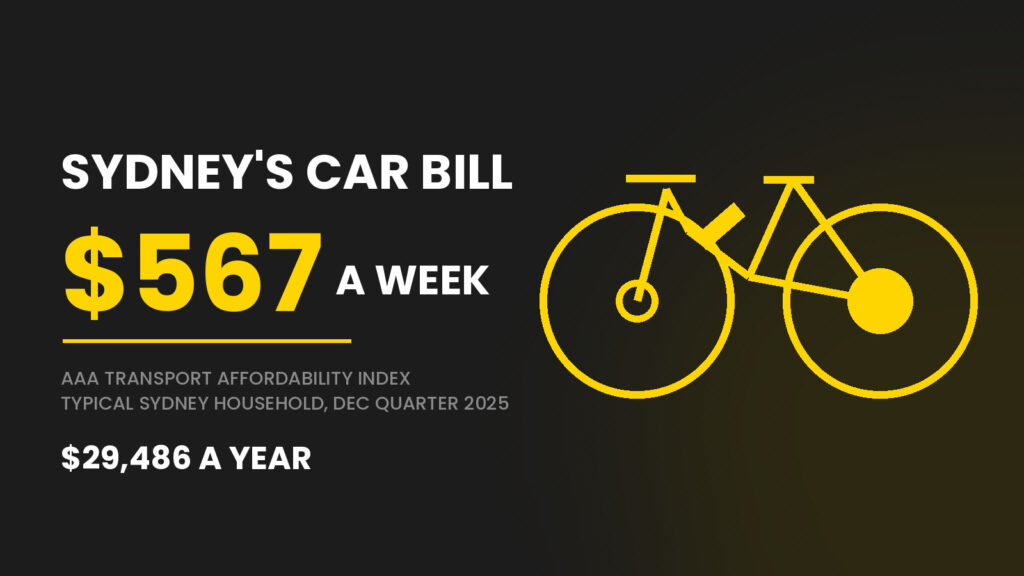
A typical Sydney household spends $567.03 a week on transport — $29,486 a year. That is the figure in the Australian Automobile Association’s Transport Affordability Index for the December quarter 2025, and it is the highest of any Australian capital. The cost of owning a car in Sydney is not a rounding error in the family budget. It is the second mortgage nobody calls a mortgage.
Here is where that money goes, why the petrol bill is the least of it, and what the same week costs on an electric bike.
What does owning a car in Sydney actually cost each week?
The AAA models a specific household: two working adults with children, two mid-range cars — one near-new on a variable-rate loan, one older and owned outright — with the newer car driven 15,000 km a year, one adult commuting by public transport, and tolls twice a week. That is an ordinary Sydney family, not an extravagant one. Their weekly bill breaks down like this.
| Weekly cost | Sydney household | A year |
|---|---|---|
| Car loan repayments | $214.47 | $11,152 |
| Fuel | $92.51 | $4,811 |
| Tolls | $60.00 | $3,120 |
| Comprehensive insurance | $50.89 | $2,646 |
| Public transport | $50.00 | $2,600 |
| Registration, CTP and licensing | $42.26 | $2,198 |
| Servicing and tyres | $37.23 | $1,936 |
| Roadside assistance | $2.63 | $137 |
| Total household transport | $567.03 | $29,486 |
The capital-city average in the same quarter was $477.92 a week. Sydney households pay $89.11 a week more than the average Australian city dweller — about $4,634 a year — for the privilege of living in the country’s most expensive place to move around.
Why is the biggest cost not the petrol?
Because the car itself is the expense. Loan repayments alone are $214.47 a week — more than double the fuel bill, and 38% of the whole transport budget. Add insurance, registration, CTP, servicing and roadside assistance and you are at $347.48 a week before the engine has turned over once.
That is the part people miss when they compare a tank of fuel to a train ticket: a car costs you most when it is parked. Sydney’s average unleaded price was 236.6 cents a litre on 5 October 2026, per the NRMA Weekly Fuel Report — roughly 39 litres a week here. Petrol is real money, and what happens to Sydney when petrol hits $3 a litre is a serious question. But the fixed costs of owning a car in Sydney do not fall when you drive less.
What does the same week cost on an e-bike?
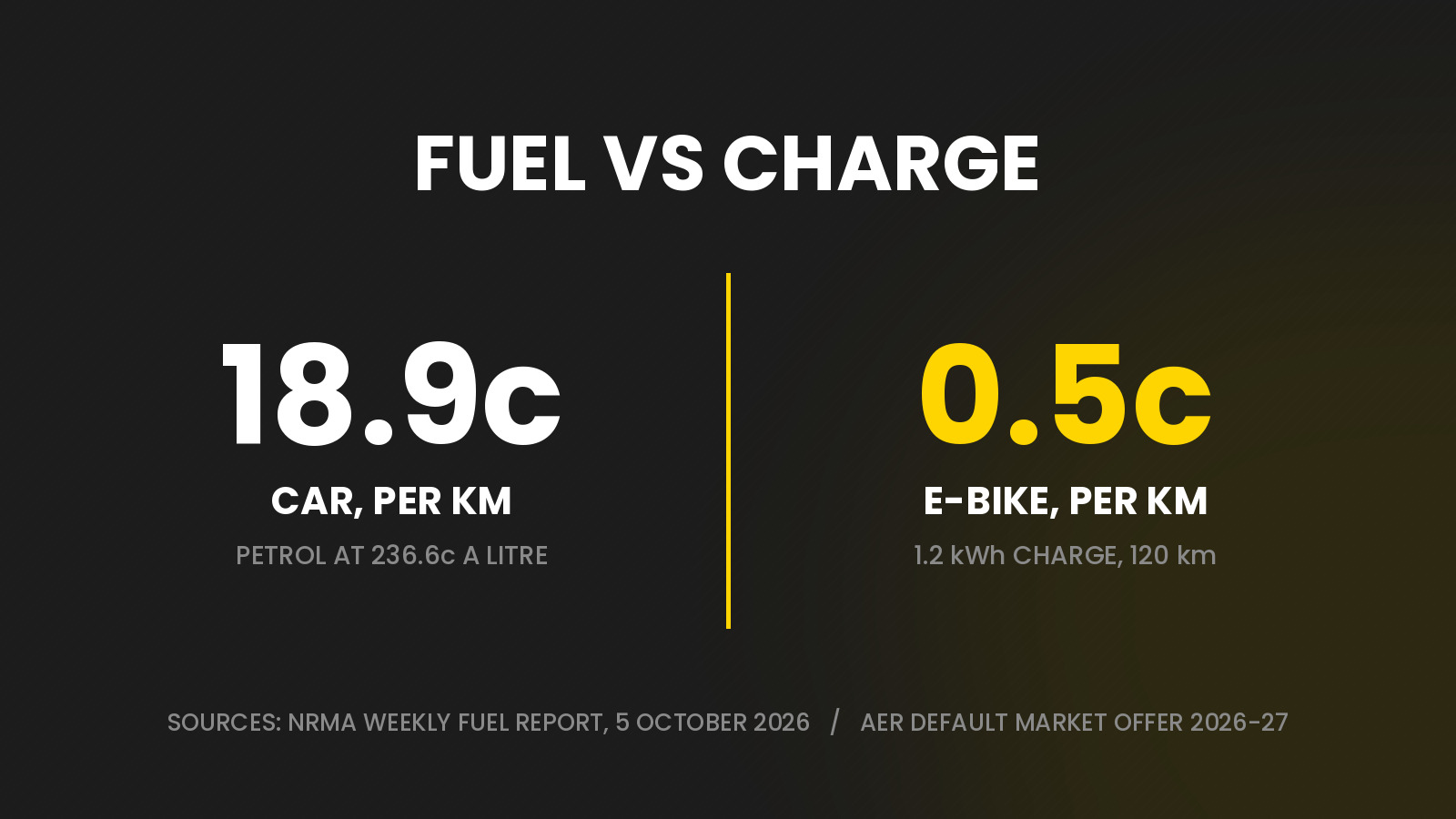
Run the numbers on energy and the gap is almost comic. The Cyberbikes Centauro carries a 48V 25Ah Samsung battery — 1,200 watt-hours — and the product page rates it at up to 120 km at 25 km/h on flat road with a 75 kg rider.
Under the AER’s Default Market Offer for 2026–27, an Ausgrid-zone household pays $1,875 a year for 3,900 kWh — about 48 cents per kilowatt-hour once the supply charge is counted in. So a full charge of that battery costs roughly 58 cents. Over 120 km that is 0.5 cents a kilometre.
A car using 8 litres per 100 km at today’s Sydney pump price costs 18.9 cents a kilometre in fuel alone — about 39 times more. Charged every single day for a year, that e-bike battery would cost around $211 in electricity. The Sydney household’s petrol bill is $4,811.
Put it another way: the fuel line alone, $92.51 a week, is within about seven dollars of what rent-to-own on a Centauro costs. Not the car. Just the petrol for it.
Why is this a road design problem, not a budgeting problem?
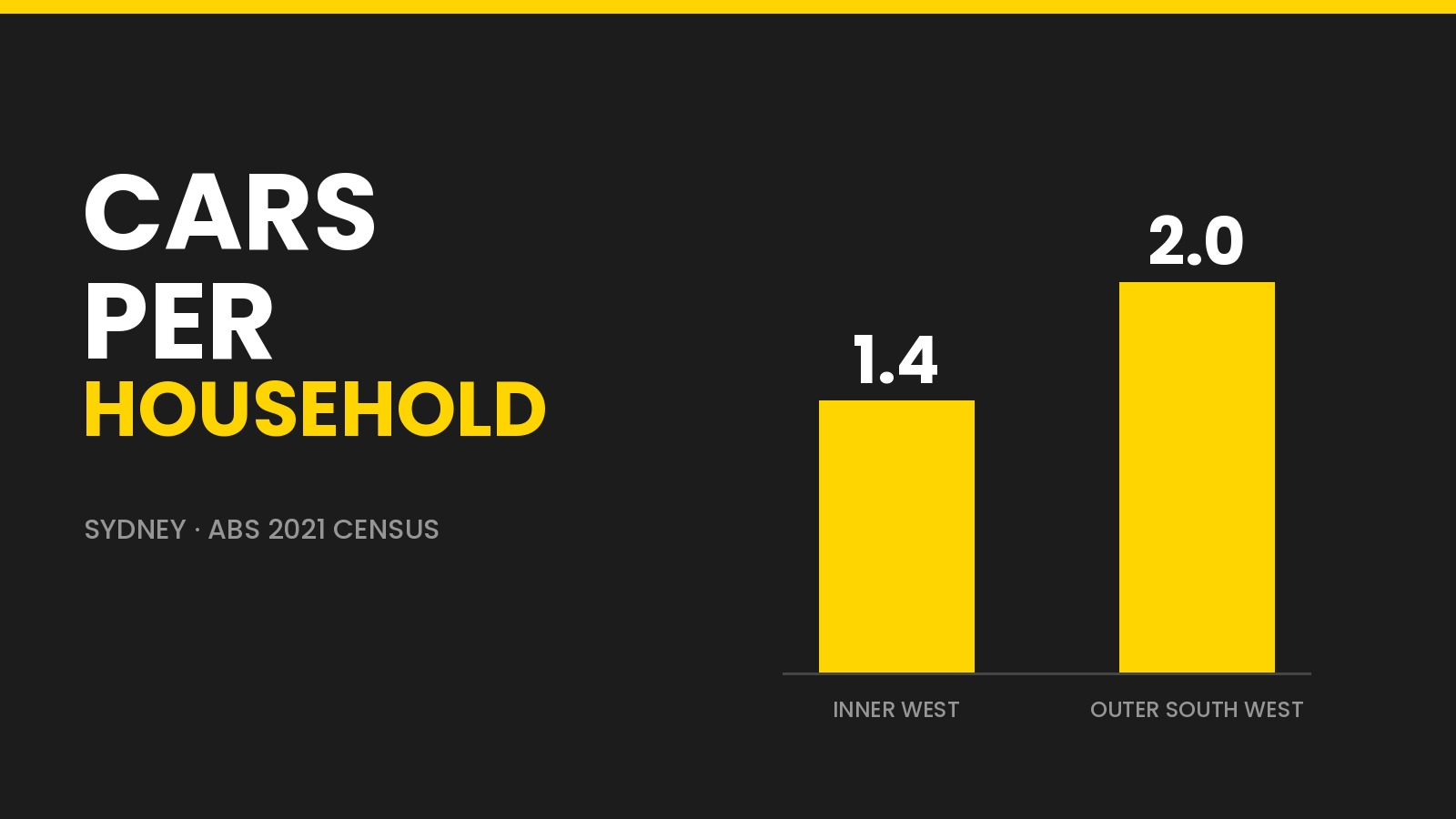
Nobody in Western Sydney is paying $567 a week because they are bad with money. They are paying it because the street outside their house was built on the assumption that every adult would own a car, and because the alternatives were never funded to the same standard.
You cannot cycle an arterial road with no separated lane, walk to a shop zoned 6 km away, or catch a bus that runs twice an hour. When a household has no safe, continuous, direct alternative, the $29,486 is not a choice — it is a tax levied by road design. That is why the $60 a week in tolls stings: a fee for a network where there is often no parallel route worth taking.
The fix is not a lecture about frugality. It is separated bike lanes that actually connect, bike parking at every station, and road space reallocated to the modes that move the most people per metre. Every kilometre of protected lane is a kilometre on which a household can delete a trip from that table.
Can an e-bike really replace a car trip in Sydney?
For a very large share of trips, yes. Transport for NSW sets the limit at 500 watts maximum continuous rated power, with pedal assist cutting out at 25 km/h and throttle-only power at 6 km/h. From 1 March 2029 the cap drops to 250 W and EN 15194 certification becomes mandatory. A bike over those limits is illegal even if restricted in software, so buy certified: the Centauro lists UL 2849, UL 2271, ISO 4210 and EN 15194, a 150 kg rider-and-cargo load and 4-piston hydraulic brakes on 180 mm rotors. Helmets are mandatory in NSW.
You do not have to sell the car this afternoon. Going from two cars to one removes the single largest line in that table — the fastest way to cut the cost of owning a car in Sydney without moving house. Our car-free Sydney e-bike commuting and rent-to-own guide walks through the whole switch.
Frequently asked questions
How much does a Sydney household spend on transport a year?
$29,486 a year, or $567.03 a week, according to the AAA Transport Affordability Index for the December quarter 2025. That is the highest of any Australian capital city and $89.11 a week above the capital-city average of $477.92.
How much does it cost to charge an e-bike in Sydney?
About 58 cents for a full 1,200 Wh battery. At the AER Default Market Offer 2026–27 rate of roughly 48 cents per kilowatt-hour in the Ausgrid zone, 1.2 kWh costs 58 cents — around 0.5 cents per kilometre over a 120 km range, against about 18.9 cents per kilometre in petrol for a car.
What is the legal power limit for an e-bike in NSW?
500 watts maximum continuous rated power, with pedal assistance cutting out at 25 km/h and throttle-only power cutting out at 6 km/h. From 1 March 2029 the limit drops to 250 W and only EN 15194 certified e-bikes will be allowed on NSW roads. A bike above those limits is illegal even if it is restricted by software.
Swap one car trip a week for an e-bike ride and see what changes. We are at Cyberbikes, 281 Parramatta Road, Leichhardt, and the Centauro is on the floor if you want to ride one before you believe the maths.
#EbikeSydney #CyberbikesLeichhardt #CostOfLiving #CarFreeSydney #SydneyTransport #RentToOwnEbike #InnerWest #CarDependency