Sydney petrol prices averaged 215.6 cents a litre for regular unleaded on 14 September 2026. At $3.00 a litre, the same 60-litre tank goes from about $129 to $180 — and a household driving 15,000 km a year in a car that uses 9 litres per 100 km pays roughly $1,140 more for exactly the same trips. The sting is that the households who feel it first are not the ones with a station at the end of the street. They are the ones for whom driving was never a choice.
Three dollars is not a thought experiment any more. It is about 40 per cent away, and we have already covered more ground than that this winter.
How far have Sydney petrol prices already moved?
A long way, very fast. The NRMA’s weekly fuel report for 14 September 2026 has the Sydney average at 213.8 cents a litre for E10 and 215.6 for U91, and expects “the low 220 cents per litre” within the week. E10 alone is up 63.7 cents a litre since 30 June. That is not a price cycle. That is a step change.
Upstream tells the same story. The Australian Institute of Petroleum published terminal gate prices of 211.2 to 233.2 cents a litre for unleaded over 14–18 September, and 244.3 to 280.1 for diesel. Brent closed at US$103.87 a barrel on 18 September, up 55.77 per cent year on year. ABC News reported Tapis — the benchmark that actually sets Australian pump prices — at US$110, up 46 per cent since July, with Commonwealth Bank strategist Vivek Dhar warning a deeper squeeze could push Brent toward US$150. Roughly 20 per cent of the world’s oil moves through one strait, and the pipeline built to bypass it is out of action.
You cannot fix any of that from Leichhardt. What you can change is how much of your week depends on it. We covered the supply side in Australia’s fuel security and days of fuel left; this is the price side, and it arrives first.
Who gets hit first when fuel prices spike in Sydney?
Whoever has the fewest alternatives. A fuel shock is not a flat tax across a city — it is a means test run by transport planning. Near a metro line, a protected bike lane or a frequent bus, you shift a few trips and absorb it. Where the only realistic way out of the street is a car, you pay the full increase and change nothing, because there is nothing to change to.
The Committee for Sydney’s State of the City 2026 shows how thin the hedge already is. Nearly every commuter car park at Sydney’s train stations is at capacity, filling roughly 50 minutes earlier than before the Metro City section opened. At Tallawong, an estimated 2,400 motorists compete for 975 spaces — served by 15 buses an hour, against 82 at Bondi Junction.
Read that as an energy-security document and it is alarming: the standard advice when fuel spikes — drive to the station, take the train — is rationed by a car park that filled before 8am. That is not a failure of the people stuck in it. It is what you get when you approve housing at the edge of the city and fund the road that reaches it, but not the bus, the bike lane or the parking that would make the train usable.
What would $3 a litre cost a Sydney household?
Take a car using 9 litres per 100 km — a fair number for the mid-size SUVs that now dominate Australian sales — and do the arithmetic at today’s price and at $3.00.
| Fuel price | Cost per 100 km | 15,000 km a year | Two cars |
|---|---|---|---|
| 215.6c/L (today) | $19.40 | $2,910 | $5,820 |
| 250c/L | $22.50 | $3,375 | $6,750 |
| 300c/L | $27.00 | $4,050 | $8,100 |
A two-car household goes from roughly $5,820 a year in fuel to $8,100 — an extra $2,280 for the identical trips. Diesel households do worse; terminal gate diesel already runs 30 to 50 cents above unleaded. And none of this is discretionary. It is the school run, the shift, the shop.
Why is an e-bike the vehicle least exposed to an oil shock?
Because its fuel is electricity bought at a regulated retail price that went down this year. The AER’s 2026-27 Default Market Offer set the Ausgrid residential benchmark at $1,899 a year for 3,900 kWh on a flat rate — down $66, or 3.4 per cent. Spread the supply charge across that usage and you are paying roughly 49 cents a kWh, all in.
Now put a battery next to it. The Cyberbikes Centauro carries a 48V 25Ah Samsung pack — 1,200 watt-hours, or 1.2 kWh. At 49c/kWh that is about 58 cents to fill, call it 65 cents once you allow for charger losses. Grin Technologies puts typical e-bike consumption at 9 to 12 watt-hours per kilometre, and 14 to 20 for a power-hungry setup. Be deliberately pessimistic and call it 15 Wh/km: 1,200 Wh still returns about 80 km, which works out under one cent per kilometre.
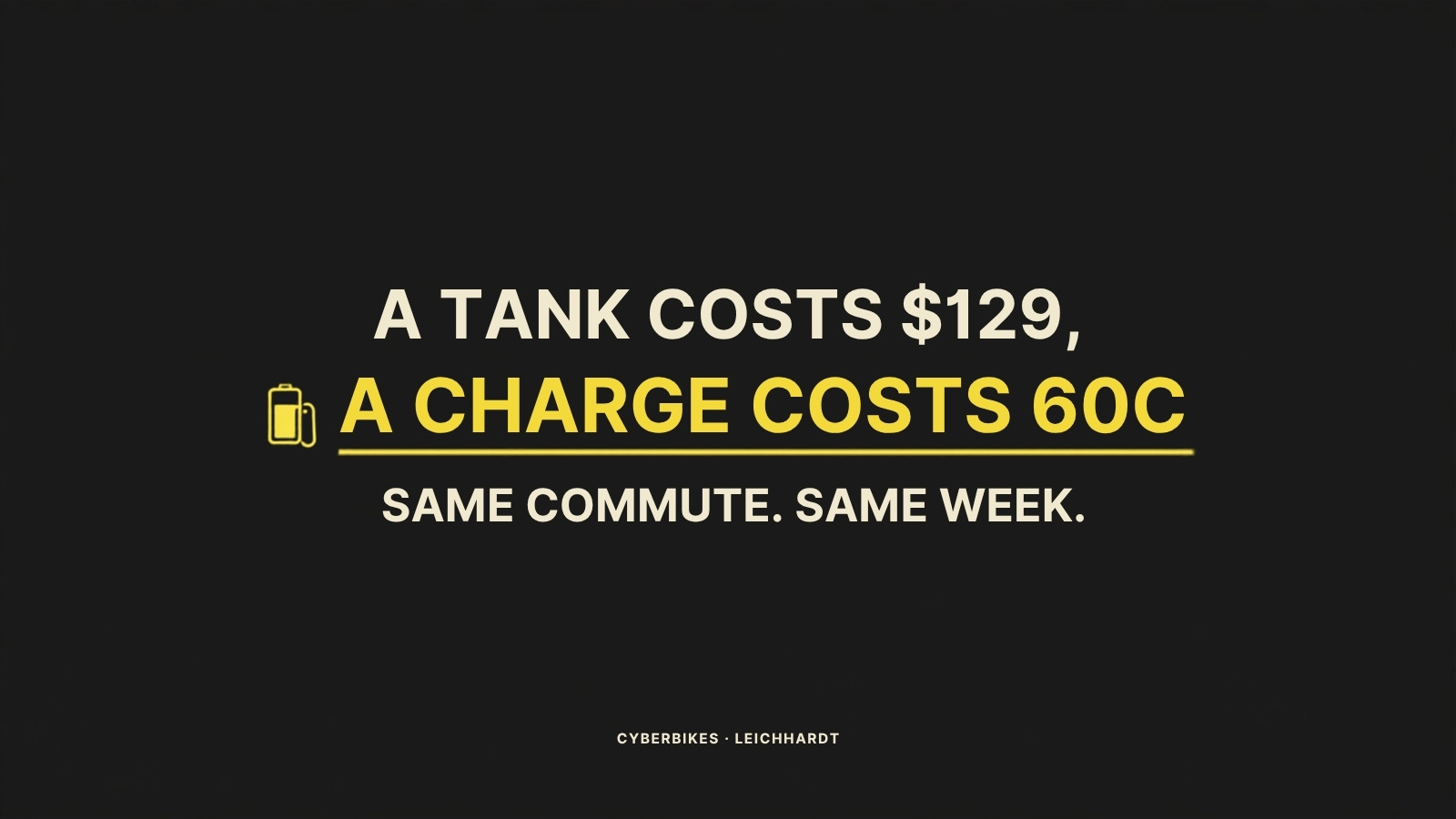
Against 19.4 cents a kilometre in fuel today — 27 cents at $3 a litre — the e-bike runs at roughly a twentieth to a thirtieth of the cost, and that gap widens every time a tanker is diverted. That is the argument: not that the e-bike is cheaper on a good day, but that it is the one vehicle in your garage whose running cost barely notices what happens in a shipping lane.
It is also legal to ride today and will still be legal in 2029. Transport for NSW allows up to 500 watts continuous rated power, with assistance cutting out at 25 km/h and throttle-only power at 6 km/h, and will require EN 15194 certification from 1 March 2029. The Centauro is a 250W EN 15194 bike with UL 2849 electronics and a UL 2271 battery — the specification NSW is heading toward, not away from. The full picture is in our guide to e-bike laws in NSW and Australia. Helmets are mandatory here, as always.
What should Sydney fix before the next shock?
Treat mode shift as energy policy, not lifestyle policy. Three things would do more for household fuel resilience than any subsidy on fuel itself:
- Finish the network. A bike lane that stops 400 metres short of the station is a decoration, not a transport option. Continuous separated routes to every interchange turn a 5 km car trip into a 15-minute ride.
- Convert car parking to bike parking at stations. One car space holds about ten bikes, so Tallawong’s 1,425 unmet motorists do not need 1,425 more car spaces — a fraction of that footprint in secure bike parking clears the queue.
- Put e-bikes in the incentive system. Electric cars still attract the largest transport subsidies in the country while the cheapest, most fuel-proof vehicle available gets none in NSW.
None of this asks anyone to give up a car. It asks the city to stop making the car the only thing that works. The deeper case is in our guide to car-free e-bike commuting and rent-to-own in Sydney.
Swap one car trip a week for an e-bike ride and see what changes. If it sticks, we are at Cyberbikes, 281 Parramatta Road, Leichhardt.
Frequently asked questions
How much are Sydney petrol prices right now?
The NRMA’s weekly fuel report for 14 September 2026 put the Sydney average at 213.8 cents a litre for E10 and 215.6 cents for regular unleaded, with prices expected to move into the low 220s. E10 has risen 63.7 cents a litre since 30 June 2026.
How much does it cost to charge an e-bike in Sydney?
A 48V 25Ah battery holds 1,200 watt-hours, or 1.2 kWh. On the AER’s 2026-27 Default Market Offer for the Ausgrid network, a typical household pays about 49 cents per kWh once the supply charge is spread across 3,900 kWh, so a full charge costs roughly 58 cents, or about 65 cents allowing for charger losses.
What is the legal power limit for an e-bike in NSW?
Transport for NSW allows a maximum continuous rated power of 500 watts, with motor assistance cutting out at 25 km/h and any throttle-only function cutting out at 6 km/h. From 1 March 2029 only EN 15194 certified e-bikes, rated at 250W, will be allowed on NSW roads. A bike above those limits is illegal even if an app or switch restricts it.
#EbikeSydney #CyberbikesLeichhardt #PetrolPrices #CarFreeSydney #RentToOwnEbike #SydneyCommute