
Sydney kids don’t ride to school any more because the street outside the school gate was rebuilt around the cars that bring them. Nationally, 61% of school trips are made in a private vehicle and only 21% are walked or ridden, according to the Australian School Travel Survey 2025 from the University of Sydney. Transport for NSW puts it in traffic terms: “every morning one in five cars on the road is driving a school student to school.” Four decades ago roughly 75% of those trips were active. Today it’s about 25%. Children didn’t change. The roads did.
How many Sydney kids are actually driven to school?
The University of Sydney surveyed 4,968 families and collected travel data for 7,880 children. The split, led by Associate Professor Jennifer Kent at the School of Architecture, Design and Planning:
| How Australian kids get to school (2025) | Share of trips |
|---|---|
| Private vehicle | 61% |
| Walking and cycling | 21% |
| Public transport | 10% |
| Dedicated school buses | 8% |
Here’s the number that ends the “it’s too far” argument: nearly four in ten children who live within one kilometre of their school are still driven there. Two-thirds of children living more than three kilometres out travel by car, and more than 80% of extracurricular trips are made by car as well. Kent’s comparison: in Germany seven in ten children walk or cycle to school. In Australia it’s two in ten.

Is the school run really what clogs Sydney’s morning peak?
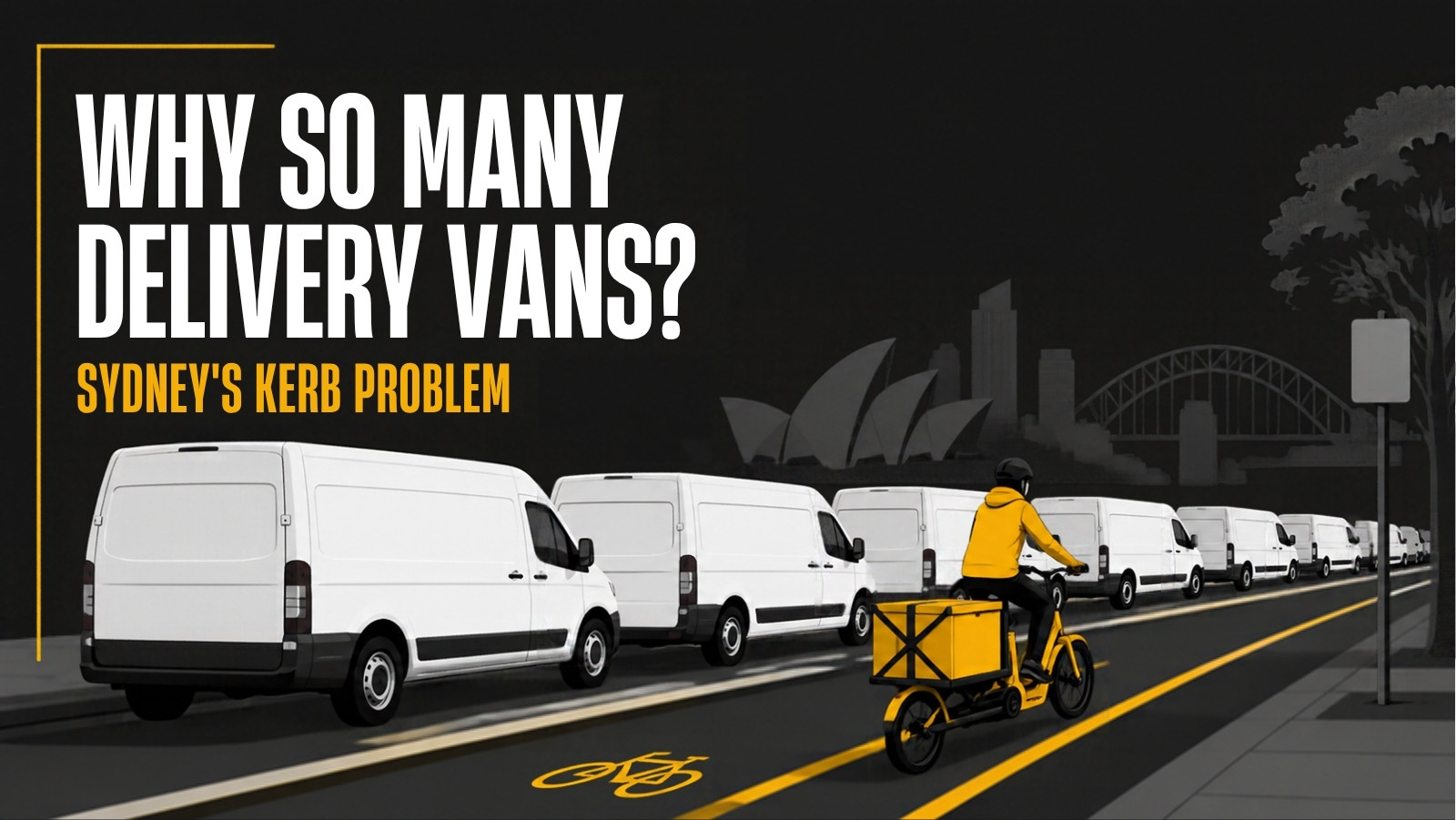
One in five cars in the morning peak is a school drop-off, on Transport for NSW’s own figure. You can feel the proof twice a year: the first morning of school holidays, the same roads with the same jobs and the same workers suddenly flow. Nothing was built. One trip type simply disappeared.
The cost of not fixing it is already measured. The Bureau of Infrastructure and Transport Research Economics estimated Sydney’s avoidable social cost of congestion at about $6.1 billion in 2015, projected to reach $9.5-$12.6 billion by 2030 (in real 2010 dollars). We are, in other words, happy to spend billions absorbing congestion and unwilling to spend thousands fixing the three kilometres that generates a fifth of it.
Why did active travel to school collapse from 75% to 25%?
Not because parents got lazy, and not because kids got soft. A South Australian literature review for the state transport department found the single biggest barrier is parental concern about speeding cars and traffic danger. That is a completely rational read of the environment we built.
And it is a self-feeding loop. More driving means more cars crowding the gate at 8:40am, which makes walking and riding feel less safe, which means more driving. Every year it gets blamed on individual choice instead of on the design decisions behind it: arterial roads slicing through catchments, 40 km/h zones that apply in two narrow windows, paths that stop 200 metres short of the gate, no secure bike parking on site, and kiss-and-ride built in as the default arrival mode.
The distances were never the problem. The 2015 Active Healthy Kids Australia report card found nearly 60% of Australian parents report the home-to-school trip is three kilometres or less. Three kilometres is a rounding error for a bicycle and a nightmare for a car, because most of the traffic you’re sitting in is other people doing the same three kilometres.
Can an e-bike legally do the Sydney school run?
Yes, and the NSW rules are more school-run-friendly than most parents realise. Read live from Transport for NSW: a legal e-bike has a maximum continuous rated power of 500 W today (dropping to 250 W, plus mandatory EN 15194 certification, from 1 March 2029); motor power must taper as you pedal faster and cut out completely at 25 km/h; throttle-only assistance must cut out at 6 km/h; and an approved helmet, securely fitted and fastened, is mandatory for the rider and for any passenger. Those limits apply even if a bike’s power is restricted by software – so an over-spec bike sold as “limited” is still illegal.
The footpath rule is the one worth knowing. In NSW, riders aged 16 or older who are not supervising a child under 16 may not ride on the footpath. Read that the other way around: a child can ride the footpath, and the adult riding with them can too. That single clause is what makes a gate-to-gate school ride workable on streets that aren’t ready for an eight-year-old on the road. If you want the full picture, our complete guide to e-bike laws in NSW and Australia goes through it line by line.
On the hardware side, a school run is a cargo problem more than a range problem. Specs read live today from the Cyberbikes Centauro product page: a 48V 25Ah (1,200 Wh) Samsung pack, about five hours to charge from empty; a 250 W continuous rear hub motor; up to 120 km at 25 km/h on the flat with a 75 kg rider and no headwind; 150 kg maximum combined rider and cargo, with the rear rack rated to 50 kg; four-piston hydraulic brakes on 180 mm rotors; and UL 2849 and UL 2271 certification, with an ISO 4210 frame. A 3 km run at a legal assisted 25 km/h is roughly eight to ten minutes door to door, hill included – and you park at the gate instead of circling for it.
What would actually fix the Sydney school run?
- 30 km/h on every local street inside a 1 km school catchment, all day, not in two narrow windows. Speed is the variable the road-safety evidence keeps pointing at.
- School streets. Close the 100 metres outside the gate to through traffic at drop-off and pick-up. Paint, bollards, a timed sign.
- Separated paths that reach the gate. A path that ends at the arterial has solved nothing; the last 200 metres is where parents make the call.
- Secure bike and e-bike parking on site. A $1,200 e-bike with nowhere to lock it stays home.
None of that is a tunnel. All of it is cheaper than one interchange, and it targets the exact trip type that makes up a fifth of the cars around you at 8:40am. If you’re weighing up dropping a car, we’ve mapped the numbers in our car-free Sydney e-bike commuting and rent-to-own guide and broken down what owning a car in Sydney really costs.
Frequently Asked Questions
Can my child ride on the footpath in NSW?
Yes. Transport for NSW states that riders aged 16 or older who are not supervising a child under 16 may not ride on the footpath. A child under 16 may ride on the footpath, and an adult supervising that child may ride there with them. An approved helmet, securely fitted and fastened, is mandatory for every rider and passenger in NSW.
How fast can a legal NSW e-bike go on the school run?
Motor assistance must reduce as you pedal faster and cut out completely at 25 km/h, and throttle-only assistance must cut out at 6 km/h. A legal e-bike has a maximum continuous rated power of 500 W today; from 1 March 2029 the limit becomes 250 W and only EN 15194 certified e-bikes will be allowed on NSW roads. Those limits apply even if the power is restricted by software.
Is three kilometres too far for a child to ride to school?
Nearly 60% of Australian parents report their home-to-school trip is three kilometres or less, and at a legal assisted 25 km/h that is roughly eight to ten minutes of riding. The Australian School Travel Survey 2025 found nearly four in ten children living within one kilometre of school are still driven, so distance is rarely the real barrier – perceived traffic danger is.
Swap one car trip a week for an e-bike ride and see what changes. If the school run is the trip you’d start with, come and talk it through with us at Cyberbikes, 281 Parramatta Road, Leichhardt – we ride these roads too.
#CyberbikesSydney #EbikeSydney #SchoolRun #ActiveTravel #SydneyTraffic #Leichhardt #CarFreeSydney #RideToSchool