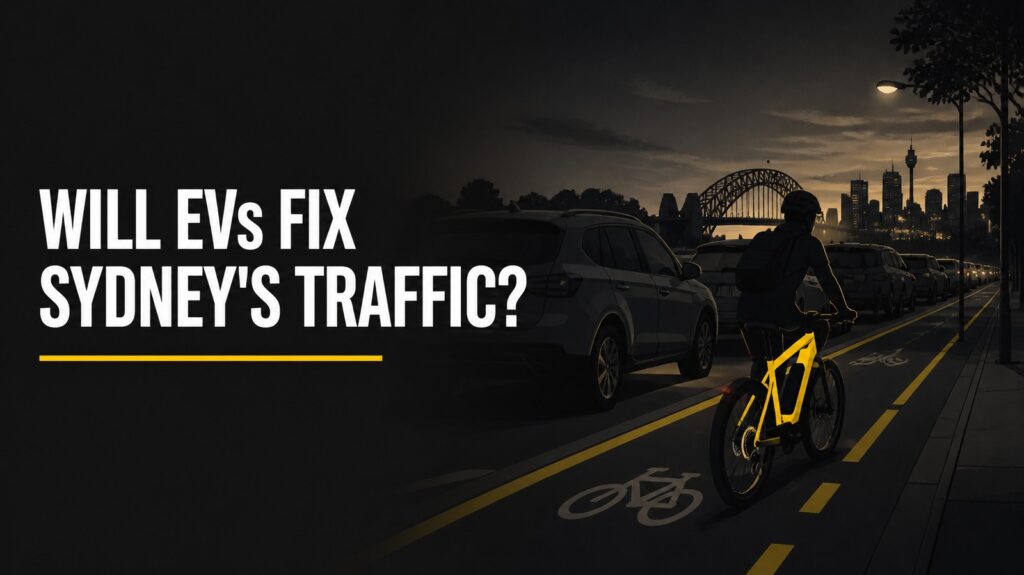
No — electric cars fix the tailpipe, not the traffic. An electric SUV occupies exactly the same lane, the same kerb and the same place in the queue as the petrol one it replaced. Battery electric and plug-in vehicles reached 25.8% of all new car sales in Australia in the first half of 2026, up from 12.1% a year earlier, yet Sydney still generates around two million car trips shorter than 2 km on an average weekday. Swapping the fuel does nothing to those two million trips. Swapping the vehicle does.
We sell e-bikes at Cyberbikes in Leichhardt, so our bias is on the table. The numbers below are not ours — they come from the Electric Vehicle Council, the ABS, Transport for NSW, the Committee for Sydney and the federal greenhouse inventory.
How many of Sydney’s cars are actually electric yet?
Far fewer than the sales headlines suggest. Australians bought 157,957 electric vehicles in the six months to June 2026 — 103,716 battery electric and 54,241 plug-in hybrid — taking the national EV fleet to roughly 612,000 vehicles, according to the Electric Vehicle Council’s State of EVs 2026 report (reported by CommBank, September 2026).
Now the denominator. The ABS Motor Vehicle Census counted 20.1 million registered motor vehicles in Australia, 5,892,206 of them in NSW, with an average vehicle age of 10.6 years. Put 612,000 over roughly 20 million and electric vehicles are about 3% of what is actually on the road. At a fleet age of a decade, even a quarter of new sales takes well over fifteen years to work through the stock.
That is the first problem with waiting for electrification: the timeline is a generation long, and the congestion is already here.
Does an electric car take up less road space?
Not one square centimetre less. Road space is geometry, and geometry does not care what is under the bonnet. A two-tonne electric wagon needs the same lane width, the same following distance, the same parking bay and the same intersection time as any other car.
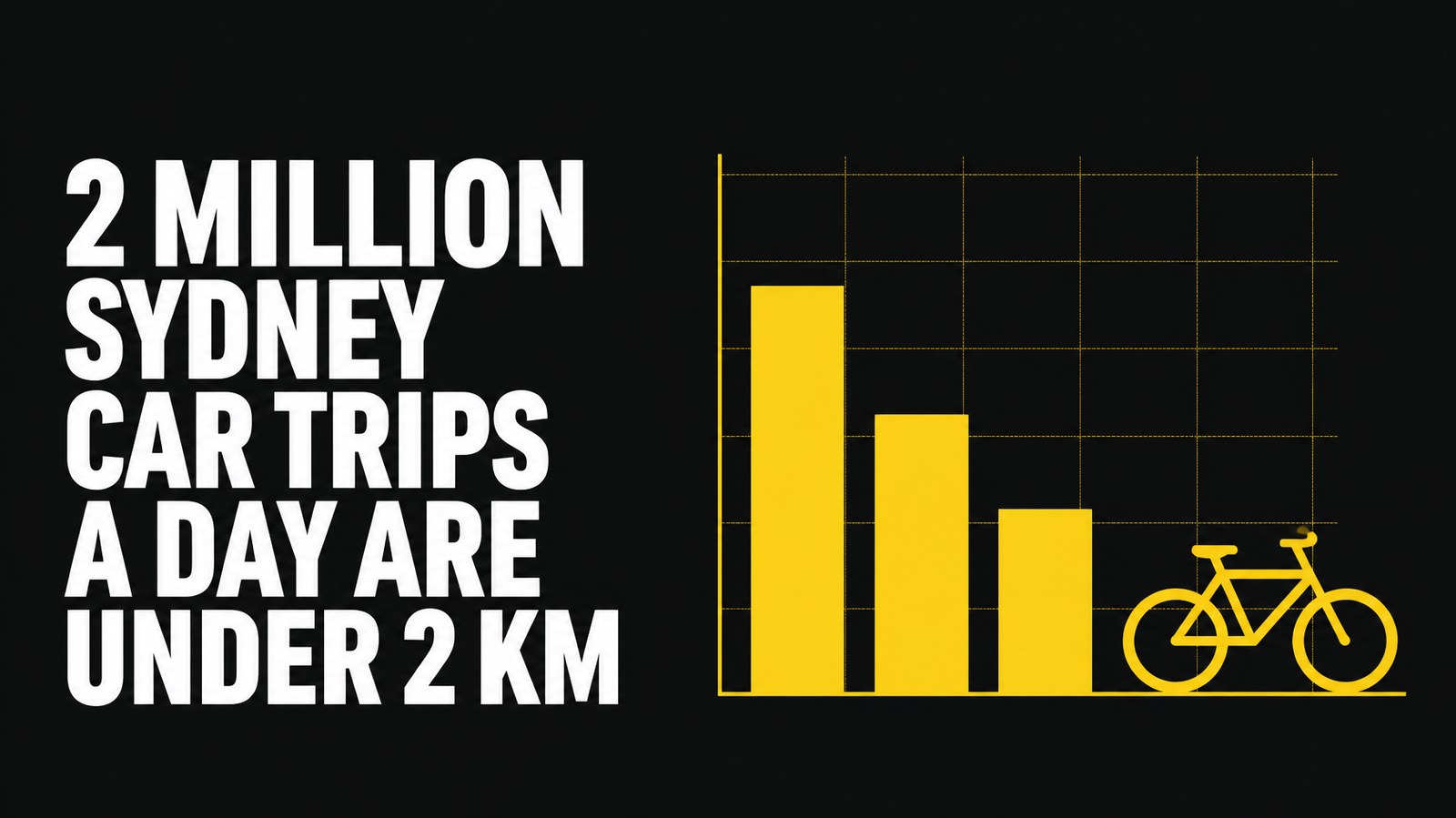
The Committee for Sydney found that Greater Sydney produces more than 11 million weekday car trips under 10 km, about two million of them under 2 km, while cycling accounts for less than 1% of all trips. Electrify every one of those two-kilometre car trips and you still have two million cars moving, parking and queuing for errands a fit ten-year-old could ride.
The cost keeps climbing with them. BITRE’s projections, summarised by Infrastructure Partnerships Australia, put the avoidable social cost of congestion across Australian capitals at $16.5 billion in 2015, rising to as much as $37.3 billion by 2030, with Sydney and Melbourne leading the increase. A silent queue is still a queue.
Are electric cars cutting Australia’s transport emissions?
Yes — slowly, and from a very high base. Australia’s transport emissions fell to 100.8 Mt CO2-e in 2025, down from 101.5 Mt in 2024, a drop of about 0.6%, while national emissions fell 2.1% to 458.9 Mt CO2-e, per the Department of Climate Change, Energy, the Environment and Water’s quarterly greenhouse inventory (as reported by carsales). That makes transport roughly 22% of the national total and one of the slowest-moving blocks in the inventory.
Half a per cent a year is real progress and worth having. It is also nowhere near the rate at which Sydney’s traffic, parking demand and road trauma need to fall. Electrification is a decarbonisation policy wearing a congestion policy’s clothes.
What would actually shift Sydney’s traffic?
Moving trips out of cars, not changing what powers them. The Committee for Sydney estimates that shifting just 2–5% of short trips within 10 km of the Eastern Harbour City would remove 20,000 to 50,000 motor vehicle trips a day. Transport for NSW’s own estimate is that cycling could reach 5% of trips with a comprehensive, connected network — five times today’s share. And 70% of Sydneysiders say they would ride at least weekly if it felt safe. The barrier is not willingness. It is the allocation of road space, and that is a decision, not a law of nature.
This is where the energy arithmetic gets absurd in the e-bike’s favour. The Cyberbikes Centauro carries a 48V 25Ah Samsung pack — 1,200 Wh — rated for up to 120 km at 25 km/h on the flat with a 75 kg rider. That works out near 10 Wh per kilometre. A full charge is 1.2 kWh: less electricity than running a 2,000 W kettle for 40 minutes, and enough to cover a fortnight of the 2 km trips above. No electric car in Australia comes within two orders of magnitude of that per kilometre.
It is also legal, cheap and available now. Under the current Transport for NSW rules, a road-legal e-bike has a maximum continuous rated power of 500 W, motor assistance that stops at 25 km/h, and any throttle-only function cutting out at 6 km/h; from 1 March 2029 the limit drops to 250 W and only EN 15194 certified e-bikes will be allowed. Helmets are mandatory. The Centauro is certified to EN 15194, UL 2849, UL 2271 and ISO 4210, which matters more every year as those rules tighten — the detail is in our complete guide to e-bike laws in NSW and Australia.
None of this is an argument against electric cars — some trips need a car, and an electric one beats a petrol one. It is an argument against pretending a cleaner fuel is the same thing as a better city. Our car-free Sydney e-bike commuting and rent-to-own guide runs the full numbers, and what owning a car in Sydney really costs covers the household side.
Frequently Asked Questions
Will electric cars reduce traffic congestion in Sydney?
No. An electric car occupies the same lane, parking bay and intersection time as a petrol car, so changing the engine removes no vehicles from the road. Electric vehicles are about 3% of Australia’s registered fleet of 20.1 million. Congestion falls when trips move out of cars, not when the fuel changes.
How much electricity does an e-bike use compared with an electric car?
Far less. The Cyberbikes Centauro’s 48V 25Ah battery holds 1,200 Wh and is rated for up to 120 km — about 10 Wh per kilometre. A full charge uses 1.2 kWh, roughly a 2,000 W kettle running for 40 minutes. An electric car uses well over 100 Wh per kilometre.
What is the legal power limit for an e-bike in NSW?
Transport for NSW currently allows a maximum continuous rated power of 500 watts, with assistance that must stop above 25 km/h and any throttle-only function cutting out at 6 km/h. From 1 March 2029 the limit drops to 250 watts and only EN 15194 certified e-bikes will be allowed. An approved helmet is mandatory.
Swap one car trip a week for an e-bike ride and see what changes. We are at Cyberbikes, 281 Parramatta Road, Leichhardt, if you want to try it before you decide.
#ebikeSydney #CyberbikesLeichhardt #CarFreeSydney #ElectricCars #SydneyTraffic #Micromobility #BikeLanes #Centauro