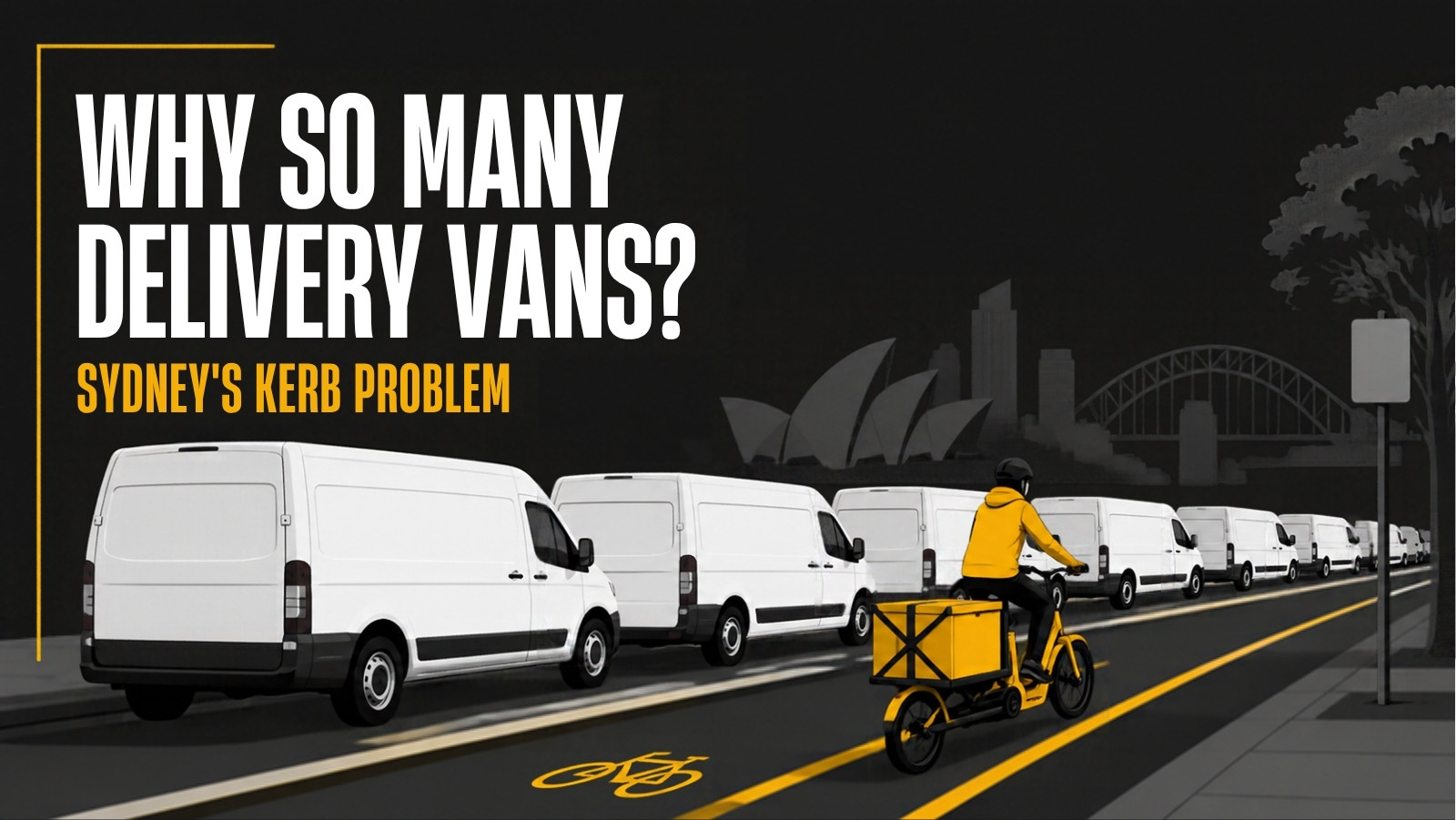
Sydney’s cars are getting bigger because the market has shifted almost entirely to SUVs and utes. SUVs made up 65% of Australia’s new-vehicle sales in the year to September 2026, and the country’s best-selling vehicle is a ute, not a car. The typical best-seller has grown from a sedan under 1.5 m tall in 2005 to a ute around 1.9 m tall in 2025, with 2026 pick-ups reaching roughly 2 m and up to 3 tonnes. That is not a styling question. University of Melbourne research published in September 2026 found every extra 10 cm of vehicle height raises a pedestrian’s odds of being killed by 11%, and every extra 100 kg raises them by 6%.
Here is our position: nobody chose this. No Sydney household voted to make the street outside their kid’s school taller and heavier. It happened because import rules, safety standards and tax settings allowed it, one model year at a time, while the roads stayed exactly as wide as they were.
Are Sydney’s cars really getting bigger?
Yes, and the numbers are not subtle. Australians bought 957,698 new vehicles in the year to September 2026, up 2.0%, with SUVs at 65% of the total. The Ford Ranger was the best-selling model, ahead of the Toyota HiLux. In NSW specifically, the NSW State of the Environment report found 76% of new vehicles sold in 2022 were either SUVs (54%) or light commercial vehicles (22%).
Size has moved with the mix. The comparison reported by ABC News is stark:
| Year and vehicle | Approximate height | Approximate mass |
|---|---|---|
| 2005 sedan | Under 1.5 m | Nearly 1.7 t |
| 2015 medium SUV | About 1.7 m | Similar to the 2005 sedan |
| 2025 ute | About 1.9 m | Heavier again |
| 2026 pick-up | About 2 m | Up to 3 t |
A 1.9 m bonnet line sits roughly 30 cm above the average Australian woman and 15 cm above the average Australian man. Electrification has not reversed any of this: battery electric vehicles were 19% of year-to-date sales in 2026, and the batteries make them heavier, not smaller.
Who actually pays for the extra metal?
People outside the vehicle. The University of Melbourne team analysed 10,376 crashes from 2012 to mid-2025 and found utes carried 1.6 times the probability of pedestrian death compared with sedans and hatchbacks, and station wagons 1.2 times. Holding everything else equal, each 100 kg added 6% to the odds of a fatality and each 10 cm of height added 11%. The researchers estimate about 9% of lives lost could be saved if vehicles had kept early-to-mid-2000s heights and weights.
The detail that should end the debate: the extra risk shows up in crashes that would otherwise be survivable. A blunt, high front end strikes an adult in the chest and head instead of the legs, so a low-speed impact on a suburban street becomes a fatality. Australian pedestrian deaths have risen over the past five years after decades of decline.
None of that is a story about bad drivers. ANCAP crash-tested five large utes and reported that all of them met Australia’s road vehicle standards while still underperforming in scenarios involving a child running out at night and in driver visibility while turning. The National Transport Research Organisation has called for a review of large ute safety standards. When a vehicle passes every rule we wrote and still fails the street, the rule is the problem, and the researchers’ own suggestions point the same way: tighter import safety regulation, and an end to tax concessions that make the largest vehicles the cheapest choice on paper.
Does a bigger fleet fit the Sydney we already built?
No, and the fleet is growing faster than the city is. NSW had 7,309,712 registered vehicles on 31 March 2024, up 17% since March 2016, while the population grew 7.7% over the same period. NSW vehicles travelled 74.8 billion kilometres in 2023, up 9% in a single year.

Meanwhile travel itself barely moved. Weekday trips across Sydney, the Hunter and the Illawarra rose just 2.2%, from 24.7 million to about 25.3 million, over a decade in which the population grew 12.7%. In Greater Sydney over that same decade, private vehicle trips rose 15% while public transport trips fell 10%. Private vehicles now carry 71.9% of weekday trips; public transport carries 8.5%.
So Sydney makes roughly the same number of trips, in more and larger vehicles, on roads that have not widened. Parramatta Road outside our Leichhardt shop is exactly as wide as it was in 2016, and kerbside bays, lane widths and intersection sight lines were all dimensioned for a fleet that no longer exists. It is the same squeeze we described in our look at which Sydney suburbs are forced into car ownership, seen from the vehicle side.
What actually fits a short Sydney trip?
Something sized for the trip. About 61% of urban homes across Greater Sydney met the 30-minute city objective by public or active transport in December 2023, and the appetite is there: 38% of NSW residents rode a bike in the past year in 2023, up from 29% in 2017, with 14% riding weekly in Greater Sydney. Transport is also the fastest-growing source of NSW greenhouse gas emissions, 21% of the state total in 2022, with road transport responsible for 89% of that.
An e-bike is the one vehicle in this conversation that is getting lighter obligations rather than heavier metal, and NSW regulates it tightly: Transport for NSW allows a maximum of 500 W continuous rated power, dropping to 250 W with mandatory EN 15194 certification from 1 March 2029, with motor assistance stopping at 25 km/h and any throttle-only function cutting out at 6 km/h. Helmets are mandatory. Notice the asymmetry: we cap a 25 kg bike at 500 W while a 3-tonne pick-up needs no justification at all.
Our own Centauro sits inside those rules: a 250 W rear hub motor, a 48V 25Ah (1200 Wh) Samsung battery with UL 2271 certification, hydraulic brakes and a welded rear rack, set up at 281 Parramatta Road, Leichhardt. For the shopping run, the school drop-off and the station trip, it does the job a two-tonne vehicle is currently doing badly. Our car-free Sydney e-bike commuting and rent-to-own guide works through what that swap costs a household.
Frequently Asked Questions
Are bigger cars actually more dangerous to pedestrians in Australia?
Yes. University of Melbourne research published in September 2026, based on 10,376 Victorian crashes from 2012 to mid-2025, found utes had 1.6 times the probability of pedestrian death compared with sedans and hatchbacks. Each extra 100 kg of vehicle weight raised fatality odds by 6% and each extra 10 cm of height raised them by 11%. The researchers estimate about 9% of pedestrian lives lost could have been saved if vehicles had kept mid-2000s dimensions.
What share of new vehicles sold in Australia are SUVs?
SUVs accounted for 65% of new-vehicle sales in the year to September 2026, out of 957,698 vehicles sold, according to VFACTS data reported by the Australian Automotive Dealer Association. The Ford Ranger was the best-selling model. In NSW, 76% of new vehicles sold in 2022 were SUVs or light commercial vehicles.
Why are e-bikes power-limited in NSW when cars are not size-limited?
Transport for NSW caps a legal e-bike at 500 W continuous rated power, falling to 250 W with mandatory EN 15194 certification from 1 March 2029, with assistance stopping at 25 km/h and throttle-only operation cutting out at 6 km/h. There is no equivalent cap on passenger vehicle height or mass in Australian road vehicle standards, which is why ANCAP could report that five large utes met every standard while still underperforming on pedestrian scenarios.
Swap one car trip a week for an e-bike ride and see what changes. We are at Cyberbikes, 281 Parramatta Road, Leichhardt, and our guide to rent-to-own e-bike commuting in Sydney is the place to start.
#ebikeSydney #Cyberbikes #CarDependency #SydneyTraffic #RoadSafety #ActiveTransport #Leichhardt #30MinuteCity