E-bike rules by state are not the same anywhere in Australia, and the gap is now enormous: New South Wales allows a 500 W maximum continuous rated motor, while Queensland, Victoria, Western Australia and South Australia all cap pedal-assist bikes at 250 W — and from 31 August 2026 Queensland also requires riders to be 16 and hold at least a learner driver licence. Every state stops motor assistance at 25 km/h, and every state and territory requires a helmet. Almost everything else — power, footpaths, age, licensing — changes the moment you cross a border.
What are the e-bike rules by state right now?
Here is what each state’s own transport authority says today. Read it as a warning, not a menu.
| State | Max continuous power | Footpaths | Age / licence |
|---|---|---|---|
| NSW | 500 W (250 W + EN 15194 from 1 March 2029) | Banned from age 16 unless supervising a child under 16 | No age limit, no licence |
| QLD | 250 W | Allowed, maximum 12 km/h | 16+ and at least a learner licence from 31 August 2026 |
| VIC | 250 W pedelec / 200 W throttle-assisted | Banned from age 13 unless accompanying someone under 13 | No age limit, no licence |
| WA | 250 W pedelec / 200 W power-assisted pedal cycle | Allowed unless signed otherwise | 16 or older |
| SA | 250 W pedelec / 200 W throttle | Not addressed on the power-assisted bicycle page | No licence |
One vehicle. Five rulebooks. The same bike is a bicycle in one capital and an unregistrable motor vehicle in the next.
Why is a legal Sydney e-bike illegal in Brisbane?
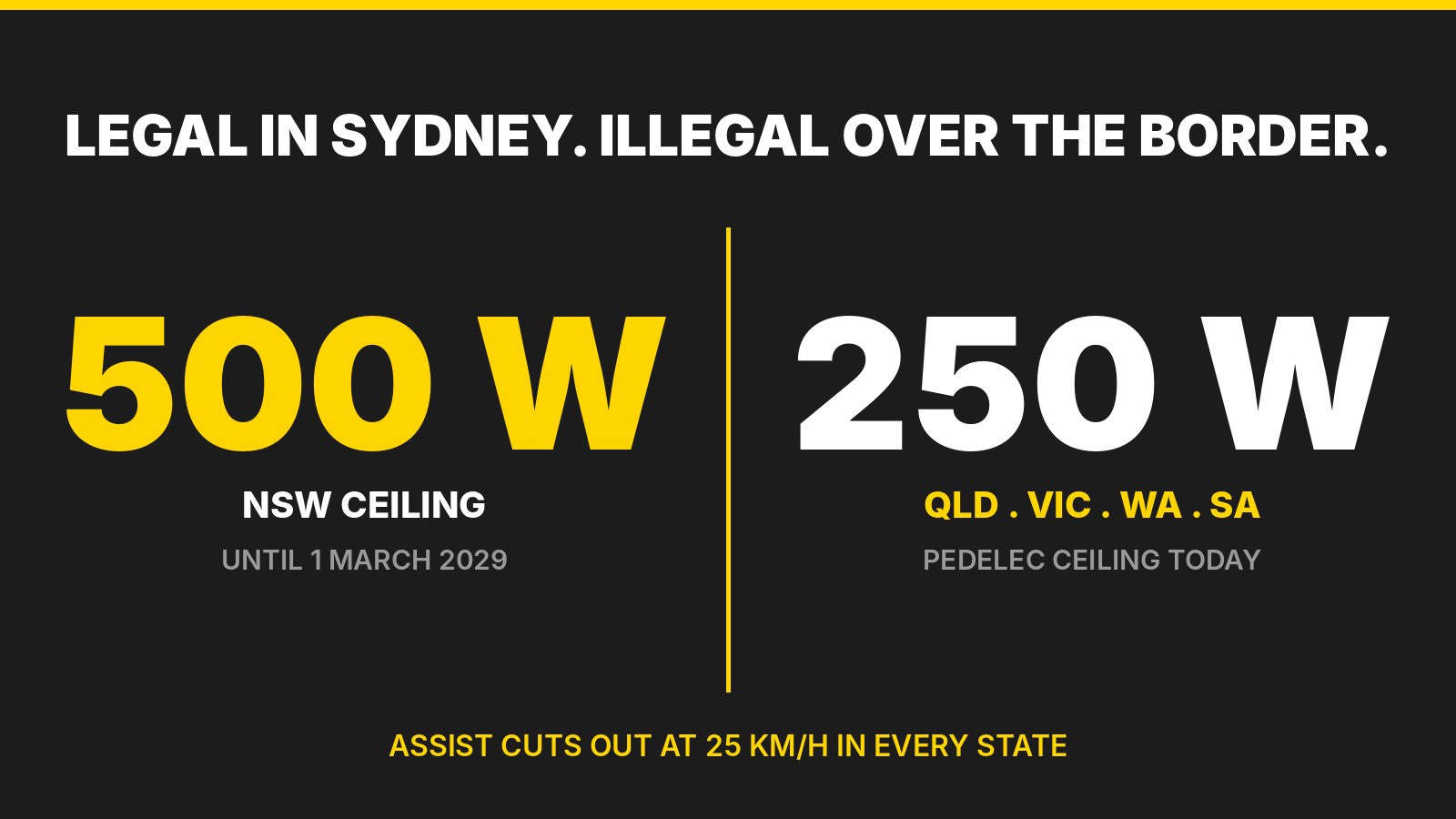
Because NSW is the outlier. Transport for NSW permits a maximum continuous rated power of 500 W, with assistance stopping at 25 km/h and throttle-only operation cutting out at 6 km/h. Ride that same 500 W bike into Queensland, Victoria, WA or SA and it is over the line on day one, because all four define a legal pedal-assist bike at 250 W.
This is not theoretical. Riders take bikes on holidays, students move interstate, retailers ship nationally. Someone who buys a compliant 500 W bike in Sydney this weekend owns something already illegal in four states — and that NSW itself will outlaw, because from 1 March 2029 only EN 15194-certified bikes will be allowed on NSW roads, at 250 W. Transport for NSW is blunt that software or app limiting does not rescue an over-limit bike.
Footpaths invert the map entirely. Perth: allowed unless signed otherwise. Brisbane: allowed at up to 12 km/h. Sydney: banned once you turn 16. Melbourne: banned once you turn 13. The safest place to ride a slow bike changes by jurisdiction, not by risk.
Why does Queensland now want a driver licence for a bicycle?
Queensland has moved hardest. From 1 July 2026 parents and guardians can be fined for letting a child ride an illegal device, and police can seize, impound and destroy non-compliant bikes. From 31 August 2026 riders must be 16 and hold a valid driver licence — a learner permit at minimum — with exemptions for supervised under-16s, certain recreational areas, and medical or disability reasons.
Set the safety intent aside and look at what the mechanism does. It makes the cheapest, lightest, cleanest vehicle on the road conditional on holding a licence for the heaviest, most expensive and most polluting one. A 15-year-old can be driven to school in a two-tonne SUV every day of the year, but cannot ride a 25 km/h bicycle there alone. That is not a safety hierarchy; it is a car-first hierarchy wearing a safety uniform.
That hierarchy has a price. The Australian Automobile Association’s Transport Affordability Index put a typical Sydney household’s transport bill at $567.03 a week in the December quarter of 2025 against a national average of $452.99 — $215.29 of it car loan repayments, $94.93 fuel. Every gram of regulatory friction on the 25 km/h option pushes a household back toward the $567 one.
Who broke the national standard, and can it be fixed?
The patchwork is not an accident of geography — it is what happens when you remove the thing holding it together. According to advocacy group We Ride Australia, the federal government adopted EN 15194 in 2012 as the benchmark an e-bike had to meet to be imported and sold, and by 2017 every state and territory had written it into law, NSW last. In 2021 pedelecs and EN 15194 were dropped from the federal definition, replaced by a broader “electrically power-assisted cycle” definition, and pedelecs left the road vehicle definition — leaving the conformity declaration process effectively voluntary.
Pull out the shared standard and each state writes its own. That is exactly what followed: parliamentary inquiries in Queensland, NSW and WA, separate enforcement operations, and transport ministers in three states writing to the federal government about imports. Speaking to ABC News in January 2026, Bicycle Industries Australia’s Peter Bourke put it plainly: every state has reacted differently.
The fix is not clever. Restore one national technical standard — EN 15194, which NSW and Queensland are both already pointing at — control what gets imported, and let the states spend their enforcement energy on the things that actually change crash outcomes: speed limits, separated infrastructure and road design. Our full breakdown of e-bike laws in NSW and Australia tracks where each rule currently sits.
So what should you actually buy in 2026?
Buy the bike that is legal everywhere, not the one that is legal here. In practice that means a pedal-assist bike with a 250 W maximum continuous rated motor, assistance stopping at 25 km/h, throttle limited to 6 km/h, and EN 15194 certification where you can get it. That specification is legal in all five states in the table above and survives the NSW 2029 change without becoming scrap.
It is also not a compromise. Our own Centauro runs a 250 W rear hub motor on a 48V 25Ah (1200 Wh) Samsung battery, quoted at up to 120 km at 25 km/h on flat road with a 75 kg rider, with a UL 2271 battery, UL 2849 system certification and an ISO 4210 frame, at $4,249 online. Power was never what held riders back — road space was.
And where the infrastructure arrives, people ride regardless of the rulebook. The Oxford Street cycleway counter in Sydney passed one million bike trips in under twelve months, averaging around 3,000 riders a day with a 24-hour record of 4,840. Build the lane and the demand is already standing there. If you are weighing it up, our guide to going car-free in Sydney on an e-bike works through the maths.
Frequently asked questions
Is a 500W e-bike legal in Australia?
Only in New South Wales. Transport for NSW currently allows a maximum continuous rated power of 500 W, dropping to 250 W with mandatory EN 15194 certification from 1 March 2029. Queensland, Victoria, Western Australia and South Australia all cap pedal-assist e-bikes at 250 W, so a 500 W bike is not a legal bicycle in those states.
Do you need a licence to ride an e-bike in Australia?
In most states, no. Queensland is the exception: from 31 August 2026 riders must be at least 16 and hold a valid driver licence, with a learner permit as the minimum, subject to exemptions for supervised under-16s, some recreational areas, and medical or disability reasons. New South Wales, Victoria and South Australia require no licence.
Can you ride an e-bike on the footpath in Australia?
It depends entirely on the state. Western Australia allows footpath riding unless a sign says otherwise, and Queensland allows it at a maximum of 12 km/h. New South Wales bans it from age 16 unless you are supervising a child under 16, and Victoria bans it from age 13 unless you are accompanying someone under 13. A helmet is required in every state and territory.
Swap one car trip a week for an e-bike ride and see what changes. We are at Cyberbikes, 281 Parramatta Road, Leichhardt, and we will tell you honestly what is legal where you actually ride.
#EbikeRules #EbikeLawsAustralia #EbikeSydney #Leichhardt #Cyberbikes #Micromobility #BikeInfrastructure #CarFreeSydney #EN15194