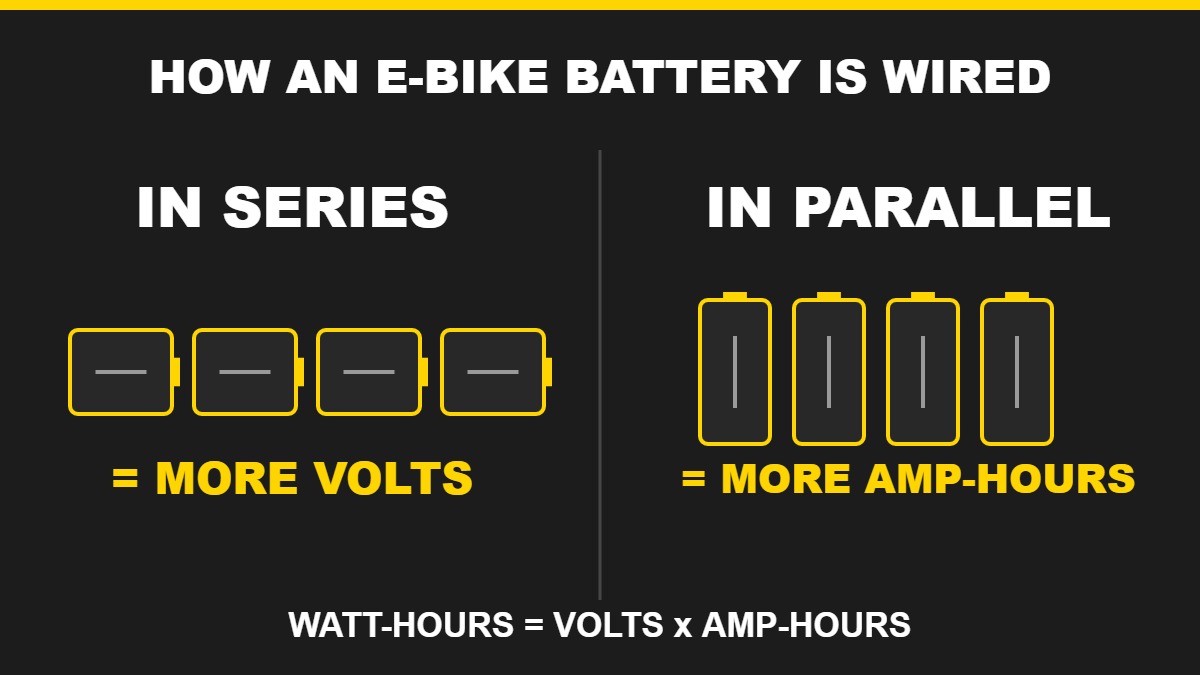
Cells wired in series add voltage; cells wired in parallel add amp-hours. Every e-bike battery you have ever ridden is some combination of the two, and the number on the sticker is just the result: a 48V 25Ah pack like the one on the Cyberbikes Centauro stores 48 × 25 = 1,200 watt-hours, because watt-hours are volts multiplied by amp-hours. Series sets how hard the pack can push. Parallel sets how long it can keep pushing. Get the balance wrong and you get a bike that either feels gutless on Norton Street or dies before you reach the Anzac Bridge.
Here is what each one actually does, why two “48V” packs can behave nothing alike, and how to read the numbers before you hand over money.
What do series and parallel actually do inside the pack?
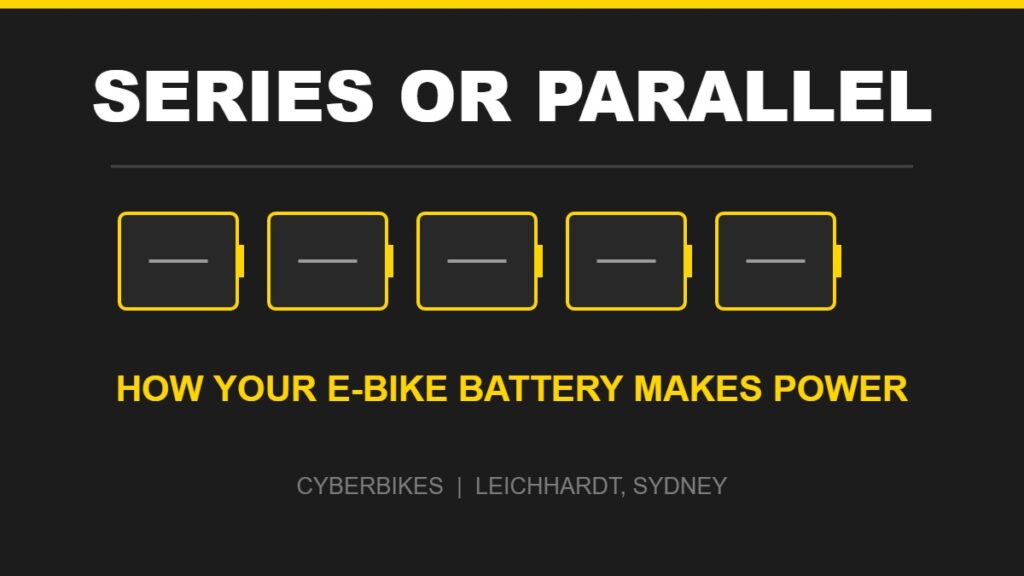
A single lithium cell is a small, fixed thing. Grin Technologies at ebikes.ca puts a lithium cell’s nominal voltage at roughly 3.7V, and notes that a nominal 36V pack is built from ten lithium cells in series. Run that arithmetic forward and a nominal 48V pack lands at thirteen cells in series — which is why the industry settled on pack voltages in rough 12V steps: 24V, 36V, 48V and occasionally 72V.
- In series (cells end to end): voltage adds up, amp-hours stay the same. Thirteen 3.7V cells of 5Ah each give you about 48V and 5Ah.
- In parallel (cells side by side): amp-hours add up, voltage stays the same. Five of those 48V strings wired in parallel give you 48V and 25Ah.
- Either way, the energy is the same sum: watt-hours = volts × amp-hours. Grin’s own example is blunt about it — a 24V 8Ah pack and a 48V 4Ah pack both hold 192Wh.
That last point is the one most riders miss. Volts and amp-hours are two ways of slicing the same loaf. A shop quoting you “52V!” without the amp-hours is quoting you half a number.
Why does 48V × 25Ah come out at 1,200Wh — and what is that worth in Sydney?
Watt-hours are the only honest measure of how much energy a pack holds, and they are the number that converts into kilometres. The Centauro’s product page lists a 48V 25Ah (1200Wh) Samsung lithium-ion pack with a UL 2271-certified battery. Multiply it out yourself: 48 × 25 = 1,200Wh.
To turn that into distance you need watt-hours per kilometre. Grin’s figures put minimal assist at 6–8Wh/km, typical assist at 9–12Wh/km, and power-hungry riding at 14–20Wh/km. Run the three bands against 1,200Wh:
| Riding style | Energy use | Range from 1,200Wh |
|---|---|---|
| Light assist, flat, steady | 6–8 Wh/km | 150–200 km |
| Typical commuting assist | 9–12 Wh/km | 100–133 km |
| High assist, hills, cargo, headwind | 14–20 Wh/km | 60–86 km |
Cyberbikes quotes the Centauro at up to 120 km at 25 km/h, measured on a flat road with a 75 kg rider and no headwind — which sits right in that middle band, around 10Wh/km. That is the honest way to read a range claim: not as a promise, but as a watt-hour figure divided by an assumed effort level. Leichhardt to the Sydney CBD is roughly 7 km each way. Even at the pessimistic 20Wh/km end, you are looking at a working week of commuting between charges.
Does more parallel mean more power, or only more range?
Both — and this is where the series-versus-parallel question stops being trivia. Parallel strings do not just store more energy, they share the current between more cells, and current is what makes heat.
The shorthand is C-rate. Grin defines 1C as the pack’s amp-hour rating expressed in amps: for an 8Ah pack, 1C is 8A and 2C is 16A. A 25Ah pack at 1C is therefore 25A. A 250W motor running on 48V pulls roughly 5.2A — about 0.2C. The pack is barely breathing.
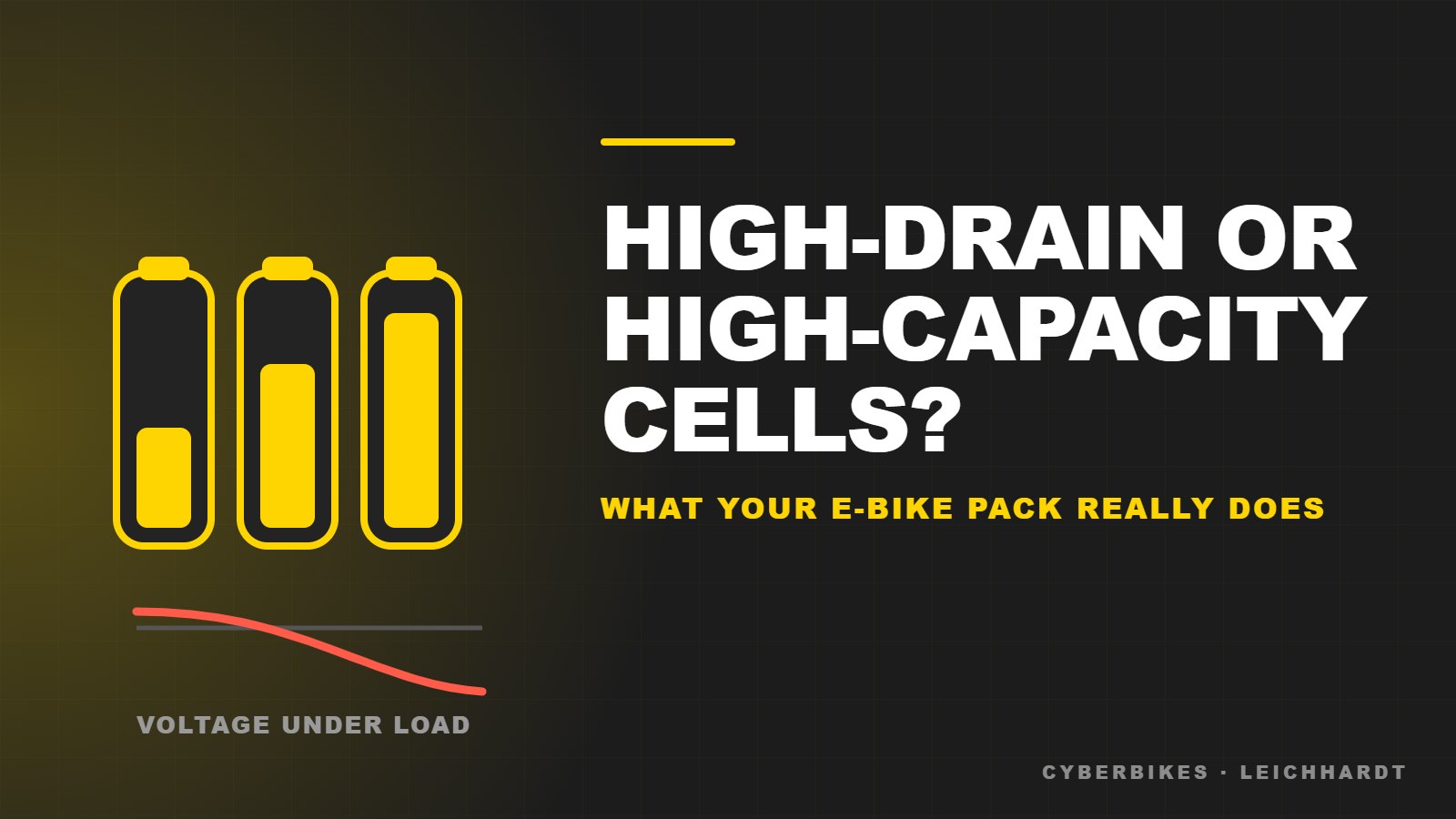
Now take Grin’s counter-example: a 4Ah pack rated at 1C continuous can only supply 4A, while an e-bike may draw 10–20A. The result is voltage sag and a shorter cycle life. Same chemistry, same brand of cell — but too few cells in parallel, so each one is flogged.
Heat makes the point mathematically. Copper losses scale with the square of current (the I²R term), and as the ebikes.ca power-ratings page states, doubling the current quadruples the heat. Spread the same 10A across five parallel strings instead of two and each cell carries less than half the current — and generates less than a quarter of the heat it otherwise would. Cooler cells last longer. That is the whole argument for a wide pack.
One honesty note: Cyberbikes publishes the Centauro’s pack as 48V 25Ah (1200Wh) Samsung cells with UL 2271 certification, but does not publish the internal series-parallel layout. We are not going to invent one. If the exact configuration matters to you, ask us at the Leichhardt workshop and we will tell you what is in front of us.
Why do two 48V packs of the same size feel completely different?
Because voltage and amp-hours describe the energy, not the delivery. Three things decide how a pack feels under your right hand:
- How hard the cells sag. Under load, pack voltage dips. A pack with too few parallel strings dips further, the display reads a lower state of charge than the cells actually hold, and the bike feels flat long before it is empty.
- What the controller is allowed to draw. Grin’s power-ratings page is explicit that peak power is set mainly by the controller’s current limit and the battery, not the motor. Their worked examples: the same motor on 36V at 20A peaks near 600W, at 40A near 1,058W, and on 52V at 20A near 840W. Three very different bikes, one motor.
- How long the heat has to build. Grin notes a motor can take one to two hours to reach thermal equilibrium, while a typical hill climb lasts five to ten minutes. Sydney’s short, sharp climbs rarely cook a well-matched system — sustained cargo hauling on high assist is the one that will.
Certification is the fourth filter, and it is the cheapest one to check. The Centauro lists a UL 2271-certified battery, UL 2849 for the e-bike system and an ISO 4210-compliant 6061 aluminium frame. Those are the marks that tell you a pack was tested as a pack, not assembled from whatever cells were cheap that month. Our complete guide to e-bike batteries goes deeper on what each standard covers, and if you are weighing a bigger pack against a more efficient bike, we compared those two paths in bigger battery or better efficiency.
Does a bigger battery make an e-bike illegal in NSW?
No. This is the single most common misunderstanding we hear at 281 Parramatta Road, so let us be precise about it: NSW regulates the motor, not the battery. Watt-hours, voltage and amp-hours are not capped.
Read live from Transport for NSW, the current rules are a 500W maximum continuous rated power, dropping to 250W from 1 March 2029 alongside a mandatory EN 15194 requirement; pedal assistance must cut out completely at 25 km/h; and a throttle-only function must cut out at 6 km/h. Transport for NSW also states plainly that software, app or switch restrictions do not make an over-limit bike legal, and that since 21 August 2026 police and authorised officers have expanded seizure powers over illegal e-bikes.
So a 1,200Wh pack is entirely road-legal. A 1,500W motor is not, no matter what the display says. The Centauro is built to those limits: 250W continuous, 25 km/h pedal assist, 6 km/h throttle.
See the battery check on the bike
If your pack is sagging early, the quickest check is the one in that clip — and it takes about two minutes on the bench.
Frequently Asked Questions
Does wiring cells in series give an e-bike more power?
Series raises voltage, and at the same controller current a higher voltage does produce more power, because watts equal volts times amps. Grin Technologies’ worked example shows one motor peaking near 600W on 36V at 20A and near 840W on 52V at the same 20A. But the controller’s current limit and the pack’s ability to supply that current decide the real figure, not the cell count alone.
How many kilometres should a 1,200Wh e-bike battery give?
Divide watt-hours by watt-hours per kilometre. Using Grin Technologies’ published bands, 1,200Wh gives roughly 150–200 km on minimal assist at 6–8Wh/km, 100–133 km on typical assist at 9–12Wh/km, and 60–86 km on high assist, hills or cargo at 14–20Wh/km. Cyberbikes quotes the Centauro at up to 120 km at 25 km/h on a flat road with a 75 kg rider and no headwind.
Is a bigger e-bike battery legal in NSW?
Yes. Transport for NSW regulates motor power and assistance speed, not battery capacity. The current limits are 500W maximum continuous rated power, reducing to 250W plus mandatory EN 15194 certification from 1 March 2029, with pedal assistance cutting out at 25 km/h and throttle-only operation cutting out at 6 km/h. A 1,200Wh battery breaks none of those limits.
Ride one before you believe the numbers
Specifications are arithmetic. Hills are not. The fastest way to find out whether 1,200Wh behaves the way this article says it should is to take a 2026 Cyberbikes Centauro up a real Sydney climb with your own weight on it. Test rides are free at 281 Parramatta Road, Leichhardt — book online or call 0491 794 668, Tuesday to Saturday. If you would rather not pay for it all at once, our rent-to-own plan starts from $99.99 per week, and you can browse the full range at cyberbikes.com.
Bring your current pack in too. If it sags under load, we will tell you whether it is the cells, the connections or the controller — before you spend money on the wrong one.
#ebikesydney #ebikebattery #CyberbikesLeichhardt #Centauro #watthours #electricbikeaustralia #renttoown #NSWebikelaw