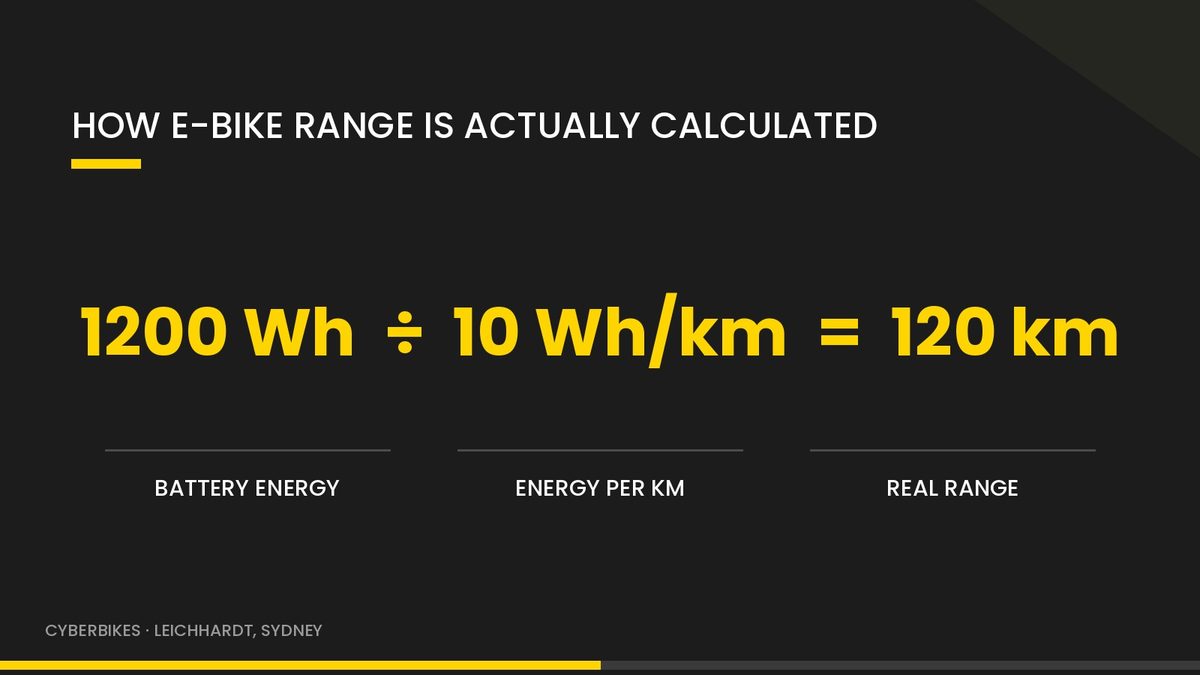
Your e-bike range is one sum: the energy in the battery divided by the energy each kilometre costs you. A 1,200 Wh pack ridden at 10 watt-hours per kilometre returns about 120 km. The same pack ridden at 20 Wh/km returns 60 km. So there are only ever two levers — carry more watt-hours, or spend fewer of them per kilometre. Buying capacity costs money and kilograms. Spending less per kilometre costs nothing, and for most Sydney riding it is the bigger win.
Here is the arithmetic, what moves it, and how to measure your own number on the ride home — using the engineering documented by Grin Technologies at ebikes.ca.
What actually sets your e-bike range?
Two numbers, multiplied and divided. First, the energy on board: watt-hours equals volts times amp-hours. Grin states it plainly — “a 24V 8Ah battery can deliver 192 watt-hours”. Scale that up and a 48V 25Ah pack holds 1,200 Wh. That is the fuel tank, and it is the only honest way to compare two batteries, because volts alone and amp-hours alone each tell you half the story.
Second, consumption: watt-hours per kilometre. This is the number nobody prints on the box. Grin’s own guidance for sizing a pack is a useful anchor — for a 40–50 km commute they recommend “on the order of 400 watt-hours”, which works out at roughly 8–10 Wh/km for steady, sensible riding. Divide tank by consumption and you have your real range.
That is exactly how a manufacturer’s claim is built. The 2026 Cyberbikes Centauro carries a 48V 25Ah Samsung pack — 1,200 Wh — and is rated up to 120 km. Read the conditions printed beside that figure: 25 km/h, flat road, 75 kg rider, no headwind. That is 10 Wh/km. The claim is not a fib; it is a sum with its inputs stated. Change the inputs and the answer changes.
For the full chemistry-and-cells picture behind the tank half of that equation, see our definitive guide to e-bike batteries.
Does a bigger battery always mean more range?
It means more range, but never for free — and the price is paid in kilograms. Grin puts lithium-ion energy density at “~110 whrs/kg”, with lithium-polymer reaching “up to 160 whrs / kg”. At around 110 Wh/kg, 1,200 Wh of cells is roughly 11 kg before you add the case, the BMS, the mounting hardware and the wiring.
So doubling a 1,200 Wh pack to 2,400 Wh adds something like 11 kg of cells to a bike that already weighs 37 kg with its battery fitted. You would be hauling that extra mass up every hill, through every set of lights, and lifting it onto every rack — to buy range you may use twice a year. Meanwhile the extra weight slightly raises the Wh/km of every single ride, so the second half of the pack is a little less useful than the first.
There is a legal ceiling worth knowing too. A bigger battery is fine; a bigger motor is where you can fall out of the law. More on that below.
What pushes your watt-hours per kilometre up?
Four things do most of the damage, and all four are at least partly in your hands.
Why does speed cost so much range?
Because air resistance climbs with the square of your speed, so the power needed to push through it climbs roughly with the cube. Grin’s power-ratings page shows the same relationship from the motor’s side: a given continuous rating scales with road speed, so a “500 W rating at 20 mph would be about 750 W at 30 mph and 250 W at 10 mph”. Sitting on 32 km/h instead of 25 km/h does not cost you a little range. It costs a lot.
Why do hills cost energy and not just time?
Lifting mass takes energy you cannot get back, and climbing is where a hub motor is least efficient. Grin notes that at constant input power, efficiency falls as the motor slows — so the slow grind up a steep pinch converts a larger slice of your watt-hours into heat rather than forward motion. The physics of that heat is unforgiving: it comes from winding current, and because heating follows I²R, doubling the current quadruples the heat. Grin is blunt about the cause, saying it is “the output torque of the motor which causes it to heat up and eventually fail”, not output power.
Do stop-start traffic and tyres really matter?
Yes. Every launch from a standstill on Parramatta Road accelerates 37 kg of bike plus you, and every brake application throws that energy away as heat. Soft tyres add rolling resistance on top. Correct pressure in the Centauro’s 26 x 2.4 tyres, carrying only what you need, and reading the lights so you roll rather than stop are the cheapest range upgrades available — and nobody sells them.
Does assist level change the number?
Directly. Assist level sets how much of the total power comes from the pack rather than your legs, so easing off a notch drops your Wh/km immediately. It is why two riders on identical bikes over the same route can report range figures 40% apart and both be telling the truth.
Capacity or efficiency: which should you actually buy?
| Lever | What it changes | Cost to you | Best for |
|---|---|---|---|
| More watt-hours | Raises the top of the sum | Money, roughly 1 kg per 110 Wh, charge time | Long rural rides, heavy cargo, hilly daily routes |
| Lower Wh/km | Lowers the bottom of the sum | Nothing — technique, pressure, assist level, load | Almost every urban commute |
| Second battery | Doubles the sum on demand | Money, but carried only when needed | Occasional big days without a permanent weight penalty |
For an Inner West commute, efficiency wins almost every time. A rider who drops from 14 Wh/km to 10 Wh/km on a 1,200 Wh pack gains about 34 km of range and spends nothing. Buying that same 34 km in cells would mean roughly 400 Wh more battery — around 4 kg of extra cells, plus the cost. The exception is real: if your route is genuinely long or genuinely steep, or you carry 50 kg on the rack, capacity is the honest answer and no amount of technique replaces it.
How do you measure your own watt-hours per kilometre?
You do not need a lab. You need one full charge and a trip meter.
- Charge to full and zero the trip meter.
- Ride your actual commute — your normal route, normal speed, normal load — until the pack is near empty.
- Divide. Pack watt-hours ÷ kilometres travelled = your real Wh/km. On a 1,200 Wh pack that dies at 75 km, you are spending 16 Wh/km.
- Repeat once in winter. Cold cells and headwinds move the number, and the honest figure is the worst one, not the best.
If your display shows watt-hours consumed directly, read it straight off at the end of a ride and skip the arithmetic. And treat a sagging voltage reading as information, not failure — a lithium cell runs from about 4.2 V down to 2.9 V across its discharge, per Grin’s figures, so a pack that looks “half empty” by voltage is often not half empty by energy.
What do the NSW rules mean for a bigger set-up?
Battery size is not what the law limits — motor power and assisted speed are. Reading Transport for NSW’s e-bike page live today: the maximum continuous rated power is 500 W, the motor must not provide power above 25 km/h, and a throttle-only function must cut out at 6 km/h. From 1 March 2029, NSW moves to 250 W and “only EN 15194 certified e-bikes will be allowed on NSW roads”.
That last date matters if you are buying now and keeping the bike. The Centauro’s 250 W rear hub motor is rated 250 W continuous and its assist cuts at 25 km/h with the throttle limited to 6 km/h, inside today’s NSW limits. A machine that clears the limit only because software holds it back is still illegal; the rating is what counts. Our complete guide to e-bike laws in NSW has the detail.
Worth noting: that Centauro pack is certified to UL 2271, its electrical system to UL 2849 and the frame to ISO 4210, and it charges in about five hours from empty — the other number a bigger battery quietly increases.
See it on a real Sydney commute
Arithmetic is one thing; a CBD run in traffic is another. Here is the Centauro doing the trip this post is really about.
The short version for everyday riders
Work out your Wh/km before you spend a dollar on capacity. Most riders find their commute costs 9–12 Wh/km and that a 1,200 Wh pack was always plenty — the range they thought they lacked was being burned at 32 km/h into a headwind on soft tyres. Fix the free things first, then buy watt-hours with your eyes open about the kilograms.
Want the number for your own route? Bring your bike to Cyberbikes at 281 Parramatta Road, Leichhardt and we will put a real Wh/km figure on your commute instead of a brochure estimate — then tell you honestly whether you need a bigger battery or just better habits. Book a test ride on the Centauro, call 0491 794 668, or browse the range at cyberbikes.com, where rent-to-own plans start from $99/week. Two ways to buy: the online price is bike-in-box, unassembled; bike-out-of-box, assembled and safety-checked in store, is $150 more.
Frequently Asked Questions
How do you calculate e-bike range from watt-hours?
Divide the battery’s watt-hours by your watt-hours per kilometre. Watt-hours equal volts times amp-hours, so a 48V 25Ah pack holds 1,200 Wh. At 10 Wh/km that is about 120 km; at 20 Wh/km it is about 60 km. Grin Technologies recommends around 400 Wh for a 40–50 km commute, which is roughly 8–10 Wh/km.
Does a bigger e-bike battery make the bike heavier?
Yes. Grin Technologies puts lithium-ion energy density at about 110 Wh/kg, so every extra 110 Wh of cells adds roughly a kilogram before the casing, BMS and wiring. Doubling a 1,200 Wh pack adds around 11 kg of cells, which you then carry up every hill and which slightly raises consumption on every ride.
What is the legal motor power limit for an e-bike in NSW?
Transport for NSW sets a maximum continuous rated power of 500 W, with motor assistance stopping at 25 km/h and any throttle-only function cutting out at 6 km/h. From 1 March 2029 the limit becomes 250 W and only EN 15194 certified e-bikes will be allowed on NSW roads. Battery capacity itself is not capped.
#CyberbikesLeichhardt #EbikeSydney #EbikeRange #WattHours #CentauroEbike #ElectricBikeSydney #InnerWest #RentToOwn