No — they are not the same company, and they are not the same bike. But strip the badges off a Mamba, a CRUZR, a ToLand, a Flight Risk, a FatFish and an Ampd Bros and you find the same fat-tyre platform underneath: a 20-inch fat tyre, a Bafang rear hub motor, Samsung or LG cells, four-piston hydraulic brakes and a 180 kg payload. What actually separates them is not the logo on the down tube. It is how much power the motor is rated for, whether the bike is legal to ride on a NSW road, and who fixes it when something breaks.
That matters more in September 2026 than it ever has, because NSW changed the legal definition of an e-bike in March 2026 — and some of the most expensive bikes on this list cannot legally be ridden on a road, a bike path or a shared path at all.
Are Mamba, CRUZR, ToLand and Flight Risk the same e-bike?
They are not the same e-bike, but most of them are built on the same reference platform. Australian fat-tyre e-bike brands overwhelmingly source from the same pool of Chinese contract manufacturers, then specify their own frame paint, badge, display and support arrangements on top.
You can see the shared DNA in the parts list. Read the published specifications for the CRUZR Stoke AF, the Flight Risk FR777, the ToLand Huntsman, the Ampd Bros ACE-X Demon S5 and the FatFish OG 2.0 side by side and the same components keep reappearing:
- 20-inch fat tyres — Vee Rubber on the CRUZR and the Flight Risk, CST on the ToLand and the Mamba Sahara, Kenda on the Ampd Bros.
- Bafang rear hub motors — named explicitly by CRUZR, Flight Risk, ToLand and Ampd Bros.
- Samsung or LG 21700 lithium cells, in 48 V to 60 V packs of 17 Ah to 25 Ah.
- Four-piston or six-piston hydraulic disc brakes on 180 mm to 203 mm rotors — Tektro on most of them.
- A 180 kg maximum payload — the identical figure quoted by CRUZR, Flight Risk, ToLand and Ampd Bros.
- 6061 aluminium alloy frames in the same step-over and step-through shapes.
A 180 kg payload figure repeated to the kilogram across four competing brands is not a coincidence. It is the same engineering document. That does not make the brands dishonest — badge engineering is normal in cars, appliances and bikes alike — but it does mean the brand name on the frame tells you very little about the machine.
Why does the same 250 W bike cost $2,499 or $5,188?
Because you are paying for the badge, the retail margin and the support arrangement, not for more motor. The clearest example in the Australian market right now: the FatFish OG 2.0 and the Flight Risk FR777 both leave the warehouse with a 250 W rated motor, yet the FR777 costs $5,188 AUD against the OG 2.0’s $2,499 AUD — more than double, for the same legal power output on a closely related chassis.
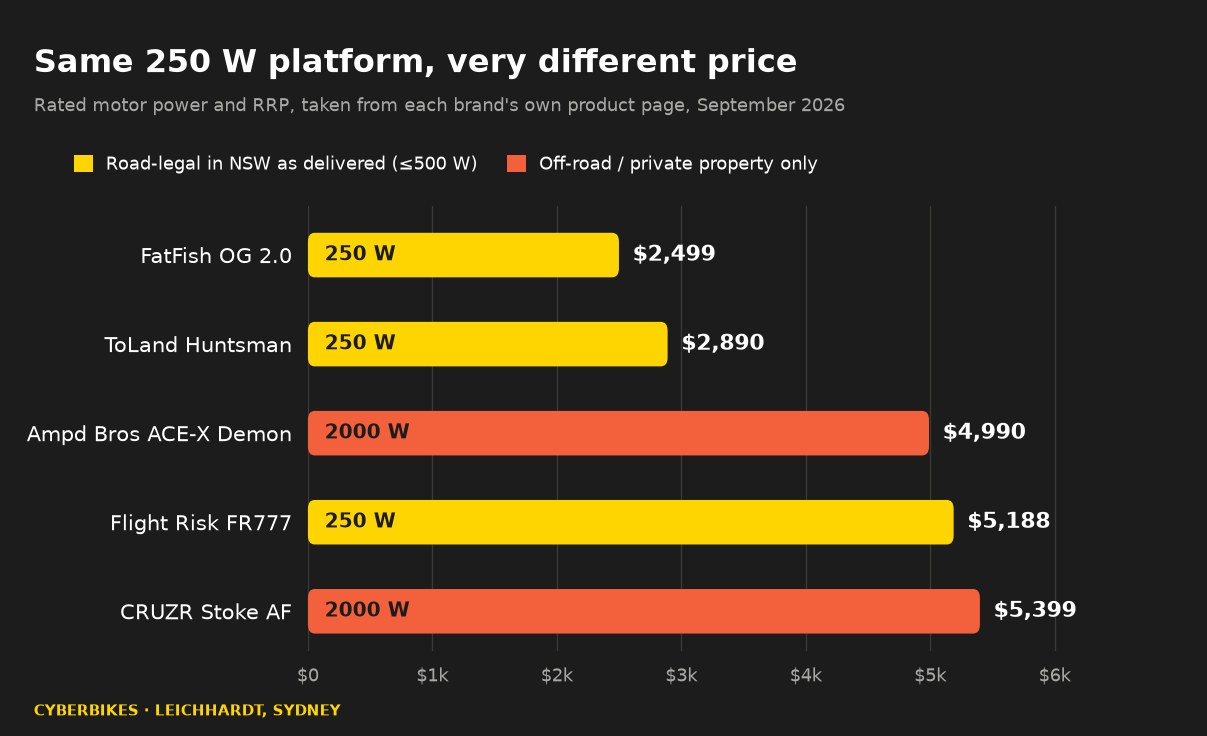
Some of that gap is real: the FR777 carries a bigger 52 V 25 Ah Samsung pack (roughly 1,300 Wh), twin-battery capability, GPS tracking and a dealer network with demo bikes. Some of it is simply what the market will bear. The point is that the price tag is not a proxy for capability, and the wattage headline is not a proxy for quality. If you want the full framework for reading past both, our 5-step guide to choosing an e-bike in Sydney walks through it properly.
Which of these e-bikes are actually legal to ride in NSW?
Under the current NSW rules, a legal e-bike has a maximum continuous rated power of 500 W, motor assistance that cuts out at 25 km/h, and throttle-only power that cuts out at 6 km/h. From 1 March 2029 that cap drops to 250 W and EN 15194 certification becomes mandatory for use on NSW roads and road-related areas. See Transport for NSW for the current rules.
Measured against that, the six brands split into two very different groups.
| Bike | Rated power | RRP (AUD) | NSW status as delivered |
|---|---|---|---|
| FatFish OG 2.0 | 250 W, 48 V | $2,499 | Within the 500 W cap; standard version not EN 15194 certified |
| ToLand Huntsman | 250 W nominal, 52 V | $2,890 | Within the 500 W cap |
| Mamba Sahara (2026) | 250 W, 48 V | — | Within the 500 W cap |
| Flight Risk FR777 | 250 W locked (500 W optional), 52 V | $5,188 | Within the cap as delivered; “Non-EN Certified” |
| Ampd Bros ACE-X Demon S5 | 2 × 1000 W, 52 V | $4,990 | Off-road / private property only |
| CRUZR Stoke AF | 2000 W rated (4120 W peak), 60 V | $5,399 | Not an EPAC — not for roads, bike paths or shared paths |
Read that last row carefully, because CRUZR says it themselves. The Stoke AF product page states the bike “does not meet the definition of an electrically power-assisted bicycle (EPAC)” and “is not supplied for use on public roads, bicycle paths, or shared pathways”. It is a 49 kg machine with a 140 Nm Bafang motor and an 85 km/h top speed. That is not a bicycle in any legal sense in NSW — it is a motorcycle without registration, and riding one on a shared path is both illegal and genuinely dangerous to the people around you.
The Ampd Bros ACE-X Demon S5 is equally explicit: its dual 1000 W motors are labelled “Off Road Only” and the model sits in an “Off-Road Series” marked for private property use. Both brands are being upfront. The problem is what happens after the sale, when a $5,000 bike that legally cannot leave private property is ridden down a bike path anyway.
There is a second trap in the 2029 deadline. A non-certified bike bought today is fine until 1 March 2029, then becomes unusable on NSW roads and paths. On a bike you expect to keep for five years, that is a real cost. Our complete guide to NSW e-bike law covers the transition in detail.
What makes the Cyberbikes Centauro different?
The Centauro is built to be legal, certified and useful for the next decade rather than to win a wattage argument. It runs a 250 W rear hub motor — already under both the current 500 W NSW cap and the 250 W cap that arrives in 2029 — and pairs it with a 48 V 25 Ah (1,200 Wh) Samsung battery, the largest pack in this entire comparison. That is the combination most of the market gets backwards: they chase watts and cut range. Watts set how hard the bike pushes; watt-hours set how far it goes, and only one of those is capped by law.
Three things on the 2026 Cyberbikes Centauro spec sheet do not appear on any of the six bikes above:
- A UL 2271-certified battery. Battery fires, not motor power, are the real safety story in Australian e-bikes. UL 2271 is an independently tested standard for the cell pack.
- An ISO 4210 MTB-compliant 6061 aluminium frame. A published structural standard for the frame itself, not a marketing adjective.
- Integrated GPS tracking via Cybertrackers, built in rather than bolted on.
The rest is ordinary good engineering: a step-through full-suspension frame with 100 mm of front travel and 120 mm of rear travel, four-piston hydraulic brakes on 180 mm × 2.3 mm rotors, 26 × 2.4 e-bike-rated tyres, walk-assist, a dual-leg kickstand, and an 18-month limited warranty. The rear cargo rack is welded to the frame and rated to 50 kg, with an optional 15 kg front basket — which is what turns it from a bike into a car replacement for the school run and the shopping.
Where the Centauro loses: its 150 kg maximum rider-and-cargo load is below the 180 kg quoted by the fat-tyre crowd, its 26 × 2.4 tyres are narrower than a 20 × 4.5 fat tyre on soft sand, and at 250 W it will not out-accelerate a 2000 W machine. If you want a bike that does 85 km/h on private land, buy the CRUZR — honestly. If you want one bike that is legal in 2026 and still legal in 2030, carries the groceries, and has a certified battery you can park inside your home, that is a different bike.
How should you actually choose between these brands?
Ignore the badge and ask four questions in this order. First, what is the continuous rated power, and is it under 500 W today and 250 W after March 2029? Second, is the battery independently certified to UL 2271 or equivalent, and is the bike EN 15194 certified? Third, who services it — is there a workshop you can ride to, holding spares for that exact frame? Fourth, what is the watt-hour figure, because that, not the motor wattage, determines whether you make it home.
Those four answers will separate six near-identical fat-tyre bikes far better than any brand name. And the third one is the one riders regret ignoring: a badge-engineered bike from a brand with no local workshop is a bike with no parts supply the day a proprietary controller fails.
At Cyberbikes we stock the 250 W Mamba range alongside our own Centauro, and we will happily tell you when a Mamba Sahara is the right bike for you instead of a Centauro. We service what we sell, from our workshop at 281 Parramatta Road, Leichhardt.
Frequently asked questions
Are Mamba, CRUZR, ToLand and Flight Risk owned by the same company?
No. They are separate Australian businesses. However, their fat-tyre models share the same underlying manufacturing platform — the same Bafang motors, 20-inch fat tyres, Samsung or LG cells, hydraulic brake sets and an identical 180 kg payload rating — because they source from the same pool of contract manufacturers.
Is the CRUZR Stoke AF 2000W legal to ride in NSW?
No. CRUZR’s own product page states the Stoke AF does not meet the definition of an electrically power-assisted bicycle and is not supplied for use on public roads, bicycle paths or shared pathways. With a 2000 W rated motor and an 85 km/h top speed it is far beyond the NSW 500 W and 25 km/h limits, and is intended for private property only.
What is the maximum legal e-bike power in NSW in 2026?
500 W maximum continuous rated power, with motor assistance cutting out at 25 km/h and throttle-only power cutting out at 6 km/h. From 1 March 2029 the limit drops to 250 W and EN 15194 certification becomes mandatory for NSW roads and road-related areas.
Why is the Cyberbikes Centauro only 250 W?
Because 250 W is the power limit that will still be legal on NSW roads after 1 March 2029, while a 500 W or 2000 W bike will not be. The Centauro puts its investment into a 48 V 25 Ah (1,200 Wh) Samsung battery, a UL 2271-certified pack and an ISO 4210-compliant frame instead — range and certification rather than wattage.
Still deciding between badges? Bring your shortlist into Cyberbikes at 281 Parramatta Road, Leichhardt and we will put the spec sheets side by side with you — or try the Centauro on rent-to-own from $99.99/week and see what a legal, certified e-bike actually does for your week.
#Cyberbikes #EbikeSydney #Leichhardt #EbikeLawNSW #FatTyreEbike #Centauro #ElectricBikeAustralia