No. Australia’s e-bike laws are not the same in every state, and the gap is now wide enough to get you fined. A 500W e-bike that is perfectly legal on a Leichhardt street is not a legal bicycle in Queensland, Victoria, Western Australia or South Australia. And since 31 August 2026, Queensland has gone further than anyone: to ride an e-bike there you must be at least 16 and hold a minimum learner licence.
Same machine. Same rider. Five different rulebooks. Here is exactly where the lines fall in 2026, who gets caught out, and what the patchwork is quietly doing to the cheapest clean vehicle Australia has.
Why isn’t there one e-bike law for all of Australia?
Because road rules are written and enforced state by state. The Australian Road Rules are a model, not a binding national code, so each state and territory adapts them and defines for itself what counts as a bicycle rather than a motor vehicle. That definition is where e-bikes live, and it is the definition that moves when you cross a border.
For most of the last decade that barely mattered, because everyone landed on roughly the same numbers. It matters now. New South Wales went up to 500W. Queensland went down to 250W and added a licence. The other three stayed put. Nobody harmonised anything, and the rider carries the risk.
How far apart are the state e-bike rules right now?
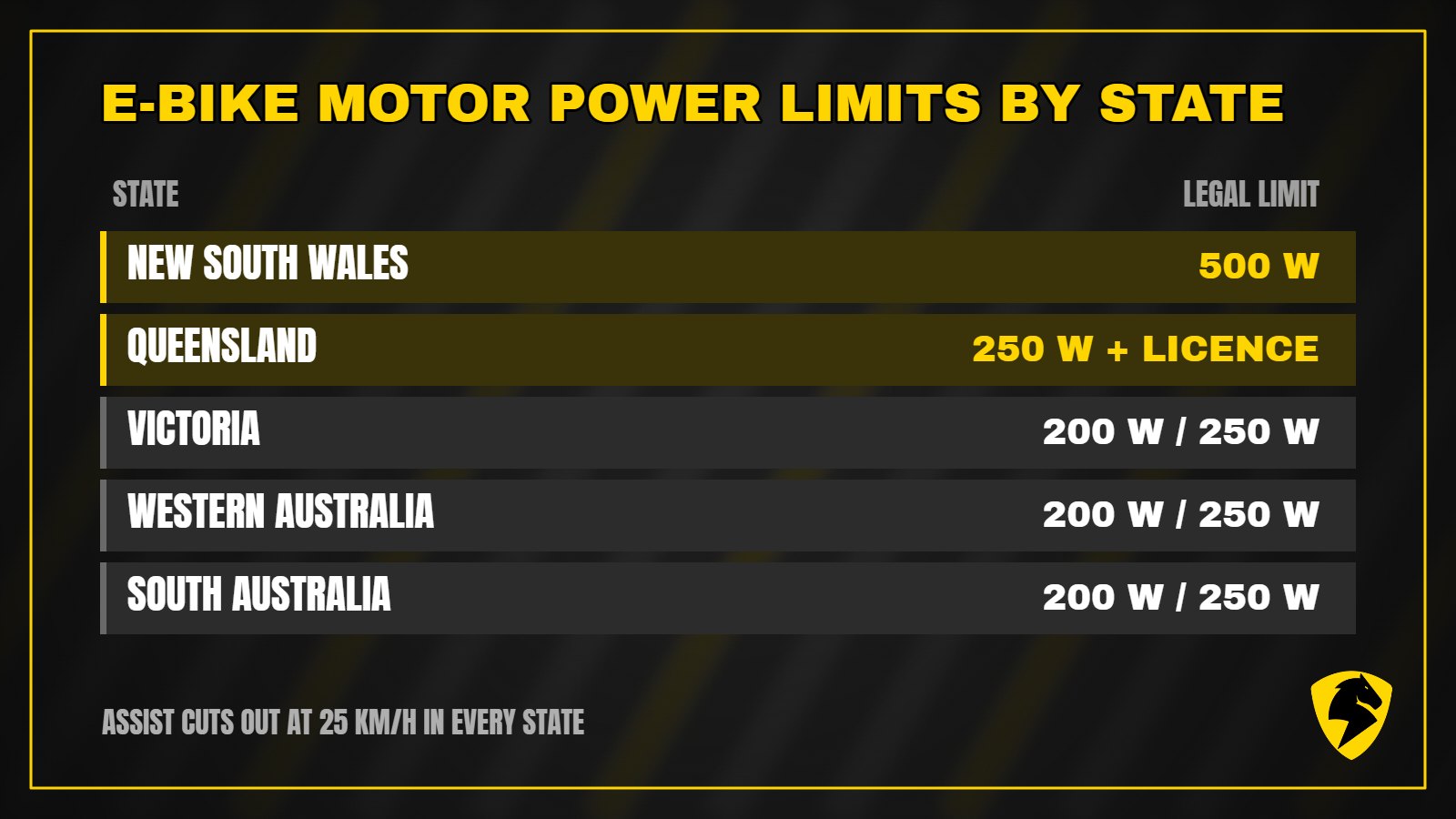
Here is the current picture, taken from each state’s own transport authority. Every state agrees on one thing only: pedal assistance must stop at 25 km/h.
| State | Maximum continuous motor power | Throttle | Licence or age rule |
|---|---|---|---|
| New South Wales | 500W now; 250W plus EN 15194 from 1 March 2029 | Throttle-only must cut out at 6 km/h | None |
| Queensland | 250W, EN 15194 compliant | Throttle only up to 6 km/h, to start moving | 16 and minimum learner licence, from 31 August 2026 |
| Victoria | 200W (PAPC) or 250W (EPAC, EN 15194) | No throttle propulsion except walk mode to 6 km/h | None |
| Western Australia | 200W (PAPC) or 250W (pedalec, EN 15194) | Assistance cuts out at 25 km/h | None for e-bikes; 16 and over for eRideables |
| South Australia | 200W (PAPC) or 250W (EPAC) | Pedalling must be the main means of propulsion | None |
A second trap sits underneath that table. In Western Australia an e-bike is explicitly not an eRideable, and eRideables are the ones capped at 25 kg, limited to 10 km/h on footpaths and restricted to riders 16 and over. In Queensland, e-bikes and e-scooters were swept into the same new rulebook. Two states, two completely different ways of slicing the same footpath. If you want the NSW detail in full, we keep a running guide to e-bike laws in NSW and Australia.
Why does Queensland now want a driver licence to ride a bicycle?
Queensland rolled its changes out in two tranches. From 1 July 2026 police gained power to seize and destroy illegal devices, riders became subject to random breath testing, devices that exceed 25 km/h unassisted were banned outright, and a 12 km/h limit was set for passing pedestrians. From 31 August 2026 the licence requirement landed, along with parental liability and a ban on retailers selling these devices to under-16s.
The penalties are not symbolic. Queensland’s road safety material lists $518 for riding without a helmet, $518 for doubling, $518 for careless riding and $518 for a parent who lets a child ride illegally. Speeding runs from $345 to $1,986. Drink riding starts at $518 and reaches $6,908 at court. Enforcement is already running hard: the state reported almost 400 illegal e-bikes and e-scooters seized and 1,747 infringement notices issued.
Our problem is with the policy, not with anyone enforcing it. The genuine danger on Australian footpaths is the illegal, unregulated 50 km/h device sold as a bicycle, and seizing those is fair enough. But a licence test is a blunt instrument aimed at the wrong target. It does nothing to a non-compliant import, and it takes the legal 250W pedal-assist bicycle away from the people who gain most from it: teenagers, people who have never driven, older riders who gave up a licence, anyone who cannot afford a car. Road safety research points at speed, road design, vehicle standards and enforcement as what changes crash outcomes. A learner permit changes none of those four.
What does the patchwork cost Sydney riders and retailers?
If you live in the Inner West it costs you certainty. You can buy a 500W e-bike on Parramatta Road entirely within NSW law and own a machine that is unlawful the moment you drive it to the Gold Coast for a week. Nothing about the bike changed. The jurisdiction did.
For a retailer it is worse, because it is five compliance stories for one product, and a moving target in NSW as well. The 500W allowance here is temporary: from 1 March 2029 New South Wales drops to 250W and requires EN 15194 certification, which is precisely where the other states already sit. We have written before about why NSW’s new e-bike law doesn’t add up, and the interstate mess is the same failure viewed from a different angle.
The mode-shift cost is the one nobody counts. Every layer of friction added to the cheapest, quietest, lowest-emission vehicle on the street is friction the car never has to carry. Making the bicycle the complicated option is a choice, and it pushes short trips back into traffic Sydney already cannot absorb.
Which e-bike specification is legal in every state today?
There is one specification that travels: a motor rated at 250W maximum continuous power, certified to EN 15194, with pedal assistance that stops at 25 km/h and no throttle propulsion above 6 km/h. That is legal in New South Wales, Queensland, Victoria, Western Australia and South Australia right now, and it stays legal in NSW after 2029. Anything above it is a state-by-state gamble, and NSW is explicit that a bike over the limit is illegal even if an app or a switch restricts it.
That is the brief our own bike is built to. The Cyberbikes Centauro cargo and commuter e-bike product page lists a 250W rear hub motor, a 48V 25Ah (1200Wh) Samsung battery certified to UL 2271, an electrical system to UL 2849, an ISO 4210 compliant 6061 aluminium frame and EN 15194 compliance, with a 150kg rider and cargo limit and 4-piston hydraulic brakes on 180mm rotors. Whatever you ride, wear a helmet: that one is mandatory in every state in Australia.
Where these numbers come from
Every figure above was read directly from the responsible authority: Transport for NSW on e-bikes, the Queensland Government e-bike rules and its StreetSmarts penalty schedule, the Queensland ministerial statement on the new laws, Transport Victoria on electric bikes, the Transport WA riding FAQs and the WA Road Safety Commission on eRideables, and SA.GOV.AU on riding a power-assisted bicycle. Rules change: check your own state before you ride interstate.
Frequently Asked Questions
Is a 500W e-bike legal in Australia?
Only in New South Wales. Transport for NSW currently allows a maximum continuous rated power of 500W, dropping to 250W with mandatory EN 15194 certification from 1 March 2029. Queensland, Victoria, Western Australia and South Australia all cap legal e-bikes at 200W or 250W, so a 500W bike bought legally in Sydney is not a legal bicycle in those states.
Do you need a licence to ride an e-bike in Australia?
In Queensland, yes. From 31 August 2026 riders of e-bikes, e-scooters, e-skateboards and e-unicycles must be at least 16 and hold a minimum learner licence, with exemptions for supervised 12 to 17 year olds and for people who cannot hold a licence for medical or disability reasons. No other state requires a licence to ride a compliant e-bike.
Which e-bike is legal in every Australian state?
One with a motor rated at 250W maximum continuous power, certified to EN 15194, with pedal assistance that stops at 25 km/h and no throttle above 6 km/h. That single specification satisfies New South Wales, Queensland, Victoria, Western Australia and South Australia today, and it still satisfies NSW after the 1 March 2029 change.
If you’re ready to be part of a car-lighter Sydney, come see us at Cyberbikes, 281 Parramatta Road, Leichhardt.
#ebike #ebikesydney #ebikelaws #Leichhardt #InnerWest #NSW #Queensland #micromobility #cyclingaustralia #cyberbikes