Yes — but only half of it. A congestion charge Sydney drivers pay at peak hour would work: pricing road space is the one lever that has reliably cut city traffic everywhere it has been tried. New York finished its first year of congestion pricing with over 27 million fewer vehicles entering the zone, traffic down 11% and morning speeds up 23% (Office of the Governor of New York). The missing half is the part Sydney keeps skipping: a charge is only fair when the people paying it have something else to ride.
What would a congestion charge cost a Sydney driver?
The most detailed Australian plan is the Grattan Institute’s, and the numbers are smaller than the panic suggests: $5 to enter the CBD cordon in the morning peak (8:00–9:30am) and $5 to leave in the afternoon peak (4:00–6:00pm), with $3 in the shoulder half-hours. Weekends, public holidays and the middle of the day are free; trucks pay more. The cordon runs west of and including the Domain, north of Central Station, east of Pyrmont (Grattan Institute, Right time, right place, right price).
Grattan modelled roughly 40% fewer cars entering the CBD each morning and CBD peak road speeds about 11% faster — which mostly benefits the people still on the road, including every bus passenger stuck behind the queue. A second phase would add a corridor charge of around 30 cents per kilometre in peak on the worst routes, including Victoria Road–Western Distributor and the M5 East–M1 run past the airport.
Does it actually work, or is it just a tax?
It works, and there is a very recent, very large experiment to prove it. New York switched on cordon pricing on 5 January 2025. One year later: 27 million fewer vehicle entries, about 73,000 fewer vehicles a day, the Holland Tunnel 51% faster, the Queensboro Bridge 29.3% faster, some drivers saving as much as 15 minutes each way. Transit ridership rose 7%.
London has charged drivers to enter its centre since 2003 and still does, every weekday from 07:00 to 18:00 (Transport for London). Two decades on, nobody has scrapped it. That’s the tell: revenue grabs get repealed, policies that give people their mornings back don’t.
The honest objection isn’t that it fails — it’s that it’s regressive if you charge people with no alternative. That objection is correct, and it is an argument about sequencing, not about whether to price the road.
What is Sydney already paying to sit in traffic?
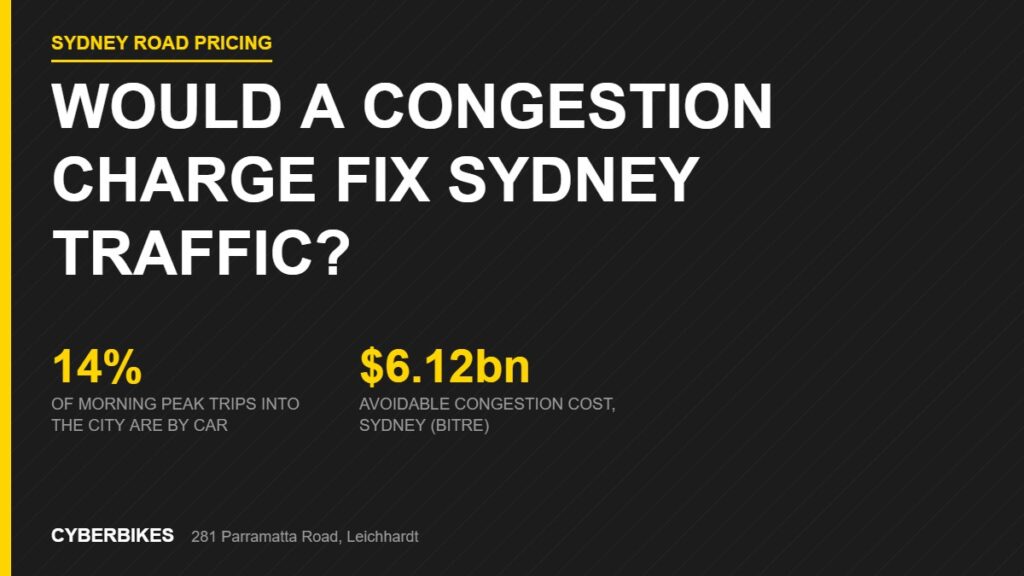
The number that should end the “we can’t afford a congestion charge” conversation: the Bureau of Infrastructure and Transport Research Economics put the avoidable social cost of congestion in Sydney at $6.12 billion a year, heading for $9.45–12.60 billion by 2030 (BITRE Information Sheet 74, real 2010 dollars). Nationally, $16.45 billion rising toward $27.7–37.3 billion.
We aren’t choosing between paying for congestion and not paying. We already pay, every morning, in a currency that never shows up on a budget line: time. The question is whether we keep paying blindly or pay a smaller, visible amount that actually changes behaviour.
Why do 25,000 cars set the rules for everyone else?
This is where the debate goes strange. Transport for NSW’s own Sydney City Centre Access Strategy found that only 14% of morning peak trips into the city centre are by car — around 25,000 car trips, a figure that has plateaued while public transport arrivals climbed from 105,000 to 145,000. Over 80% of peak-hour trips into the centre are already by public transport.
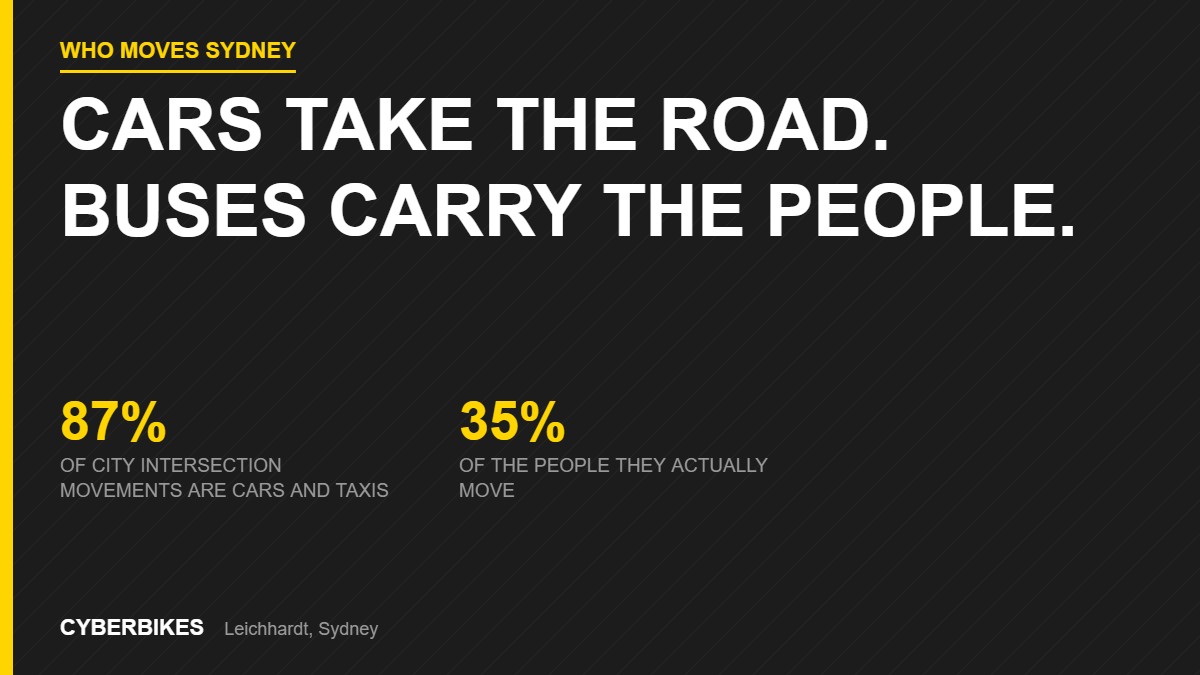
And yet between 8am and 9am, cars and taxis account for 87% of traffic movements through city centre intersections while moving just 35% of the people. Buses move 62% of them. The single clearest illustration in the whole document: on George Street near Goulburn Street, roughly 5,900 people travel northbound on 170 buses, while about 900 people travel in 720 cars.
Four times as many vehicles, one-sixth as many people. Peak-hour road pricing isn’t an attack on anyone’s lifestyle — it’s a correction to a network that hands its scarcest space to the least space-efficient way of moving a human body. The same arithmetic plays out on every street in the city: road space that’s free at the point of use gets used until it’s full. Always.
Should the charge come before the alternative?
No — and this is the part we’ll argue about with anyone. Charge first, build later, and you’ve made driving a class filter: fine if you can absorb $10 a day, brutal for the shift worker commuting from a suburb with four buses an hour. Build the alternative first and the charge becomes a nudge toward an option that was already there.
For a large share of Sydney trips that alternative already exists and costs cents. An e-bike needs no parking station, pays no cordon charge in any scheme ever proposed, and runs on a few cents of electricity per charge. The full case is in our car-free Sydney e-bike commuting guide, and who really pays for Sydney’s toll roads covers how we already price roads — badly, and only on motorways.
Before you swap, know the rules: NSW changed its e-bike definition in March 2026. Legal here means 500 W maximum continuous rated power (dropping to 250 W plus mandatory EN 15194 certification from 1 March 2029), assistance stopping at 25 km/h, and any throttle-only function cutting out at 6 km/h. Over those limits is illegal even if an app or switch limits it, and since 21 August 2026 police have expanded seizure powers (Transport for NSW). Helmets are mandatory. Our Centauro is built inside them: a 250 W rear hub motor, a UL 2271-certified 48V 25Ah Samsung battery, full suspension and hydraulic brakes.
Sydney will get road pricing eventually — every city with this much traffic and this little room does. The only choice we control is whether we spend the years before it arrives building something worth switching to.
Frequently Asked Questions
Does Sydney have a congestion charge in 2026?
No. Sydney has tolled motorways but no cordon or peak-hour congestion charge for entering the CBD. The leading proposal is the Grattan Institute’s $5 morning-entry and $5 afternoon-exit cordon charge on weekdays, with $3 in the shoulder periods.
Would a congestion charge apply to bikes and e-bikes?
No scheme in operation or proposed for Sydney applies to bicycles or e-bikes. Cordon and corridor charges price motor vehicles using scarce road space. An e-bike commute into the Sydney CBD would cost nothing under the Grattan plan.
How much does traffic congestion cost Sydney each year?
BITRE estimates the avoidable social cost of congestion in Sydney at $6.12 billion a year, rising to between $9.45 billion and $12.60 billion by 2030 in real 2010 dollars. Nationally the cost is $16.45 billion, heading toward $27.7–37.3 billion by 2030.
If you’re ready to be part of a car-lighter Sydney, come see us at Cyberbikes, 281 Parramatta Road, Leichhardt — we’ll show you what your actual commute looks like on an e-bike before anyone charges you a cent to drive it.
#CongestionCharge #SydneyTraffic #eBikeSydney #Cyberbikes #Leichhardt #CarFreeSydney #RoadPricing #BikeCommute