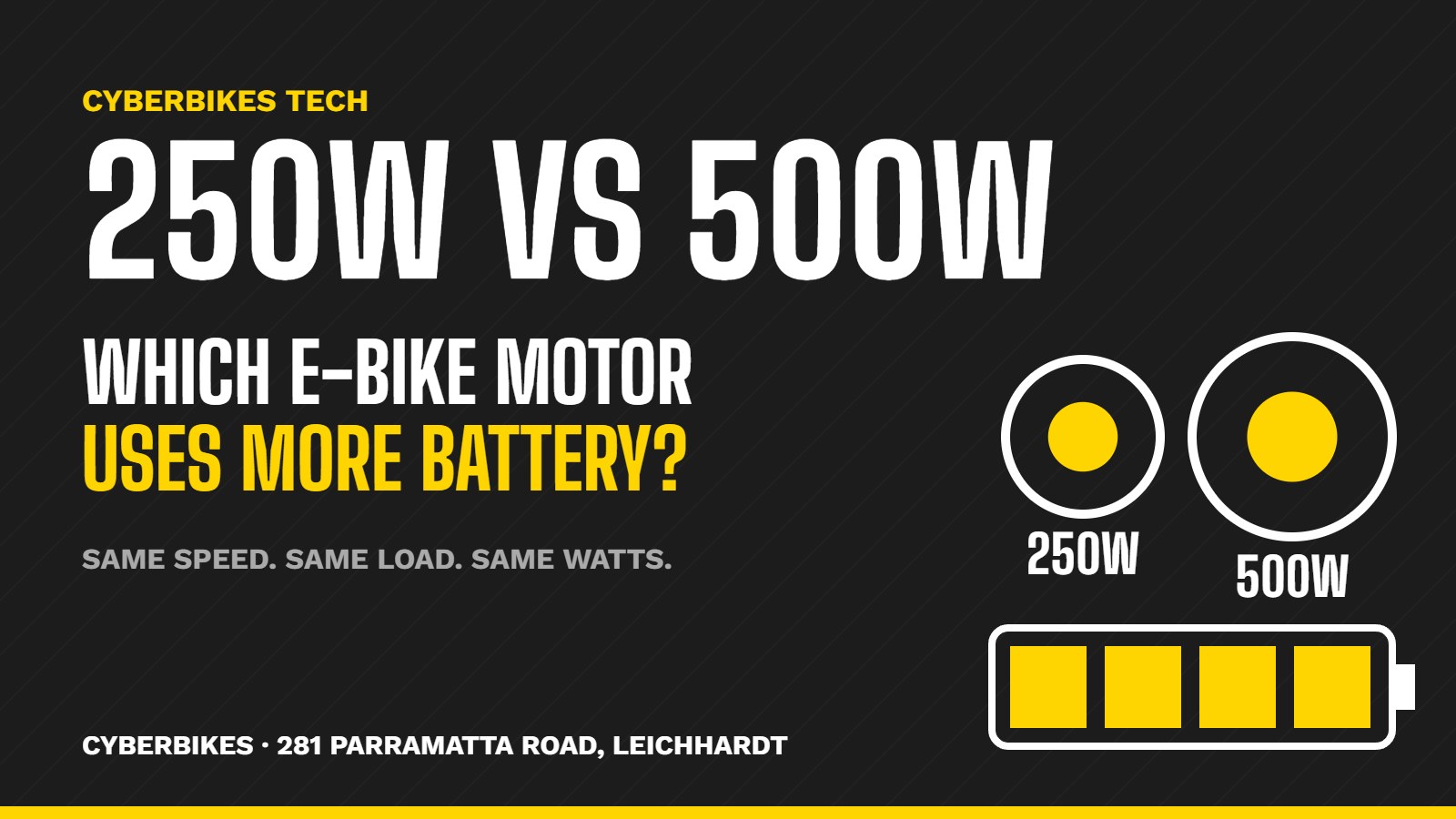
The “250W” stamped on a road-legal e-bike is not the most power its motor can make — it is a continuous rating used for legal compliance, and the very same motor can briefly push two to four times that when you hit a hill. There is no universal standard for measuring e-bike power in watts, which is exactly why one motor gets sold as 250W, 500W and even 1000W by different sellers. Learning the difference between continuous power, peak power and the “input” watts used in marketing is the single best way to judge what an electric bike will actually do — and to stop overpaying for a big number that means very little.
At Cyberbikes in Leichhardt we get asked “how many watts is it?” every week, and the honest answer is that watts alone never tell the whole story. Here is what the number really means, grounded in the engineering explained by Grin Technologies at ebikes.ca, whose motor simulator is the reference tool for this.
| Power rating | What it measures | Where you see it |
|---|---|---|
| Continuous power | Watts the motor can sustain indefinitely without overheating | Legal ratings (e.g. 250W to EN 15194) and honest specs |
| Peak output power | The most mechanical watts the motor delivers in short bursts | Real hill-climbing and off-the-line punch |
| Peak input power (V × A) | Electrical watts pulled from the battery, before motor losses | Inflated marketing claims (“3600W”) |
What does the “watt” number on an e-bike actually measure?
A watt is a watt: 600 watts of mechanical power moves a bike the same way whether it comes from a small geared hub motor, a big direct-drive hub, a mid-drive, or a gust of tailwind. The catch is that, unlike a 60-watt light bulb, an e-bike motor does not draw a fixed power when you switch it on. Spin it with the wheel off the ground and it produces almost no power; load it against a hill and its output climbs as it slows, until either heat or the controller’s current limit stops it.
So a motor’s real output depends on how hard it is working and how much current the controller allows — not on a figure printed on a sticker. As Grin puts it, there is no consistent way to give a single watts rating, which is why the same motor can legitimately appear as 250W, 500W or 1000W. To see how the motor, controller, sensors and battery work together, read our guide on how e-bikes actually work.
Continuous vs peak power — what is the difference?
Continuous power is what a motor can put out indefinitely without cooking itself. Peak power is the short burst it can deliver for a minute or two — and peak is usually all you need, because even the steepest Sydney hill climbs are over in a few minutes, not hours. A motor can safely handle far more power briefly than it can sustain, so peak is what gives an e-bike its punch off the lights and up a climb.
Peak output happens right at the point where the controller hits its battery-current limit. That is why two bikes wearing the same “250W” label can feel completely different: the one with a higher-current controller and a higher-voltage battery has a much bigger peak.

Does more voltage or more amps make a bike feel more powerful?
Grin’s simulator shows it clearly. Take one motor on a 36V battery with a 20A controller: it peaks at about 600 watts. Swap in a 40A controller and the same motor peaks at roughly 1058 watts — 80% more on paper — yet above 40 km/h the two feel identical; you only notice the difference on steep climbs. Now keep the 20A controller but move to a 52V battery: peak output is only about 840 watts, yet the bike feels stronger because it keeps accelerating to a higher speed and draws more average power. The lesson: peak watts alone do not predict how powerful a bike feels.
Why is the same motor sold as 250W, 500W and 1000W?
Because sellers quote whichever number flatters the product. The most common trick is to advertise peak input power — volts times amps drawn from the battery — rather than the mechanical power the motor actually delivers. A 72V pack and a 50A controller multiply out to a headline “3600W”, even if that setup only produces around 2000 watts of real output and cannot sustain half of that without overheating. Grin notes the advertised input figure typically exceeds true peak output by at least 30%, and often by two or three times the power a motor could hold continuously. In plain terms: a bigger headline wattage frequently just means a bigger battery and controller, not a fundamentally stronger motor.
What limits how much power an e-bike motor can make?
Heat. When a motor is loaded to make torque, it pulls more current through its copper windings, and that current is what heats it up. Double the current for double the torque and you do not double the heat — you quadruple it, because heating follows the I²R relationship (heat rises with the square of the current). Crucially, it is torque, not power, that overheats a motor: a motor grinding slowly up a hill can cook itself while producing fairly modest watts.
Motors are heavy lumps of metal, so they shrug off short bursts, but a hub motor can take one to two hours to reach its steady-state temperature — far longer than any real hill climb, which is why continuous ratings look so conservative next to what riders actually demand. Cooler air helps too: you can safely sustain more power on a crisp Sydney winter morning than in 40°C summer heat.
So is a 250W e-bike “underpowered”? What it means in NSW
Not at all — and this is where the ratings finally make sense. In NSW, a pedal-assist e-bike is road-legal as a 250W continuous rated bike (to the EN 15194 standard) with motor assistance cutting off at 25 km/h. That 250W is a continuous figure for compliance; it says nothing about the peak the motor delivers when you push off or climb.
Our Cyberbikes Centauro is a good example: it runs a 250W continuous motor (EN 15194) with a 48V 25Ah Samsung battery — that is 1,200Wh of energy — and is built to the UL 2849 e-bike and UL 2271 battery safety standards. On paper it is “just 250W”, but the continuous rating is a legal ceiling, not the motor’s ceiling, so it climbs Sydney’s hills confidently while staying fully compliant. To judge any e-bike properly, ignore the headline watts and look instead at the continuous rating for legality, the battery watt-hours for range, and — ideally — a torque figure plus a test ride for feel. Still wondering if 250W is enough for your commute? We go deeper in is a 250W e-bike motor actually powerful enough.
See it in action
Frequently Asked Questions
Is a higher-wattage e-bike always more powerful?
No. Watt ratings are not standardised, so a bigger number often just reflects a larger battery and controller. A bike’s real-world feel depends on its continuous rating, peak output, battery voltage and torque, not the headline watts.
What does “250W continuous” mean on an Australian e-bike?
It is the power the motor can sustain indefinitely without overheating, used for legal compliance under EN 15194 in NSW, where pedal assistance must cut off at 25 km/h. The same motor can still peak well above 250W for short bursts like hill starts.
Why is peak power not always useful?
Peak output happens only at the controller’s current limit and lasts a short time. Two bikes with very different peaks can feel the same at cruising speed, so peak mainly matters for acceleration and short, steep climbs rather than overall performance.
Ready to feel what a well-matched motor, controller and battery actually do? Come in for a test ride at Cyberbikes, 281 Parramatta Road, Leichhardt, or browse the Centauro e-bike at cyberbikes.com. Ask about our rent-to-own plans — from $99.99/week.
#Cyberbikes #eBikeSydney #ElectricBikeLeichhardt #eBikePower #CentauroEbike #eBikeTech