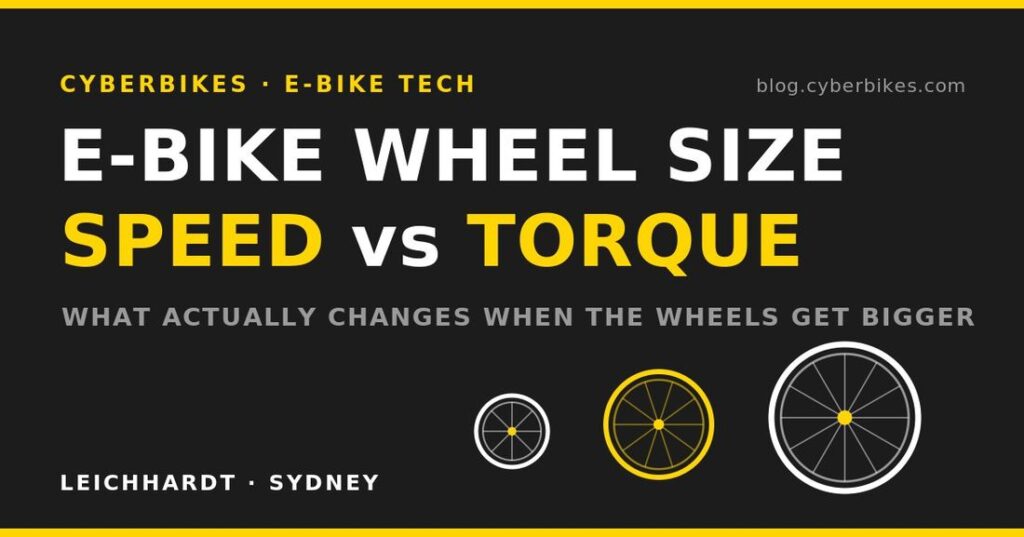
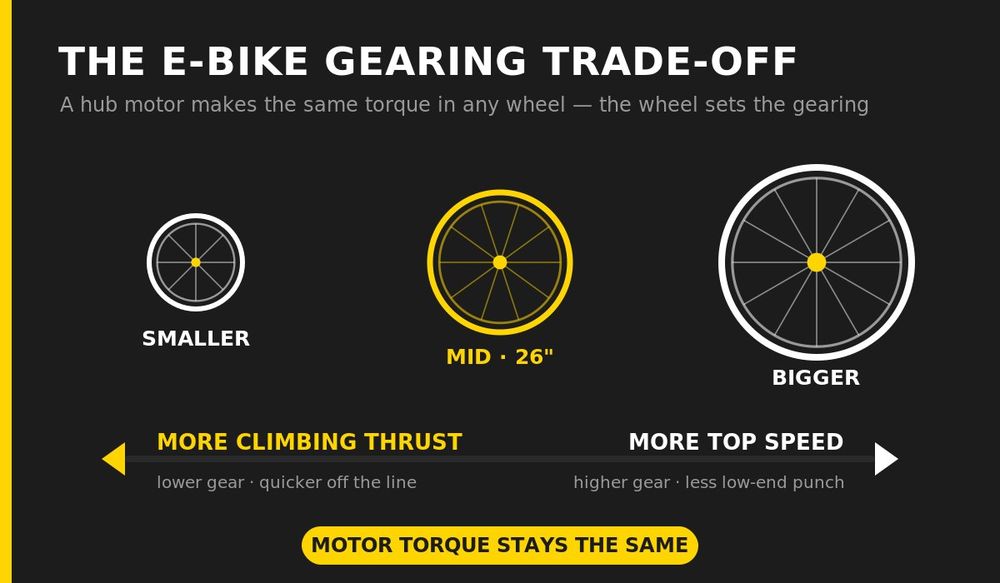
Short answer: yes — but not the way most riders expect. Changing your e-bike wheel size barely touches the motor’s actual torque; what it really changes is your gearing. A smaller wheel behaves like a lower gear, giving more thrust for climbing and quicker acceleration but a lower top speed. A bigger wheel behaves like a higher gear: more top speed, less low-down punch. As Grin Technologies put it on their motor simulator, “the torque of the motor is independent of wheel diameter” — it’s the thrust at the road that shifts.
That single distinction settles almost every argument about 20-inch folders, 26-inch commuters and 29-inch mountain e-bikes. Here is how e-bike wheel size actually works, why it matters far less for top speed than you would think in New South Wales, and how to use it when you choose your next ride.
Wheel size is really about gearing, not motor power
Your motor produces a certain twisting force — torque, measured in newton-metres — for a given current. That figure is set by the motor itself, not by the wheel it sits in. What the wheel changes is how that torque reaches the ground.
Grin’s simulator can plot two different things: the motor’s torque in newton-metres, or the thrust at the tyre in pounds of push. Their engineering note is blunt: “Thrust naturally increases as you select smaller wheel sizes, while the torque of the motor is independent of wheel diameter.” Better still, they add that thrust “is what most people actually mean when they talk about ‘torque’.” So when a mate insists their small-wheel e-bike “has more torque,” what they really feel is more thrust.
Picture a spanner. The motor’s torque is how hard you twist the bolt; the wheel’s radius is the length of the spanner working against the road. A smaller wheel is a shorter lever between the axle and the tarmac, so the same twist becomes more push — but the wheel covers less ground per turn, so you top out sooner. That is the whole trade-off in one picture:
Does a bigger wheel make an e-bike faster?
At the same motor RPM, yes — a bigger wheel gives a higher top speed. Road speed is simply how fast the wheel spins multiplied by how far it rolls in one turn. A motor spinning at its unloaded RPM carries a 29-inch wheel further per revolution than a 20-inch wheel, so the bike rolls faster. Grin’s simulator makes the same point: “the road speed is calculated based on wheel size.”
Here is the Sydney catch. In New South Wales, a road-legal e-bike is either a 200W throttle bike or a 250W pedal-assist (pedelec) that must stop assisting at 25 km/h. Once you hit that cap, the motor stops pushing no matter which wheel you are on. So for a compliant e-bike Sydney riders can legally use on shared paths and roads, a bigger wheel does not hand you a higher legal top speed — the electronics cut assist at 25 km/h either way. On a legal e-bike, the real differences show up in acceleration, comfort and climbing, not outright speed.
Do smaller wheels give more climbing power?
Yes — a smaller wheel delivers more thrust to the road, which is exactly what you want on a hill. Because thrust equals motor torque divided by the wheel’s radius, shrinking the wheel multiplies the push at the tyre. Grin quantify climbing neatly: “the pounds thrust needed to overcome gravity when climbing a hill is simply weight × %grade.” More available thrust means steeper hills held at a steadier speed.
This is why Grin Technologies flatly recommend that, for any bike running two different wheel diameters, “you will always get the best motor performance putting the hub drive in the smaller of the two wheels.” On Sydney’s punchier climbs — the pinch up from Iron Cove, or the drags around Leichhardt and Balmain — a smaller-wheeled hub bike, or a geared hub, will feel noticeably more willing than a big 29er running the same motor. The internal gearing of the motor matters here too, which is why it is worth understanding geared vs direct-drive hub motors alongside wheel size.
The catch is that all that thrust comes with a lower ceiling: you reach the motor’s limit sooner. On a legal 25 km/h bike that barely matters; on private land or a trail, it is where you would feel it.
Does wheel size change range, efficiency and motor heat?
It can — mostly through how hard the motor has to work on climbs. A hub motor is happiest spinning quickly. Force it to crawl slowly under heavy load and it draws big current and turns much of that energy into heat instead of motion. That is the I²R relationship — heating rises with the square of the current — and it is the same reason motors cook on long, slow climbs.
A smaller wheel keeps the motor spinning faster for the same road speed, nudging it into a more efficient, cooler part of its range when you are grinding uphill. A larger wheel does the opposite: the motor turns more slowly for a given speed, so on a sustained climb it can run hotter and waste more energy, trimming your range. On flat, smooth ground the picture softens — bigger wheels tend to roll with a touch less resistance — but for Sydney’s stop-start, hilly inner-west riding, the climbing behaviour usually matters more. If you want the full chain from battery to wheel, our guide to how e-bikes actually work: motors, sensors and controllers breaks it down.
E-bike wheel sizes compared: 20″ vs 26″ vs 29″
Every size is a balance of the same two levers — thrust and speed. Here is the quick comparison:
| Wheel size | Top-speed potential (same motor) | Thrust & acceleration | Best suited to |
|---|---|---|---|
| 20″ (folders, compact cargo) | Lower | Highest — strong climbing, quick off the line | Tight city riding, folding e-bikes, heavily loaded cargo |
| 26″ (all-round commuter / MTB) | Balanced | Strong and well-rounded | Mixed Sydney flats and hills — the sensible all-rounder |
| 27.5″–29″ (trail / road e-MTB) | Higher | Lower — smoother but less punchy | Fast rolling on smooth surfaces, taller riders, distance |
There is no single “best” wheel size — only the right one for your terrain and load. Bigger is not faster on a legal e-bike, and smaller is not automatically better either.
See how gearing works on a mid-drive
Wheel size is the “fixed gear” of a hub-motor bike. On a mid-drive, the bike’s actual gears do that job — and using them well keeps the motor in its sweet spot, exactly as choosing the right wheel does. This @cyberbikesau video breaks down why gears matter on a mid-drive e-bike:
What this means when you buy an e-bike in Sydney
For most riders, your wheels should follow your terrain, not a spec-sheet bragging right. If you climb a lot or carry loads, lean smaller for thrust; if you cover long, smooth distances, a bigger wheel rolls sweetly. The 26-inch wheel remains the great all-rounder, which is exactly why the Cyberbikes Centauro runs 26 × 2.4″ tyres: enough rollout for a relaxed 25 km/h cruise, enough thrust for Sydney’s hills, and a fat contact patch for comfort. It pairs that with a 250W motor and a 48V 25Ah (1200Wh) Samsung battery — UL 2271-certified — on an ISO 4210-tested full-suspension frame with 4-piston hydraulic brakes.
The best way to feel the difference is to ride a few back to back. Pop into Cyberbikes at 281 Parramatta Road, Leichhardt and our team will match wheel size, motor and gearing to how and where you actually ride.
Frequently asked questions
Do bigger wheels make an e-bike faster?
At the same motor RPM a bigger wheel rolls further per turn, so it has a higher top-speed potential. But on a road-legal NSW e-bike the motor stops assisting at 25 km/h regardless of wheel size, so a bigger wheel mostly changes ride feel, comfort and rollover, not your legal top speed.
Are smaller wheels better for climbing hills?
Generally yes. A smaller wheel converts the motor’s torque into more thrust at the road — Grin’s rule of thumb is that climbing needs thrust equal to weight × grade — so a smaller-wheeled hub bike pulls harder up steep streets. Grin even advise fitting a hub motor to the smaller wheel when a bike has two sizes.
Does changing my e-bike’s wheel size affect range?
It can. Forcing a hub motor to spin slowly under load — a bigger wheel on a steep climb — makes it draw more current and run hotter, wasting energy as heat. A smaller wheel keeps it spinning efficiently on climbs, while a bigger wheel can be marginally more efficient on smooth, flat ground.
Still not sure which wheel size suits your commute? Come in for a test ride at Cyberbikes, 281 Parramatta Road, Leichhardt, browse the range at cyberbikes.com, or ask about our rent-to-own plans from $99.99/week.
#eBikeSydney #ElectricBikeLeichhardt #Cyberbikes #CentauroEbike #eBikeTech #HubMotor #eMTB #SydneyCycling