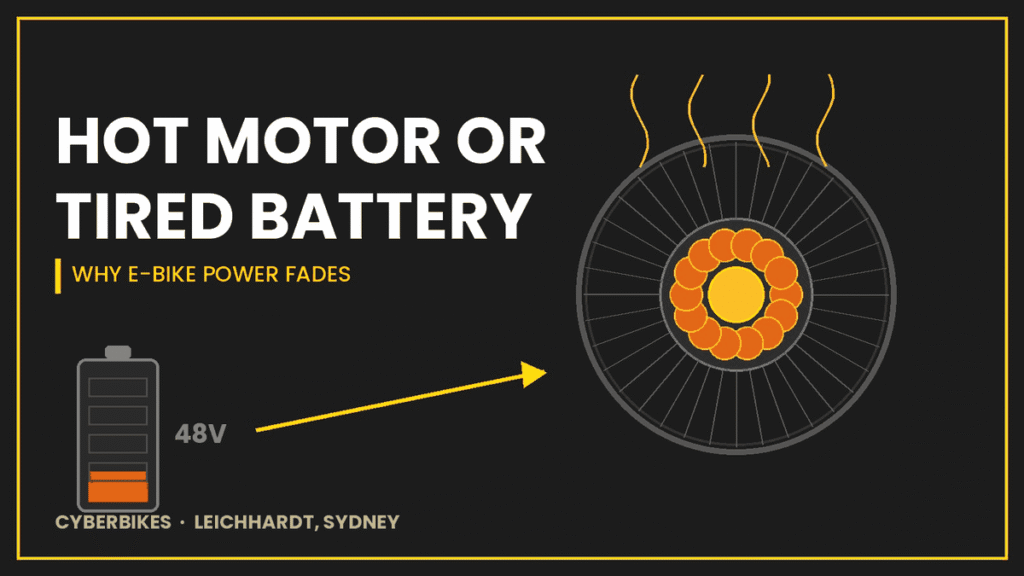
If your e-bike feels strong at the bottom of a climb and limp at the top, the cause is almost always one of two things: battery voltage sag, which is instant and recovers the moment you ease off, or motor heat, which builds over minutes and does not. Sag is a current problem in the pack; heat is a torque problem in the motor. They feel similar in the saddle and need completely different fixes, so this guide separates them properly — with the physics, the numbers, and what each one means on a real Sydney ride.
What is e-bike power fade, and is it the battery or the motor?
E-bike power fade is any loss of assist that happens while you ride, rather than because the pack is empty. There are two mechanisms behind it.
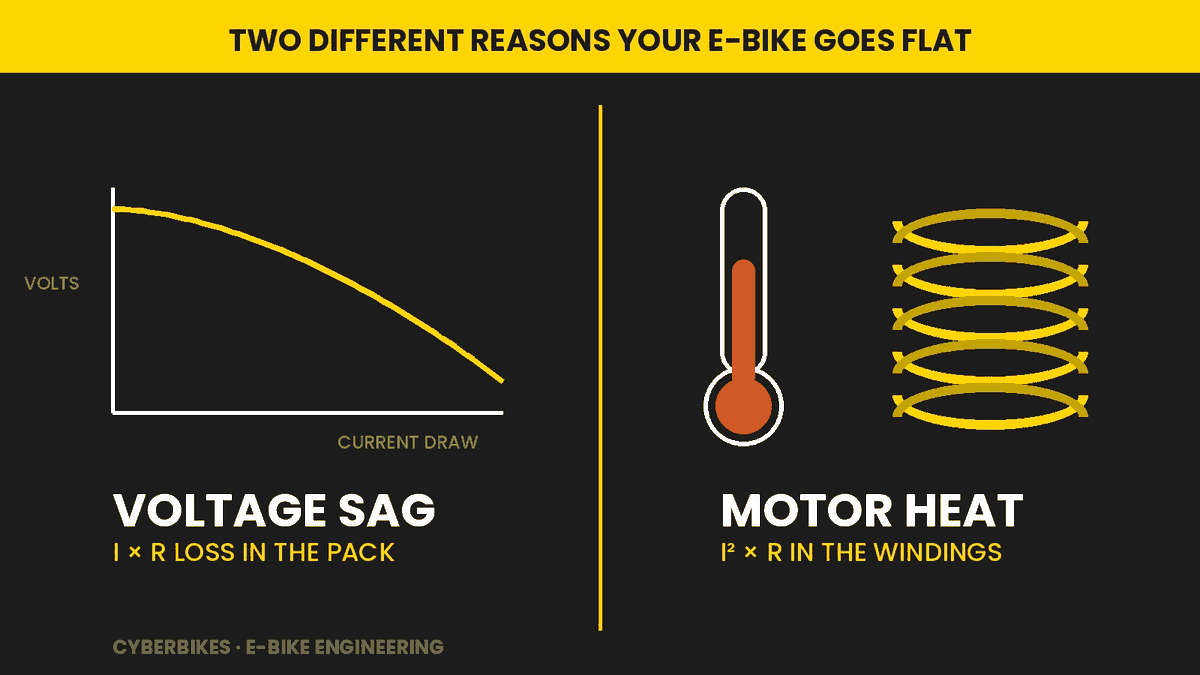
- Voltage sag. Every battery has internal resistance. Pull current through it and the pack’s terminal voltage drops by roughly I × R. Since power is volts times amps, a sagging pack delivers fewer watts at the same current. Ease off and the voltage springs straight back.
- Motor heat. Current through the motor windings generates heat at a rate proportional to I² × R. Grin Technologies, who build the motor simulator most of the industry tests against, put it bluntly: double the winding current and you make four times the copper heat. That heat takes minutes to build and many more to leave.
The giveaway is timing. Sag shows up within a second of demanding power and disappears just as fast. Heat-related fade arrives after several minutes of hard work and stays with you even after you crest the hill. If you want the full picture of how the pack, controller and motor hand power to each other, our guide to how e-bikes actually work — motors, sensors and controllers walks through the whole chain.
Why does motor heat depend on torque rather than watts?
This is the single most misunderstood thing about e-bike motors, and it explains why a “250W” motor can cook itself on a steep driveway while cruising happily at 500W on the flat.
Grin’s power ratings explainer states the principle directly: “it’s not the output power but the output torque of the motor which causes it to heat up and eventually fail.” Torque in a hub motor is set by current, and heat scales with the square of that current. Output power, meanwhile, is torque multiplied by speed.
So two rides at the same 400W draw can be worlds apart:
- 400W at 25 km/h on flat Parramatta Road. High speed, modest torque, modest current — the motor is spinning fast and shedding heat into the airstream.
- 400W at 8 km/h grinding up a Leichhardt back street. Low speed, high torque, high current. Same watts on the display, several times the copper heat in the windings.
Grin also notes that there is no standardised way to rate an e-bike motor at all — the same hardware “sold as 250W, 500W, and 1000W” by different vendors, each with a defensible justification. The number on the sticker is a legal and marketing figure. The number that decides whether your motor fades is the current you are asking it to hold.
How hot is too hot, and how fast does it happen?
Grin’s figures are useful here because they are specific. A quality motor’s magnets and insulation will generally survive 150–180°C, but continuous power ratings are typically calculated assuming the motor settles at around 100°C. Crucially, a hub motor takes “upwards of 1-2 hours” to reach true thermal equilibrium, while a typical hill climb lasts “less than 5-10 minutes”.
That gap is why fade on a long climb is so common: you are drawing far more than the continuous rating, banking on the climb ending before the heat catches up. On a short Sydney rise it does. On the drag up from Iron Cove with 30 kg of shopping on the rack, sometimes it doesn’t. Grin’s own fix — flooding the motor shell with Statorade ferrofluid — raises continuous motor power by roughly 40%, which shows how much of a motor’s “rating” is really a cooling problem.
How much range does a 48V 25Ah pack actually give you?
Energy, not power, sets range, and the arithmetic is simple: watt-hours equals volts times amp-hours. The 2026 Cyberbikes Centauro carries a 48V 25Ah Samsung lithium-ion pack, which its product page lists as 1200Wh — and 48 × 25 is indeed 1200.
The same page quotes up to 120 km at 25 km/h, measured on a flat road with a 75 kg rider and no headwind. Divide the energy by the distance and you get the number that actually matters:
- 1200Wh ÷ 120 km = 10 Wh/km under those test conditions.
- A 12 km commute from Leichhardt into the CBD and back is 24 km, or about 240Wh — a fifth of the pack.
- Double your energy use to 20 Wh/km with hills, headwind, a loaded rack and high assist, and that same 1200Wh covers 60 km instead of 120 km.
Nothing dishonest happens between those two numbers: Wh/km simply tracks how hard you make the motor work, and range figures are always quoted at the gentle end. The Centauro’s listed 37 kg weight and 150 kg maximum rider-and-cargo load feed straight into it, because every extra kilogram is extra torque on every rise. For cells, capacity and charging in full, see our definitive guide to e-bike batteries.
Does a hot motor drain the battery faster?
Yes, and the mechanism is worth understanding. Heat is energy that left the battery and never reached the road. Every watt turned into copper heat is a watt that did not move you forward, so a motor working deep in its high-torque, low-speed region is simultaneously the hottest and the least efficient. Grin’s efficiency curves show exactly this: at a constant input power, efficiency falls away as speed drops.
This is the same trade petrol cars make, only far worse — which is the point of this short from our channel:
A healthy e-bike motor turns most of its input into motion; a petrol engine turns most of its fuel into heat first. Fade, in both cases, is thermodynamics presenting the bill.
How do you tell sag from heat on your own bike?
Four checks, in order, using nothing but the display and your own hands.
- Watch the voltage, not the bars. Note the resting figure, then the figure under full assist. A large gap that closes instantly when you stop pedalling is voltage sag. A small gap with fading power is heat.
- Time it. Fade in the first few seconds of a climb is sag. Fade after five minutes of climbing is heat.
- Feel the motor. Stop and put a hand near the hub shell. Warm is normal. Too hot to keep your hand on means the windings are far hotter still, and the controller may already be rolling power back to protect them.
- Change one variable. Drop a gear and spin faster at the same assist level. If the fade eases, you were in the high-torque, high-heat region and have just moved out of it.
A pack that sags badly even when freshly charged is telling you about its age or its cells, and that is a workshop job. At our Leichhardt shop we see it most in older packs and in cheap cells that never matched the controller’s current limit.
Do NSW e-bike rules limit how much power you can have?
They do, and the limits are tighter than a lot of online advice suggests. Transport for NSW currently requires a maximum continuous rated power of 500 watts, with assistance that stops at 25 km/h and any throttle-only function cutting out at 6 km/h.
- From 1 March 2029, only EN 15194 certified e-bikes will be allowed on NSW roads, and the continuous power ceiling drops to 250W.
- A bike that exceeds any of those limits is illegal “even if its power or speed is restricted by an app or switch” — software limiting does not make a non-compliant motor legal.
This is why the Centauro is built around a 250W rear hub motor with pedal assist cut at 25 km/h and throttle limited to 6 km/h: its product page lists it as designed to meet EN 15194 for power and speed, alongside UL 2849 for the e-bike system, UL 2271 for the battery and ISO 4210 for the frame. A compliant 250W motor fades sooner than an illegal 1500W one. It is also the one you can legally ride to work.
Frequently Asked Questions
Why does my e-bike lose power halfway up a hill?
If the power drops within a second or two of hitting the slope and returns the moment you ease off, it is battery voltage sag — internal resistance pulling the pack voltage down under high current. If the power fades gradually after several minutes of climbing and stays weak at the top, the motor windings are hot and the controller is limiting current to protect them. Dropping to a lower gear and spinning faster reduces the torque demand and lets the motor cool.
Is voltage sag the same as a flat e-bike battery?
No. Voltage sag is a temporary drop caused by current flowing through the pack’s internal resistance, and the voltage recovers within seconds of reducing load. A flat battery has actually run out of stored energy, measured in watt-hours, and only recovers by charging. A sag-prone pack can still hold most of its watt-hours — it simply cannot deliver them quickly, which is usually a sign of cell age or a cell chemistry mismatched to the controller’s current limit.
Does a hotter e-bike motor use more battery?
Yes. Heat in the windings is energy drawn from the battery that never became motion, and it rises with the square of the current, so doubling winding current produces four times the heat. A motor working at low speed and high torque is both the hottest and the least efficient, which is why steep climbs, heavy loads and constant stop-start riding all push your watt-hours per kilometre up and your range down.
Ride one before you believe the spec sheet
The only way to know how a motor behaves on your hill, with your weight and your shopping, is to take it up that hill. Test rides at Cyberbikes Leichhardt are free — come to 281 Parramatta Road, Leichhardt, book online at cyberbikes.com, or call 0491 794 668, Tuesday to Saturday. If you would rather not pay for a bike up front, our rent-to-own plan starts from $99.99 per week and includes servicing at our own workshop.
#ebike #ebikesydney #cyberbikes #leichhardt #ebikebattery #hubmotor #ebikerange #commuterbike #cargoebike #sydneycycling