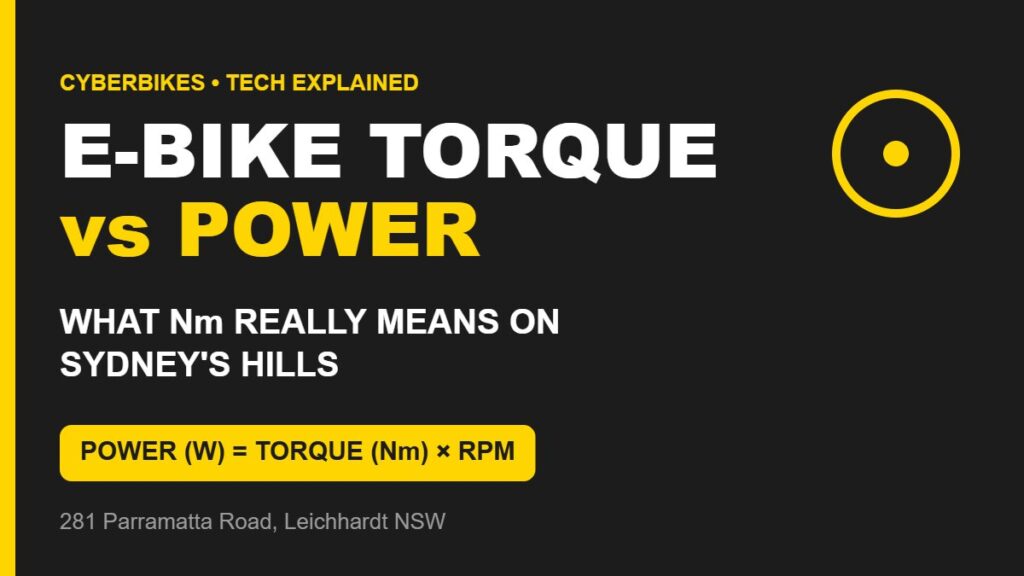
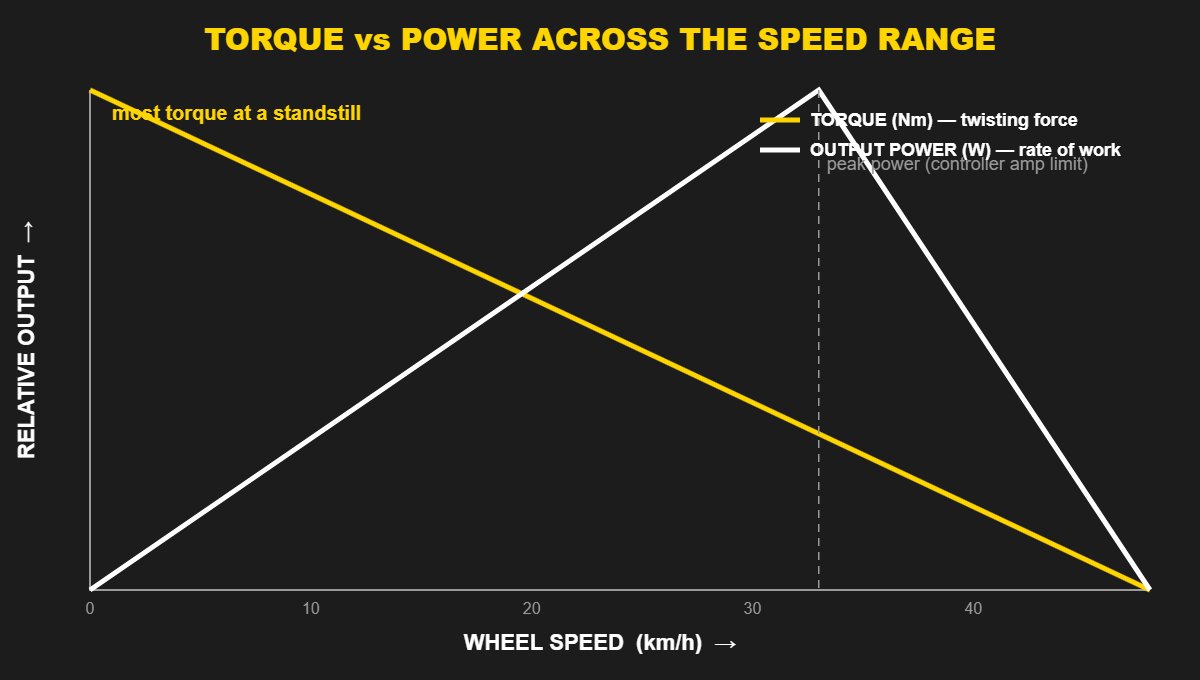
Torque is the twisting force an e-bike motor delivers (measured in newton-metres, Nm); power is how fast it turns that force into motion (measured in watts). Power equals torque multiplied by rpm, so the same motor can be a “250W” or a “600W” motor depending only on how fast it is spinning. For starting on a hill, hauling cargo or pulling into a Sydney headwind, torque is what you feel. For top speed, power and battery voltage matter more.
At Cyberbikes in Leichhardt we get asked “how many watts is it?” every week — and it’s the wrong first question. Below we break down what torque and power actually are, why the watt rating on a spec sheet is close to meaningless on its own, and what all of this means when you’re grinding up Norton Street. The engineering here follows Grin Technologies’ motor-ratings research at ebikes.ca, tied back to real Sydney riding.
Torque vs power: the 30-second answer
Torque is rotational force — how hard the motor twists the wheel. Power is the rate of doing work — torque combined with speed. The relationship is fixed physics:
Power (watts) = torque (Nm) × rotational speed (rad/sec), or in everyday units, Power ≈ Torque × RPM × 0.104.
Grin gives a clean example: a motor producing 20 Nm at 100 rpm makes about 209 watts, but that same 20 Nm at 300 rpm makes about 628 watts. Identical twisting force, triple the power — purely because it’s spinning faster. That single fact is why “watts” is such a slippery number, and why torque is the spec that describes what the bike does at low speed.
Why torque is what you feel on a Leichhardt hill
When you pull away from the lights on Parramatta Road, or start a climb from walking pace, the wheel is barely turning — rpm is low. Look at the formula: at low rpm, even a lot of power translates into modest thrust, but torque directly sets how hard the bike shoves you forward from a standstill. A motor with strong low-speed torque feels punchy off the line and holds a steady pace up a hill without you having to hammer the pedals.
This is also why two e-bikes with the same “250W” sticker can feel completely different. One might deliver its rated output only once it’s spinning fast; the other might be geared to produce high torque down low. On Sydney’s short, sharp inner-west climbs — and with a load of shopping or a kid on the back — low-speed torque is the number that decides whether you cruise up or grind to a crawl.
Why “250W” barely tells you anything on its own
Here’s the uncomfortable truth from the engineers at Grin: there is no standard for what a motor’s “rated watts” means. The exact same motor is sold by different vendors as 250W, 500W or 1000W, and each can justify their number. A watt rating in isolation is close to a marketing figure. There are three very different things a “watt” number might describe:
| Rating type | What it measures | How honest it is |
|---|---|---|
| Nominal / rated power | A ballpark label (often for legal compliance), with no fixed rpm behind it | Vague — treat as an order-of-magnitude only |
| Peak output power | The most mechanical power the motor delivers, right at the controller’s current limit | Well-defined, but mostly set by the controller and battery, not the motor |
| Peak input power (V × A) | Volts × amps drawn from the battery — the biggest, showiest number | Often overstates real output by 30–300% |
Grin’s point is that peak power is “mostly a function of the motor controller and battery pack” — swap in a higher-amp controller and you get more punch off the line; raise the battery voltage and you get a higher top speed and higher average power. The motor itself barely changes. If you’re weighing up the numbers, it’s worth reading our companion piece on whether a 250W e-bike motor is actually powerful enough for Sydney riding.
Where NSW law fits in
In NSW, a legal power-assisted pedal cycle is either a 200W throttle-style e-bike or a 250W pedelec (a pedal-assist bike whose motor cuts out at 25 km/h). Those wattage figures are nominal legal ratings, not a measure of how the bike feels — which is exactly why a compliant 250W pedelec can still climb strongly. The 25 km/h assist cut-off means the law caps your speed, not your torque: a well-geared 250W bike can still deliver plenty of hill-pulling force while staying road-legal. Every e-bike we sell at Cyberbikes is built to these NSW limits.
Torque, heat and why motors burn out
Here’s the part most riders never hear: it’s torque, not power, that heats a motor up and eventually kills it. To make more torque, the motor draws more current through its copper windings, and that current is what generates heat. The relationship is brutal — the “I²R” law of physics means that if you double the current (and torque), you quadruple the heat.
That’s why a motor can happily produce big torque for the few minutes it takes to top a steep climb, but would cook itself if you demanded that torque continuously. Grin notes it can take a hub motor 1–2 hours to reach a steady-state temperature, while the longest hills you actually meet on the road are over in 5–10 minutes. In practice, short bursts of high torque — exactly what you need for Sydney’s stop-start hills — are well within a quality motor’s comfort zone. Sustained overloading (a heavy rider, a big load, and a long, relentless grade in summer heat) is what causes trouble. If you want the full picture, see our guide on why e-bike motors overheat and how to prevent it.
Mid-drive vs hub: how gearing multiplies torque
This is where torque gets practical. A mid-drive motor sends its power through the bike’s chain and gears, so when you drop into a low gear, the drivetrain multiplies the motor’s torque at the wheel — brilliant for steep, technical climbs. A hub motor drives the wheel directly at a fixed ratio, so it delivers smooth, quiet, low-maintenance torque that’s ideal for commuting and flatter runs. Neither is “more powerful” in watts; they just deliver their torque differently. We break the two down in detail in how mid-drive and hub motors actually work.
What this means for the Cyberbikes Centauro
Our 2026 Cyberbikes Centauro runs a 250W rear hub motor paired with a 48V 25Ah (1200Wh) Samsung battery that is UL 2271 certified. The hub design gives that smooth, direct, low-maintenance torque delivery that suits inner-west commuting and cargo duty, while the big 1200Wh pack (volts × amp-hours = watt-hours) keeps the assist available over long Sydney rides. The ISO 4210-compliant full-suspension aluminium frame is rated to carry a combined rider-and-cargo load of 150kg, with a welded rear rack good for 50kg — so the motor’s usable torque isn’t wasted on a flimsy platform. It’s priced at $3,999.99, and it’s built to the 200/250W, 25 km/h NSW rules from the ground up.
See the engineering for yourself
Understanding what’s under the hood is the best defence against buying on hype. This short Cyberbikes video makes the same argument — buy the engineering, not the look:
Frequently Asked Questions
Is torque or power more important on an e-bike?
For everyday riding, torque usually matters more. Torque (in Nm) sets how strongly the bike accelerates from a standstill and climbs hills, which is where you notice the assist most. Power (in watts) mainly affects top speed and how the bike feels at higher speeds. Since power equals torque times rpm, a bike with strong low-speed torque feels punchy even at a modest wattage.
How many Nm of torque do I need for hills in Sydney?
For typical inner-Sydney commuting on a legal 250W pedelec, mid-range torque (roughly 40–80 Nm at the motor, depending on gearing and wheel size) handles the city’s short, steep climbs comfortably, especially on a geared hub or mid-drive. The right figure depends on your weight, any cargo, and how steep your regular route is — which is why a test ride tells you more than a spec sheet. Pop into Cyberbikes Leichhardt and try one on a real hill.
Why do two 250W e-bikes feel so different?
Because “250W” is only a nominal rating with no fixed standard behind it. Two motors with the same sticker can have different gearing, different controller current limits and different battery voltages — all of which change the torque delivered at the wheel and the peak power available. How the bike actually feels is set by the whole system, not one number.
Want to feel the difference torque makes? Come in for a test ride at Cyberbikes, 281 Parramatta Road, Leichhardt, or browse the Centauro online. Ask about our rent-to-own plans — from $99.99/week.
#Cyberbikes #ebikeSydney #electricbikeLeichhardt #CentauroEbike #ebikeTorque #rideelectric