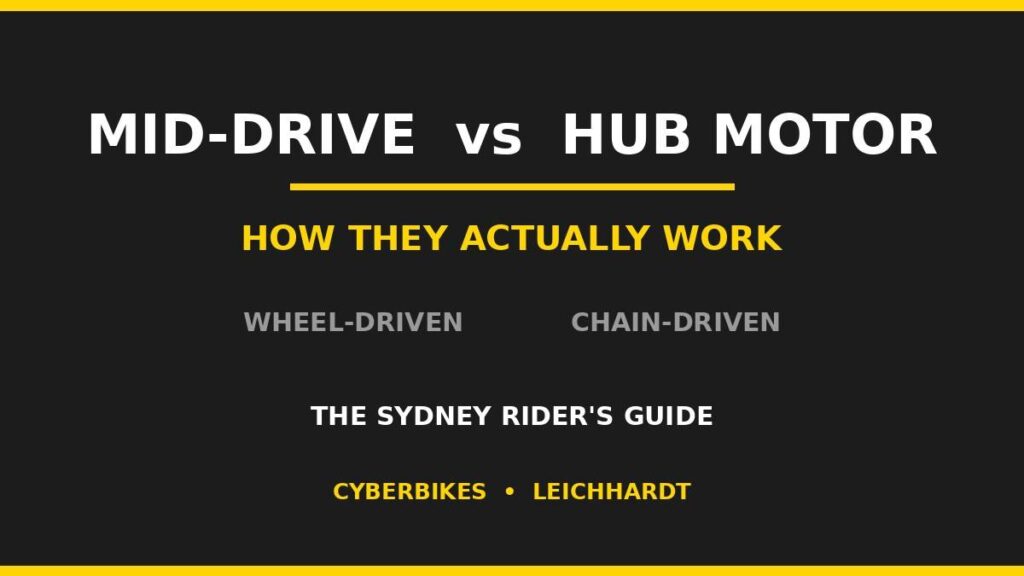
A hub motor is a self-contained motor built into the wheel that pushes the bike directly, while a mid-drive motor sits at the cranks and drives the bike through your chain and gears. That single difference — wheel versus chain — decides how each one climbs, how much it weighs, whether it can recover braking energy, and how much wear it puts on your drivetrain. Both are excellent; they just win in different places. Here is how each one actually works, and which one makes sense for real Sydney riding.
How a hub motor actually works
A hub motor is, in the words of Grin Technologies (ebikes.ca), “about as simple as things get.” Imagine an electric motor where you hold the axle still and let the body spin, then lace a wheel rim onto that spinning body. There are almost no external moving parts — no brackets, no extra chain, no exposed transmission. The motor drives the wheel directly, completely independent of your pedals and gears.
Under the hood, hub motors are permanent-magnet brushless machines. The physics is refreshingly linear: torque is directly proportional to current (twice the amps, twice the pull), and the voltage a motor generates as it spins — the back-emf — is directly proportional to speed. Push more current and you get more torque; the motor speeds up until its back-emf nearly matches the battery voltage. That is the whole reason a 250W hub on a 48V battery settles at a steady cruising speed and holds it.
Direct-drive vs geared hub motors
There are two families of hub motor, and the distinction matters. A direct-drive hub has the wheel bolted straight to the motor with no internal gears. It is simple and silent, but because the wheel only turns around 200 rpm, the motor has to be physically large and heavy to make useful torque — the power density of any motor is proportional to the speed between its magnets and windings. Its big upside: because it is always mechanically engaged, it can do regenerative braking. The downside of “always engaged” is constant drag — ebikes.ca notes this can range from imperceptible to feeling “like you are always riding with a flat.”
A geared hub motor adds a planetary gear set inside so a small, fast motor (often spinning over 3,000 rpm) is reduced to wheel speed. Per ebikes.ca, geared hubs typically weigh about 50% less than an equivalently powerful direct-drive motor and often make more torque — a good geared hub can produce up to around 80 N·m versus roughly 35 N·m for a typical direct-drive. Almost all geared hubs contain a freewheel, so there is very little drag when you are not on the throttle — but that freewheel eliminates regen. The trade-offs: more moving parts to wear, and a little audible whir.
How a mid-drive motor actually works
A mid-drive motor mounts at the bottom bracket — where the cranks are — and feeds its power into the same chain and cassette your legs use. That is the key architectural difference. Instead of turning the wheel directly, a mid-drive turns the chainring, so it gets to use your bike’s gears exactly like you do. Drop into a low “granny” gear on a steep pitch and the motor multiplies its torque through that gear ratio, which is why mid-drives feel so strong on sustained, technical climbs.
The physics inside the motor is identical to a hub — the same watts = volts × amps, the same torque-from-current relationship. What changes is the leverage. A hub motor is stuck at one effective ratio (the wheel), while a mid-drive borrows whatever gear you have selected. On slow, steep, loose terrain — fresh snow, sand, short sharp trail sections — ebikes.ca confirms a mid-drive in the granny gears can climb “with excellent efficiency,” often beating a hub. The catch is that all that force now runs through a normal bicycle chain.
Mid-drive vs hub motor: the real-world differences
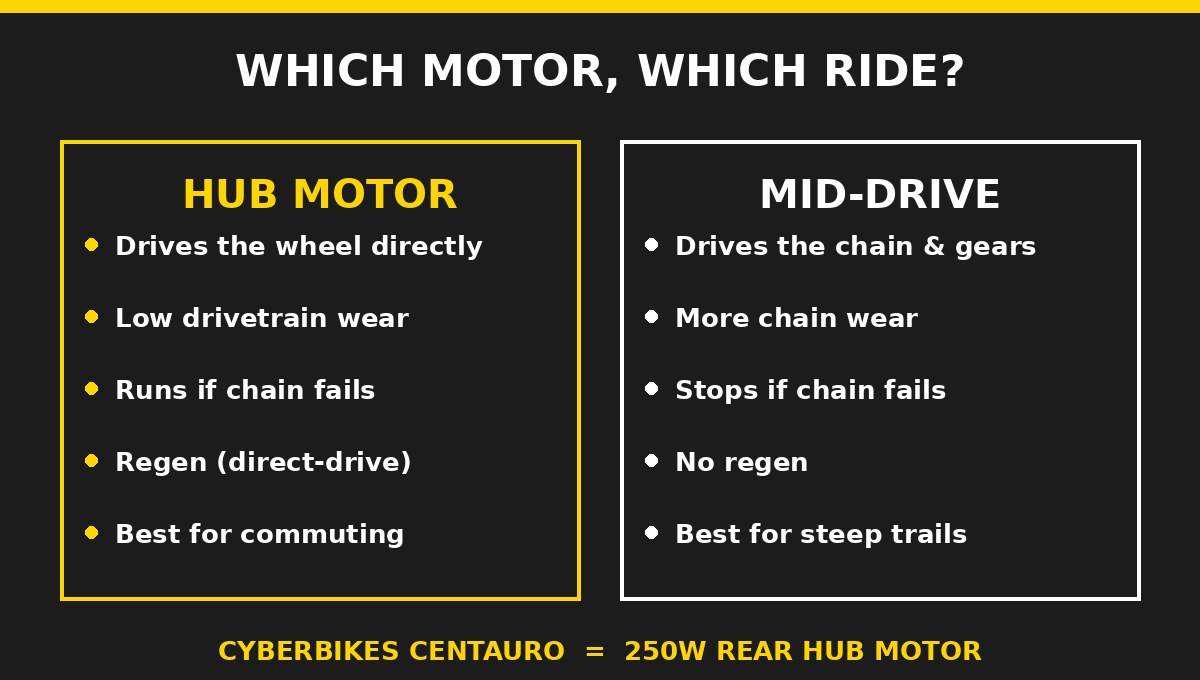
Here is how the two architectures compare on the things riders actually feel, drawing on Grin Technologies’ engineering notes:
| Feature | Hub motor | Mid-drive motor |
|---|---|---|
| Drives the bike via | The wheel, directly | Your chain & gears |
| Drivetrain wear | Low — reduces chain stress | Higher — adds motor force to the chain |
| Reliability if chain fails | Keeps propelling you | Stops with the drivetrain |
| Steep, slow, technical climbs | Good | Excellent (uses low gears) |
| Steady road commuting | Excellent, low maintenance | Little practical advantage |
| Regen braking | Possible (direct-drive only) | No |
| Weight for the power | Heavier (direct-drive) | Lighter, centred low |
The honest summary from ebikes.ca is telling: for most people commuting on roads, where holding a steady speed regardless of hill grade matters most, “a mid-drive offers almost no advantage and hub motor kits shine the strongest for reliable and low maintenance commuter ebikes.”
Which one is right for Sydney riding?
For the flat-to-rolling reality of most Sydney commutes — the Inner West, the harbour foreshore, a run down Parramatta Road to Leichhardt — a hub motor is usually the smarter choice. It needs almost no extra maintenance, it doesn’t chew through chains, and if your derailleur ever jams in traffic the motor still gets you home. A mid-drive earns its keep if your riding is genuinely mountainous or off-road, where you are grinding up long, steep, loose climbs in a low gear.
Whichever you choose, the law is the same in NSW: a legal power-assisted pedal cycle is limited to 250W of continuous rated power with assistance cutting off at 25 km/h. Both hub and mid-drive systems on road-legal e-bikes are built to that ceiling, so the choice is about how the power is delivered, not how much.
Why the Cyberbikes Centauro uses a hub motor
Our 2026 Cyberbikes Centauro runs a 250W rear hub motor — a deliberate choice for a bike designed to commute, carry cargo, and shrug off daily use. Because the hub drives the wheel directly, the Centauro’s chain only ever carries your pedalling, not the motor’s force, so the drivetrain lasts longer and needs less fuss. Paired with a 48V 25Ah (1200Wh) Samsung battery, full suspension (100mm front, 120mm rear), a frame-welded rear rack rated to 50kg, and a 150kg total load capacity, it’s a hub-driven workhorse that’s certified to UL 2849, UL 2271, ISO 4210 and EN 15194. Priced at $3,999.99, it’s the kind of low-maintenance hub setup ebikes.ca describes as ideal for real commuting. If you’re weighing motor power for everyday use, our breakdown of whether a 250W e-bike motor is actually powerful enough is worth a read.
See a mid-drive motor being installed
Want to see the mid-drive architecture up close? This quick clip from our workshop shows a Bafang mid-drive install — including the torque-wrench tip that keeps the motor mount secure:
Frequently asked questions
Does a hub motor or mid-drive wear out your chain faster?
A mid-drive wears the chain faster because it adds motor force on top of your pedalling, all running through the same chain and cassette. A hub motor drives the wheel directly, so it actually reduces stress on your drivetrain — one reason hub motors are favoured for low-maintenance commuting.
Which is better for climbing hills?
For long, steep, slow or off-road climbs, a mid-drive wins because it uses your low gears to multiply torque. For typical road hills where you want to hold a steady speed, a good hub motor climbs perfectly well with far less maintenance.
Can a mid-drive motor do regenerative braking?
No. Regen requires a motor that is always mechanically engaged with the wheel, which only direct-drive hub motors are. Mid-drives (and geared hubs with a freewheel) cannot recover braking energy.
Does the Cyberbikes Centauro use a hub or mid-drive motor?
The Centauro uses a 250W rear hub motor, chosen for low drivetrain wear and reliable, low-maintenance commuting and cargo use in Sydney conditions.
Come and feel the difference
The best way to understand hub versus mid-drive is to ride one. Come in for a test ride at Cyberbikes, 281 Parramatta Road, Leichhardt, or browse the hub-driven Centauro e-bike online. Ask us about rent-to-own plans from $99.99/week — our team in Leichhardt will help you match the right motor to your ride.
#Cyberbikes #ebikeSydney #electricbikeLeichhardt #hubmotor #middrive #CentauroEbike #ebikeTech