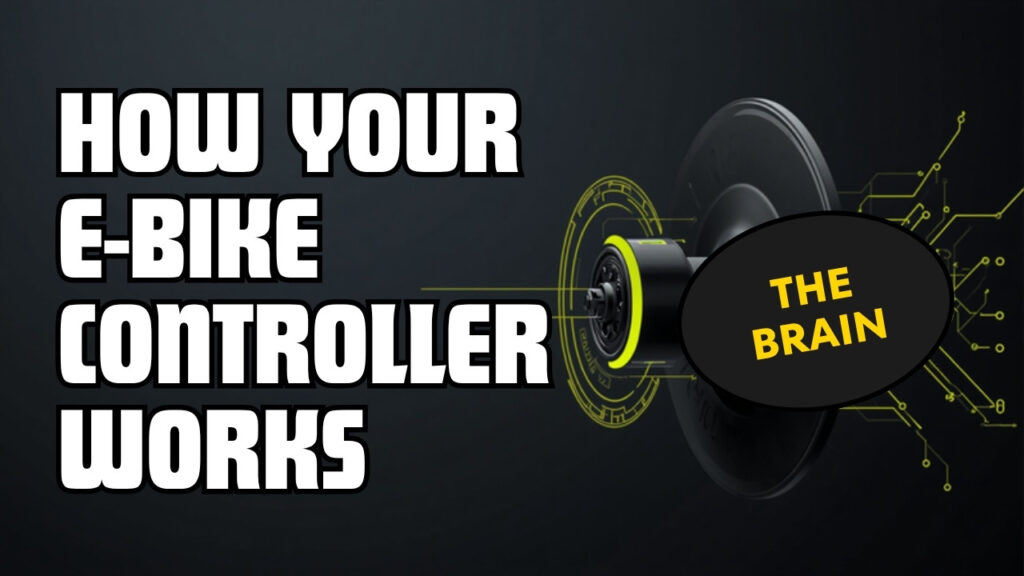
An e-bike motor controller is the electronic brain that sits between your battery and your motor. It takes steady DC power from the battery and rapidly switches it into precisely timed pulses that spin the motor, while capping how much current — measured in amps — is allowed to flow. That current limit is the single biggest factor in how much torque, and therefore how much pull, your e-bike delivers. On a road-legal build like the Cyberbikes Centauro sold here in Leichhardt, the controller is also what keeps the 250W rear hub motor inside NSW law by cutting assistance once you hit 25 km/h.
If your bike has ever felt strong off the line but flat at speed, refused to climb a steep pinch even at full throttle, or thrown an error code, the controller is usually the part doing the deciding. Here is how it actually works, what the amps really mean, and why a bigger controller is not always a better one.
What does an e-bike motor controller actually do?
Your battery stores energy as direct current at a fixed voltage. Your motor, by contrast, is a three-phase brushless machine with three sets of copper windings that need power delivered to them in a constant, rotating sequence to spin smoothly. The controller is the translator between those two worlds. It uses fast electronic switches (power transistors called MOSFETs) to fire current into each of the motor’s three phases in the right order and at the right instant, timed to where the rotor is at that moment. Cheaper motors use Hall sensors to report rotor position; some systems read it electronically instead.
To vary speed, the controller does not simply lower the voltage. It switches the power on and off thousands of times per second and changes the ratio of on-time to off-time — a technique called pulse-width modulation. A higher duty cycle means the motor sees a higher average voltage and spins faster; a lower one slows it down. At the same time, the controller is constantly reading your throttle or your pedal-assist sensor, checking your speed, and deciding how much current to let through. In short: the motor makes the force, the battery holds the energy, but the controller decides how, when, and how much.
What do the amps on my e-bike controller mean?
Amps are the amount of current the controller allows to flow into the motor, and current is what creates torque. More amps means more twisting force at the wheel. According to Grin Technologies’ engineering write-up at ebikes.ca, the peak mechanical power a motor produces occurs right at the point where the controller hits its battery current limit. Below the speed at which that peak happens, the controller is current-limited — it is clamping the electrical power going in.
The relationship between the numbers is simple physics: watts = volts × amps. A 48V battery paired with a 20A controller can push roughly 960 watts of input power at its peak. Grin notes an important quirk here: at low speed your input watts (volts × amps, the figure a Cycle Analyst or display shows) stay pinned at that current limit, yet the mechanical power actually reaching the road drops, because a motor becomes less efficient the slower it turns.
There is a catch that every rider should understand. Heat in a motor comes from current flowing through the resistance of the copper windings, and it follows what engineers call the I²R relationship. As ebikes.ca explains, if you double the current to get double the torque, you generate four times as much heat inside the windings. That is why simply fitting a higher-amp controller is not a free lunch: more amps buy grunt, but they also cook the motor faster on long, slow, heavily loaded climbs.
Higher-amp controller vs higher-voltage battery: which is more powerful?
This is where most riders get confused, so here is a concrete comparison. Grin ran the same hub motor on a 36V battery with three different setups. The results show that peak power is mostly a property of the controller and battery, not the motor itself.
| Setup (same motor) | Peak output power | How it feels to ride |
|---|---|---|
| 36V + 20A controller | ~600 W | Modest, steady |
| 36V + 40A controller | ~1058 W | Punchier off the line; identical above 40 km/h |
| 52V + 20A controller | ~840 W | Lower peak, yet pulls harder to 55+ km/h |
The 40A controller lifts peak power by about 80%, so it accelerates faster from a standstill, but once you are cruising above 40 km/h the ride feels identical to the 20A version and your average energy use barely changes. The 52V setup has a lower peak than the 40A one, yet it feels more powerful in practice because the extra voltage lets the motor keep pulling to a much higher speed. The rule of thumb: amps buy low-speed acceleration and hill grunt; volts buy top speed. This is exactly the kind of trade-off we walk customers through in the shop, and it is covered in more depth in our guide to how e-bikes actually work: motors, sensors and controllers.
Throttle vs pedal-assist: how the controller decides your power
With a throttle, you command the controller directly — twist for more, ease off for less. With pedal assist, the controller makes the call for you, using signals from a sensor at the cranks. As Grin’s pedal-assist theory page lays out, there are several control schemes a controller can run: constant power (a fixed number of watts whenever you pedal), constant throttle (your assist level effectively sets a speed cap), cadence-based (more power as you spin faster), and torque-multiplier (the motor amplifies your own pedalling watts by a set ratio). Which one your bike uses depends on its sensor. If you want the full breakdown of the two sensor families feeding those decisions, see our post on torque sensor vs cadence sensor.
Controller vs display: what’s the difference?
They are easy to confuse because they are wired together, but they do very different jobs. The display (or a Cycle Analyst) is the dashboard: it shows speed, battery level and power draw, and it is where you set your assist level. The controller is the muscle that actually switches the current. When you tap the assist button, the display sends that setpoint to the controller, and the controller executes it by adjusting how much current it lets through. The wattage figure on your screen is the input power — volts multiplied by amps — not the mechanical power at the wheel.
How the controller keeps your e-bike legal in NSW
In New South Wales, a pedal-assist e-bike (pedelec) is limited to 250W of continuous rated power with assistance that must cut out at 25 km/h, while a throttle-only e-bike is capped at 200W. Those limits are enforced in the controller’s firmware — it is the component that watches your speed and current and tapers the motor off at the legal ceiling. That is why “derestricting” or flashing a controller to bypass the cap is a genuine problem: it legally reclassifies your bike as an unregistered motor vehicle, which is not allowed on Sydney’s roads, bike paths or shared paths, and it voids your warranty and insurance. Every Centauro that leaves Cyberbikes Leichhardt is set up road-legal from the start.
What this means for your ride
The Cyberbikes Centauro runs a 250W rear hub motor fed by a 48V 25Ah Samsung battery — that is 1200Wh of energy (volts × amp-hours), housed in a UL 2271-certified pack. Because a hub motor cannot change gears the way a mid-drive can, its controller works most efficiently when the wheel is spinning at a decent speed, so a light bit of pedalling on steep climbs keeps the motor in its happy zone and the windings cool. That is the everyday payoff of understanding the controller: you ride in a way that gets the most out of it and the least heat into it.
Want to see how a well-tuned controller feels under real Sydney conditions? Come in for a test ride at Cyberbikes, 281 Parramatta Road, Leichhardt, or browse the Cyberbikes Centauro online.
Watch: getting a Bafang motor back on the road
Controllers and motors are the two parts riders worry about most. In this short from our workshop, the Cyberbikes team shows how a Bafang motor gets diagnosed and repaired — handy context for understanding what actually lives inside your drive system.
Frequently Asked Questions
Can I upgrade my e-bike controller for more power?
Technically yes, but be careful. A higher-amp controller roughly quadruples the heat in your motor windings for double the torque (the I²R relationship), which can overheat and permanently damage the motor on sustained low-speed climbs. Bypassing the 250W and 25 km/h limits also makes your bike an unregistered motor vehicle that is illegal on NSW roads and paths, and it voids your warranty. Talk to Cyberbikes Leichhardt before changing anything.
What’s the difference between controller amps and battery amp-hours?
Controller amps measure the instantaneous current the controller lets flow, which sets your torque and power. Battery amp-hours (Ah) measure stored capacity. Multiply volts by amp-hours to get energy in watt-hours: the Centauro’s 48V × 25Ah equals 1200Wh. In short, amps decide how hard you can push; amp-hours decide how far you can go.
Why does my e-bike slow down on steep hills even at full throttle?
On a steep climb the motor drops below the speed where it makes peak power. Below that point the controller is current-limited: your input watts stay capped while the mechanical power reaching the road falls, because the motor is less efficient at low RPM (per ebikes.ca). Pedalling to keep the wheel spinning faster helps the controller deliver more usable power and generates less heat.
#Cyberbikes #eBikeSydney #ElectricBike #Leichhardt #eBikeTech #MotorController #CentauroEbike