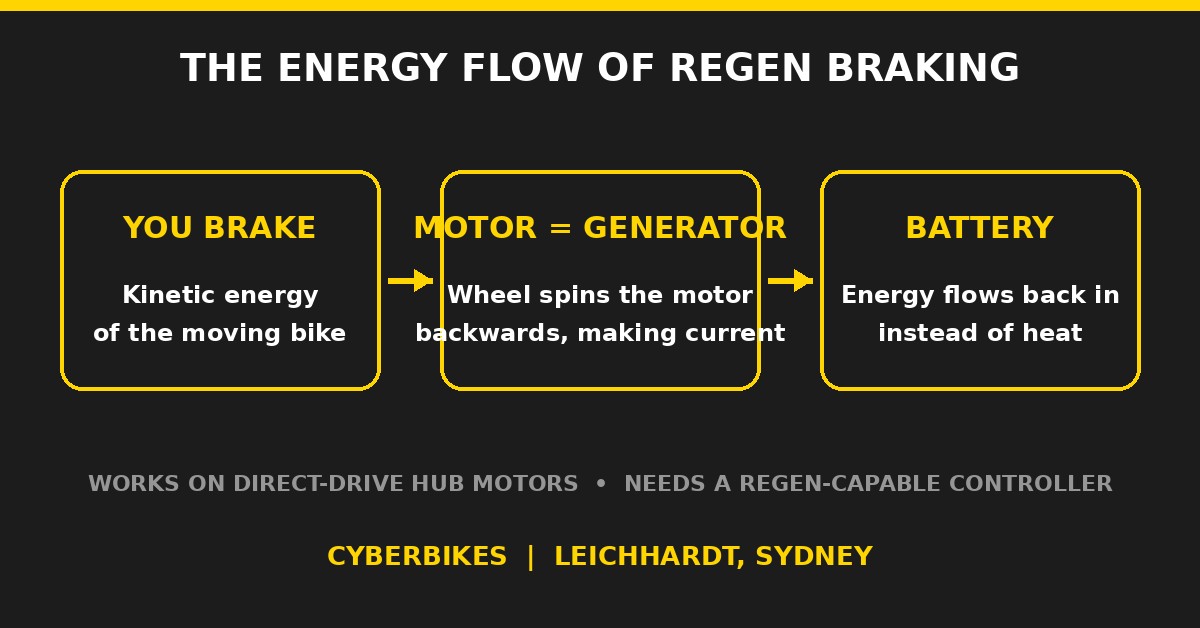
Regenerative braking on an e-bike uses the electric motor itself as a brake: as you slow down, the wheel spins the motor like a generator, turning your momentum back into electricity and feeding it into the battery instead of burning it off as heat. It gives smooth, weather-proof braking with almost no wear, and it recovers a little range every time you slow. But it only works on certain motor types and only if the controller supports it — so it is not a feature every e-bike has.
At Cyberbikes in Leichhardt, this is one of the questions we get most from riders eyeing hilly commutes across Sydney. Here is exactly how e-bike regenerative braking works, which bikes can do it, and where its real-world limits are — grounded in the engineering explainers from Grin Technologies at ebikes.ca.
What is regenerative braking on an e-bike?
A normal bicycle brake is a one-way street: your speed is kinetic energy, and friction brake pads scrub it off as heat into the rotor and air. That energy is gone forever. Regenerative braking — “regen” for short — recycles part of it instead.
An e-bike motor is essentially the same machine whether it is driving or braking. Push electricity in and it spins the wheel. Spin the wheel and it pushes electricity out. When you trigger regen, the controller flips the motor from consumer to producer: the turning wheel now drives the motor as a generator, and the electrical drag that creates is what slows you down. That recovered current flows back up into the battery pack. As Grin’s engineers put it, regen “captures this braking energy and puts it back into the battery pack, rather than burning it all off as heat.”
Because the braking force comes from an electromagnet, not a pad squeezing a rotor, it is perfectly consistent in the wet, in the cold, and after long descents — and it wears out precisely nothing.
Which e-bikes can actually do regen?
This is where most of the confusion lives, because the majority of e-bikes sold cannot regen at all — and it has nothing to do with the battery. It comes down to how the motor is coupled to the wheel.
- Direct-drive hub motors — yes. The motor is rigidly locked to the wheel with no clutch in between, so the wheel can always spin the motor. These are the natural home of regen.
- Geared hub motors — usually no. Most geared hubs contain a freewheel clutch so the motor disconnects when you coast (this is what makes them light and efficient). A disconnected motor cannot be spun by the wheel, so no regen. The exception is a special non-freewheeling geared hub like Grin’s GMAC.
- Mid-drive motors — no. A mid-drive sends its power through the chain and the rear freewheel/cassette, which is designed to slip when you stop pedalling. Braking energy can’t travel back through it to reach the motor.
On top of the motor, you need a controller that supports regen. As ebikes.ca notes, “many budget controllers either don’t or don’t support it very well,” which is a big reason regen stays niche in the e-bike world.
Want to understand these motor types from the ground up? Our guide to geared vs direct-drive hub motors breaks down the trade-offs, and the full picture lives in our pillar explainer on how e-bikes actually work: motors, sensors and controllers.
How do you control the braking force?
Regen is only useful if you can tell the motor when — and how hard — to brake. The controller needs a signal, and there are several ways riders send one:
- E-brake lever cut-off: the simplest setup. Pulling the brake lever triggers a fixed amount of regen. It works, but you can’t vary the strength, so the mechanical brakes still do most of the job.
- Throttle-based modulation: Grin’s system re-purposes the throttle so that, with the brake levers active, twisting it controls braking force instead of power — giving you smooth, variable regen from existing hardware.
- A dedicated regen throttle: a second throttle mapped purely to braking, so you can feather regen from zero to full.
- Automatic speed-limit regen: some controllers apply regen automatically to hold a set speed downhill. Grin calls this “especially nice on hilly terrain” because it kicks in on descents with no input from you.
The technical bit: how much energy do you really get back?
Here is the honest engineering answer: less than most people hope, but more than the sceptics claim — and it depends entirely on your terrain.
The energy stored in a moving bike is proportional to the square of its speed (the classic ½ × mass × velocity²). Slowing from higher speeds theoretically holds more to recover. But a bike and rider are light and don’t carry much momentum compared to a car, and some of the recovered energy is always lost to heat in the motor windings and electronics on the way back to the battery.
The practical upshot: on flat, steady riding where you rarely brake, regen adds very little. On stop-start city commuting or long hilly descents, where you’d otherwise dump a lot of speed into your brake pads, the gains become genuinely worthwhile — and the bonus is near-zero brake-pad wear. Grin’s own team have chased regen since their earliest prototypes precisely because of what it does on hills.
Battery capacity is measured in watt-hours (volts × amp-hours). A Cyberbikes Centauro, for instance, runs a 48V 25Ah Samsung pack — that’s 1,200Wh of usable energy. Regen won’t refill a pack that size on its own, but on the right bike it trims what you draw and eases the load on your brakes.
Does regen replace your brakes? (and the safety rules)
No — regen supplements your mechanical brakes, it does not replace them. Regen braking force fades as the wheel slows and effectively disappears at walking pace, so it cannot bring you to a hard, controlled stop the way hydraulic discs can. It is a modulating, energy-saving assist, not your emergency brake.
That also matters legally. Under NSW road rules an e-bike must have working brakes to be road-legal, and a power-assisted pedal cycle is limited to 250W continuous assistance cutting out at 25 km/h. Regen doesn’t change any of that — you still need proper, maintained mechanical brakes. It’s why the Centauro we sell ships with 4-piston hydraulic brakes and 180mm rotors: real stopping power first, with any electrical assist as a bonus.
See it explained
Getting more range and performance out of your motor is often as much about how the system is tuned as the hardware itself. Our Cyberbikes team walks through motor programming — power, torque and range settings — in this video:
Frequently Asked Questions
Does regenerative braking charge my e-bike battery a lot?
Not dramatically. On flat riding the gains are small, but on stop-start commutes and long descents regen recovers a meaningful amount and, just as valuably, saves wear on your brake pads. It reduces net battery draw rather than fully recharging the pack.
Can any e-bike be converted to have regenerative braking?
No. Regen needs a direct-drive hub motor (or a special non-freewheeling geared hub) plus a controller that supports it. Standard geared hub motors and mid-drive motors freewheel when you coast, so the wheel can’t spin the motor to generate power.
Does regen braking damage the motor or battery?
No. The motor is designed to run in both directions, and controllers limit the regen current to a safe charging level for the battery. Regen actually reduces mechanical wear because your friction brakes do far less work.
The bottom line
Regenerative braking is one of the genuinely clever tricks of electric propulsion: smooth, weatherproof, low-wear braking that hands a little energy back to your battery. It shines on Sydney’s hills and stop-start streets, but only on direct-drive systems with a regen-capable controller — and it always works alongside, never instead of, your mechanical brakes. Curious whether it suits your commute? Come in for a test ride at Cyberbikes, 281 Parramatta Road, Leichhardt, or browse the range at cyberbikes.com. Ask us about rent-to-own plans from $99.99/week.
#ebikeSydney #Cyberbikes #electricbikeLeichhardt #regenerativebraking #ebiketech #CentauroEbike