Your e-bike battery protects itself with a small circuit board called a Battery Management System, or BMS — the electronic brain wired to the cells that watches every cell’s voltage and temperature and instantly cuts power the moment anything is overcharged, over-discharged, over-drawn, or too hot. It also quietly balances the cells so they age at the same rate. Without a working BMS a lithium pack would be both unsafe and short-lived, which is exactly why Grin Technologies (ebikes.ca) warns you should only ever charge a lithium battery that has one. At Cyberbikes in Leichhardt we think the BMS is the most important — and least understood — part of any e-bike battery.
What a BMS actually protects against
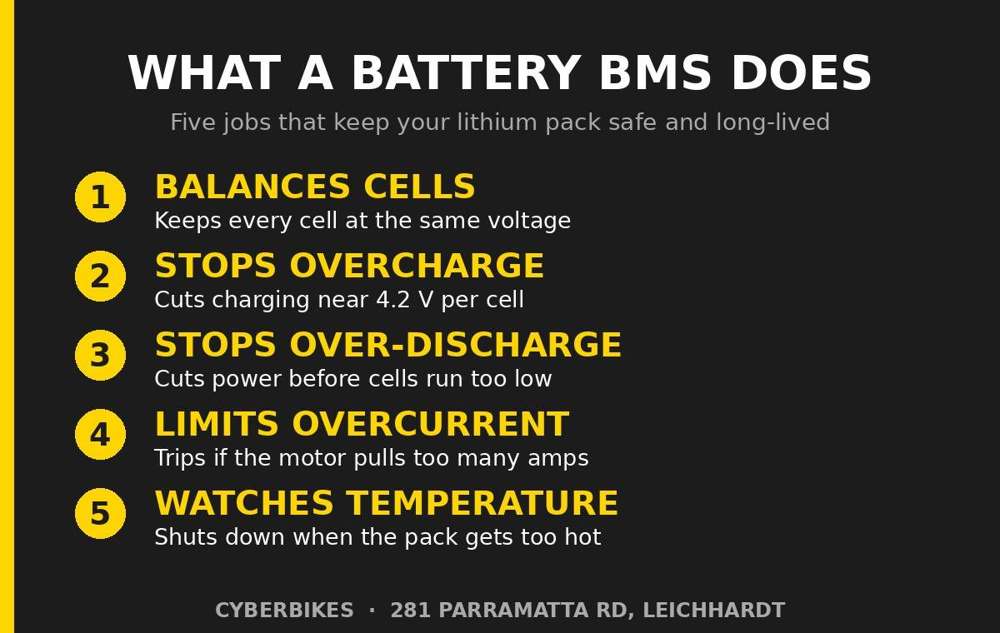
Lithium cells are fussy about their voltage window. Push a cell much past about 4.2 volts and it can vent or catch fire; drain it below roughly 2.9–3.0 volts and you permanently damage it. A single pack has dozens of these cells, and the BMS sits across all of them, sensing each one and firing electronic cutoffs before any cell strays outside safe limits. Grin describes their packs as carrying “a robust BMS circuit for overcharge, over-discharge, and overcurrent protection,” with awareness of individual cell voltages so it can spot a cell going out of balance or shorting. In practice the BMS has five jobs: it balances the cells, blocks overcharge, blocks over-discharge, limits overcurrent, and watches temperature. Take any one of those away and the pack becomes either a fire risk or a paperweight.
The engineering: cells, voltage and why balancing matters
An e-bike battery is not one big battery — it is many small cylindrical cells (usually 18650 or 21700 size) wired together. Cells in series add up to the pack voltage, since each lithium cell sits around 3.7 volts nominal; cells in parallel add capacity in amp-hours. Multiply the two and you get watt-hours, the number that really decides range: watt-hours are roughly amp-hours times pack voltage. The Centauro e-bike we build at Cyberbikes runs a 48V 25Ah Samsung pack, which works out to 1,200 watt-hours. At the roughly 10 Wh per kilometre that Grin quotes for typical riding, that is around 120 km of assisted range — less if you ride hard, more if you pedal in.
Here is where balancing earns its keep. No two cells are perfectly identical, so during charging some fill faster than others. If one cell hits 4.2 volts while its neighbours lag behind, the charge has to stop early to protect that full cell — and the whole pack loses usable capacity. A balancing BMS bleeds a little charge off the fuller cells so they all finish level, keeping every kilometre available and stopping the weakest cell from being stressed on every ride. An unbalanced pack feels like it “lost range” long before the cells are actually worn out. If you want the full picture on cell chemistry and capacity, our definitive guide to e-bike batteries goes deeper.
Why does my e-bike cut out at full throttle?
If your bike briefly dies under hard acceleration or on a steep hill, the BMS is usually doing exactly what it should. Every BMS has an overcurrent trip: ask the cells for more amps than the board is rated to pass and it shuts the pack off to protect them. Grin puts it plainly — pair a controller set to 40 amps with a pack whose BMS is rated for 25 amps and “the BMS will either cut out at full throttle or the pack will run stressed and wear out faster.” The fix is not to bypass the BMS but to match the battery to the bike: the pack’s current rating should always cover what your controller draws. A battery rated for more current than the controller needs is never a problem; the reverse is.
Single-port vs dual-port BMS — and the safe way to charge
Not all BMS boards are wired the same, and the difference matters most at the wall. A single-port BMS uses one set of terminals for both charging and discharging, so the same protection sits in the path whether power is going in or out. A dual-port BMS has separate charging and discharging circuits. Grin points out the catch: if you parallel-connect two packs and charge them together, a pack fed through its discharge leads on a dual-port board has no overcharge protection in that path — a real risk if a cell misbehaves. The safe habit is simple: charge each battery with its own charger, and only join packs in parallel for riding.
| BMS protection | What it does for you |
|---|---|
| Cell balancing | Keeps every cell level so you get full capacity and range |
| Overcharge cutoff | Stops charging near 4.2 V per cell to prevent fire risk |
| Over-discharge cutoff | Cuts power before cells drain too low and get damaged |
| Overcurrent trip | Protects cells when the motor demands too many amps |
| Temperature protection | Shuts the pack down if it gets too hot or too cold to charge |
How to keep your BMS and battery happy in Sydney
The BMS protects the pack, but a few habits let it protect your range for years instead of months. First, partial charging: for everyday riding, charge to about 80–90% and save the full 100% charge for the days you need maximum range. Grin notes that one habit alone “can multiply both the cycle life and the calendar life of a lithium battery.” Second, never store a pack dead flat, and don’t leave it uncharged for months — our Cyberbikes warranty terms flag that a battery left uncharged for over two months, or damaged by freezing or excessively hot weather, falls outside cover. Sydney’s cold winter mornings and hot summer afternoons both stress cells, and the BMS’s temperature protection will simply cut output to keep them safe.
This is also where certification comes in. The Samsung pack in the Centauro e-bike is UL 2271-certified for battery safety and ships UN38.3-tested for transport — and a well-designed BMS is central to passing those standards, exactly as Grin’s UL 2271-certified packs are. It is worth knowing your battery has been tested to a real standard rather than trusting a cheap generic pack. If you already own a bike, our guide to how long e-bike batteries last pairs neatly with these charging habits.
See it explained
In this Cyberbikes video we walk through how battery capacity, voltage and your riding style shape real-world range — the same numbers the BMS is quietly protecting every time you ride.
Frequently asked questions
What is a BMS on an e-bike battery?
A BMS (Battery Management System) is a small circuit board inside the battery that monitors every cell’s voltage and temperature and cuts power to prevent overcharging, over-discharging, overcurrent and overheating. It also balances the cells so the pack ages evenly and safely.
Why does my e-bike cut out at full throttle?
Often the BMS is doing its job. If your controller tries to pull more amps than the battery’s BMS is rated for, the BMS trips to protect the cells. Grin Technologies notes that pairing a 40A controller with a 25A-rated pack will make the BMS cut out at full throttle or run the pack stressed, so the pack’s current rating should always cover what the controller draws.
Can I ride or charge a lithium e-bike battery without a BMS?
No. Lithium cells are damaged or made dangerous by overcharge and deep over-discharge, so a working BMS is essential. Grin Technologies advises only ever charging a lithium battery that has an onboard BMS. If you suspect a faulty BMS, have it checked at Cyberbikes in Leichhardt before riding.
How do I keep my e-bike battery’s BMS healthy?
Charge to about 80-90% for everyday use and only fill to 100% before long rides, never store the pack flat or leave it uncharged for months, and keep it out of extreme heat and cold. These habits reduce cell imbalance and let the BMS protect your range for longer.
Ride with a battery you can trust
The BMS is invisible, but it is the difference between a battery that lasts and one that lets you down. Every Cyberbikes electric bike, including the Centauro, is built around a certified pack and a proper BMS — and our team in Leichhardt can diagnose or replace a tired BMS on almost any e-bike. Come in for a test ride at Cyberbikes, 281 Parramatta Road, Leichhardt, browse the Centauro e-bike, or ask about our rent-to-own plans from $99.99/week.
#CyberBikes #ebikeSydney #electricbikeLeichhardt #ebikebattery #BMS #CentauroEbike #ebiketech