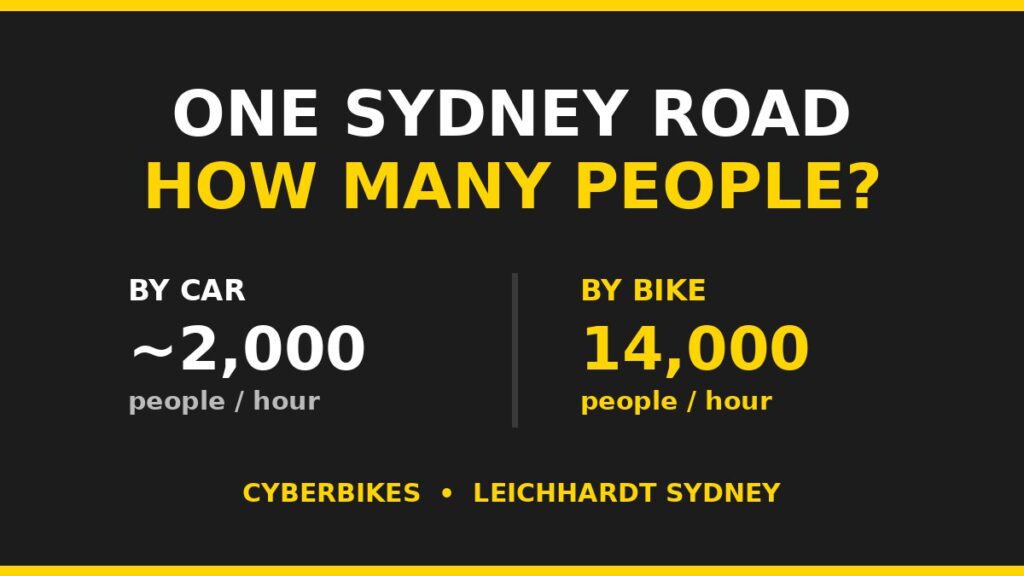
A single Sydney road lane packed with cars moves only about 2,000 people an hour — but hand that same road space to bikes and it can carry up to 14,000. That’s not wishful thinking: it’s the number the Committee for Sydney put on Sydney’s own streets. So when we ask how many people a Sydney road can move, the honest answer is: far more than we currently let it — because we’ve been measuring the wrong thing.
What does “moving people” actually mean on a Sydney road?
For decades we’ve measured roads by how many vehicles they carry, not how many people. It’s a subtle swap with huge consequences. A traffic lane clogged with single-occupant cars looks busy, but it’s one of the least efficient ways ever invented to move human beings through a city. On Sydney’s main roads, space is scarce and contested — you can’t simply bulldoze another lane through Newtown or Leichhardt. The only lever left is efficiency: how many people you move through the road space you already have.
Reframed that way, the picture flips. A car lane’s ceiling sits around 2,000 people per hour. Give the same strip of Sydney road space to protected cycling and you can push up to 14,000 people through it. Same asphalt, seven times the throughput. This is the quiet maths behind every serious plan to unclog a modern city.
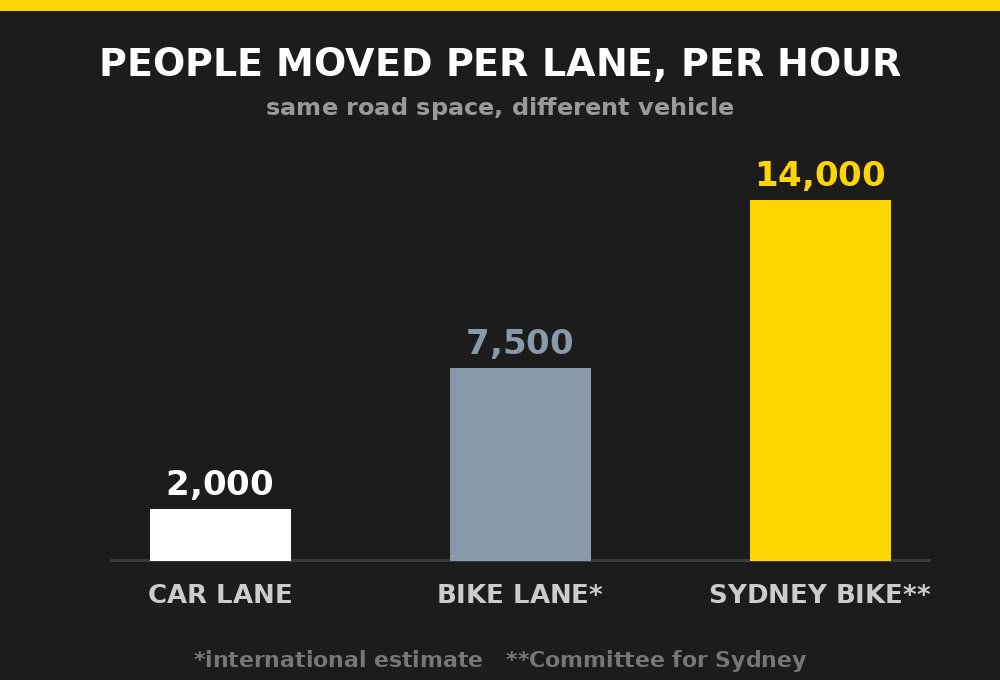
How much more can one Sydney road move on bikes than in cars?
The gap is enormous, and it holds up internationally. Transport-capacity research compiled by NACTO finds a general traffic lane moves roughly 2,000 people an hour when it’s full of cars, while a protected bike lane on the same footprint can carry around 7,500. The Committee for Sydney’s Sydney-specific figure is even more striking — a jump from 2,000 to 14,000 people once a road is properly reallocated to cycling.
Buses and trains are brilliant at this too, which is exactly the point: cars are the outlier. Every mode that packs people efficiently — walking, cycling, mass transit — beats the private car by multiples on a per-lane basis. The e-bike simply extends the winning end of that range to riders who’d never tackle Sydney’s hills and distances on a regular pushbike.
If bikes are so efficient, why is Sydney still stuck in traffic?
Because the network isn’t there yet. You can’t ask people to ride 14,000-per-hour capacity down a painted line that vanishes at the next intersection. Today only about 16,000 cycle trips a day are made across Sydney City and the Inner South — but the Committee for Sydney estimates that with a genuinely connected, safe network that could rise to over 240,000 trips a day. Transport for NSW itself reckons cycling’s share of trips could hit 5% with comprehensive infrastructure. The capacity is latent; it’s the safe, continuous lanes that are missing.
There’s an honest trade-off, and it’s worth naming: reallocating road space means giving something up in the short term, and Sydney’s distances and topography put real cycling off the table for a lot of people. That’s precisely the problem the e-bike solves. An electric motor flattens the hills and shrinks the distances, turning a sweaty 12 km commute into an easy one — which is why mode shift and better street design have to arrive together, not one without the other. It’s the same reason building more motorways never fixes Sydney’s traffic: you can’t pour your way out of a maths problem.
What does Sydney gain by giving road space to bikes?
Room to breathe. The Committee for Sydney found that shifting just 2–5% of short trips within 10 km of the Eastern Harbour to cycling would strip 20,000 to 50,000 car trips off the city’s roads every day. Those aren’t abstract cars — they’re the ones idling in front of you on Parramatta Road. Fewer cars per person moved means less congestion, lower emissions, cleaner air and cheaper travel, all without a single new lane of tarmac.
The tool that makes this realistic for ordinary Sydneysiders is the e-bike. Our Cyberbikes Centauro runs a 250 W motor and a 48V 25Ah (1200Wh) Samsung battery — NSW-legal at 25 km/h pedal-assist, certified to UL 2271 and EN 15194 — with a full-suspension step-through frame that carries up to 150 kg of rider and cargo. It’s a car-replacement for the trips that clog Sydney worst: the school run, the commute, the grocery dash. If you want the bigger picture on ditching the car, our guide to what owning a car in Sydney really costs does the sums.
Frequently Asked Questions
How many people can one traffic lane move?
A single traffic lane full of cars moves roughly 2,000 people per hour. The same lane reallocated to protected cycling can carry around 7,500 people per hour by international estimates, and up to 14,000 according to the Committee for Sydney’s analysis of Sydney streets — because bikes use road space far more efficiently than single-occupant cars.
Would bike lanes make Sydney traffic worse?
The evidence points the other way. Committee for Sydney modelling suggests shifting just 2–5% of short trips within 10 km of the Eastern Harbour to cycling would remove 20,000–50,000 car trips a day from Sydney’s roads. Moving more people through the same road space reduces congestion rather than adding to it.
Are e-bikes legal to ride on Sydney roads?
Yes. In NSW a pedal-assist e-bike is street-legal with a motor up to 250 W continuous that cuts out at 25 km/h, with no licence or registration required. The Cyberbikes Centauro is built to that EN 15194 standard and its battery is UL 2271-certified for safety.
Sydney doesn’t have a road-space shortage — it has a road-space efficiency problem. Swap one car trip a week for an e-bike ride and you’re already part of the fix. Curious what going car-lighter would look like for you? Come talk to us at Cyberbikes, 281 Parramatta Road, Leichhardt — the Centauro is a good place to start.
#Cyberbikes #eBikeSydney #Leichhardt #CarFreeSydney #SydneyTraffic #BikeLanes #UrbanMobility #eBikeCommute #Centauro