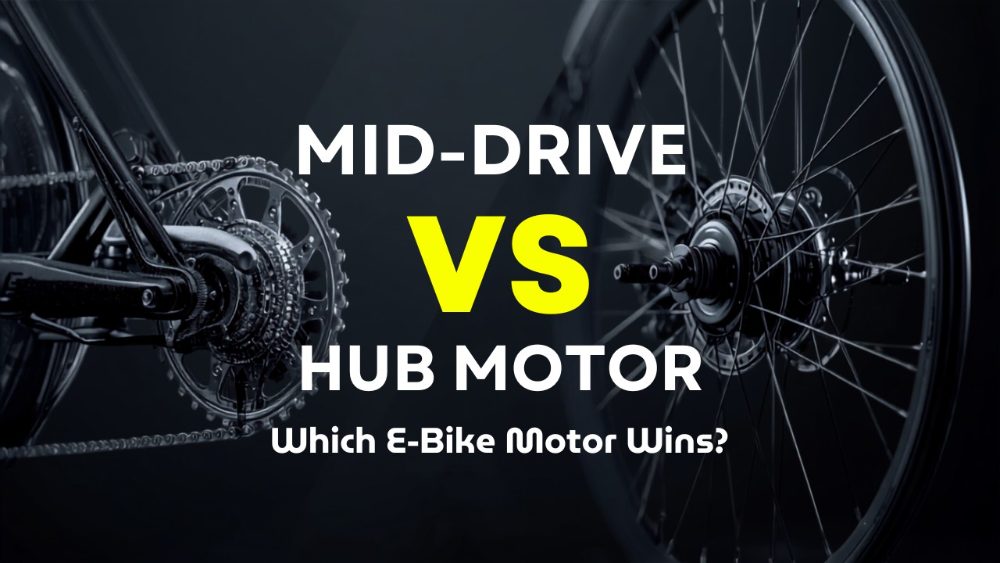
Mid-drive vs hub motor comes down to one thing: where the motor puts its power. A mid-drive motor drives the bike’s chain and gears, so it multiplies torque through your cassette to climb steep hills and haul cargo efficiently. A hub motor drives the wheel directly, which makes it simpler, quieter, cheaper and lower-maintenance — the better pick for the flat-to-rolling roads most Sydney riders cover. Neither is universally “better”; the right motor depends on your terrain, your budget, and how much you load the bike. Here’s the full engineering breakdown, in plain rider language.
How a mid-drive motor actually works
A mid-drive motor sits low and central at the bottom bracket, right where your pedals turn, and feeds its power into the same chain and gears you pedal with. That single design choice is its superpower. Because the motor drives through your cassette, you can downshift on a climb and let the motor keep spinning fast in its efficient range instead of grinding slowly.
Why does spinning fast matter? As Grin Technologies explains on ebikes.ca, a motor’s power density is proportional to the relative speed between its magnets and windings. A mid-drive spins internally at several thousand rpm and then gears down, so a small, light motor can deliver big torque. When you hit a hill, you drop into a low gear, the motor multiplies its torque through the drivetrain, and you climb. The trade-off is simple physics: all of that torque runs through your chain, cassette and chainring, so those parts wear faster and need replacing more often than on a hub-driven bike.
How a hub motor actually works
A hub motor is built into the centre of the wheel and drives it directly, completely independent of your gears. Turn the throttle or pedal, current flows to the windings, and the wheel spins. There are no external brackets or extra chains — it mounts like any other wheel. There are two families, and the difference matters.
Geared vs direct-drive hub motors
Direct-drive hubs are the simplest machines going: the wheel rim is laced straight onto the spinning motor body, with no internal gears. They’re large and heavy, but they’re always mechanically engaged, which is what makes regenerative braking possible. The downside is cogging or drag torque — ebikes.ca measures it at roughly 0.3–1 Nm — so you’re always fighting a little resistance, even with the power off.
Geared hubs put a planetary reduction gearset inside, letting a fast, efficient motor spin down to wheel speed. They weigh about 50% less than an equivalent direct-drive motor and often make more torque. A freewheel inside means almost no drag when you’re not on the power — but that same freewheel rules out regenerative braking. Most modern commuter e-bikes, including the Cyberbikes Centauro, use a compact geared rear hub: light, quiet, low-maintenance, and happy to run a throttle. If you want the deeper picture on drives, sensors and controllers, our guide on how e-bikes actually work: motors, sensors and controllers ties it all together.
Mid-drive vs hub motor: the head-to-head
| What matters | Mid-drive motor | Hub motor |
|---|---|---|
| Power delivery | Through the bike’s gears | Direct to the wheel |
| Steep hills & heavy cargo | Excellent — multiplies torque | Good with a geared hub |
| Weight balance | Centred and low | Weight sits at the wheel |
| Maintenance | Higher — chain & cassette wear | Lower — drivetrain untouched |
| Upfront cost | Usually higher | Usually lower |
| Regenerative braking | No | Direct-drive hubs only |
| Fixing a flat | Standard wheel | Heavier wheel, unplug wiring |
| Best for | Hills, cargo, off-road | Flat-to-rolling commutes |
Why torque, not watts, decides the climb
Here’s the part that cuts through the marketing. On its motor power ratings page, ebikes.ca makes the point bluntly: a watt is a watt. Six hundred watts of mechanical power will move a bike the same way whether it comes from a small geared hub, a huge direct-drive hub, or a mid-drive. Power is just torque times spin: Power (watts) = torque × rpm × 0.104. The same motor making 20 Nm at 100 rpm produces about 209 watts; at 300 rpm it produces about 628 watts.
That formula is why a “750W” sticker tells you almost nothing on its own. What actually gets you up a hill is torque — and torque is also what heats a motor up. Push twice the current through the windings for twice the torque and you generate four times the heat (the I²R relationship). Sustain that too long and the motor cooks. This is the mid-drive’s hidden advantage: by downshifting, it makes the wheel torque you need while the motor itself spins fast at lower current, so it stays cooler on a long climb. A single-speed hub can’t downshift, so on a steep grade it slows, current climbs, and heat builds.
Why do mid-drive motors overheat — and how do you stop it?
Even a mid-drive will overheat if you lug it — that is, hold full assist in too high a gear at low speed on a climb. Same I²R physics: low rpm plus high torque means high current and rapid heat build-up. The fix is free and simple: downshift early, keep your cadence up, and don’t sit on full throttle at a crawl. Popular Bafang mid-drives will even throw a heat-related fault if the controller senses trouble. Our workshop team walks through a common Bafang overheating fix in this short:
A few related questions riders ask us at Cyberbikes: Is a mid-drive worth the extra cost? If you ride steep terrain or carry loads daily, yes — the efficiency and hill-climbing pay off. For flat commutes, the premium is hard to justify. Do hub motors overheat too? Yes, on long steep climbs, because they can’t gear down — which is why sensible wattage and good thermal design matter. Is a mid-drive harder to maintain? Generally yes: expect to replace chains and cassettes sooner because the motor’s torque runs through them.
Which e-bike motor is right for Sydney riding?
Start with the law, because it shapes the choice. In NSW, a pedal-assist e-bike (a pedelec) is limited to 250W of continuous rated power and must cut its motor assistance at 25 km/h; a throttle-only e-bike is capped at 200W. Both mid-drive and hub motors have to meet those limits to be road-legal here, so this isn’t about chasing raw power — it’s about which motor uses its legal watts best for your riding.
For most inner-west and Sydney commutes — flat to gently rolling, plenty of stop-start traffic — a quiet 250W geared rear hub is the sweet spot: low-maintenance, throttle-friendly, and cheaper to run. That’s exactly why our Centauro e-bike uses a 250W rear hub motor paired with a 48V 25Ah (1200Wh) Samsung battery, full suspension (100mm front, 120mm rear), hydraulic brakes, a 150kg load rating and a 50kg rear rack, all built to UL 2849, UL 2271, ISO 4210 and EN 15194 standards — a practical, NSW-legal package at $3,999.99. If you live up in the hills or move serious cargo every day, a mid-drive may earn its keep — and the best way to decide is to ride both. Pop into Cyberbikes in Leichhardt and feel the difference for yourself.
Frequently asked questions
Is a mid-drive or hub motor better for Sydney commuting?
For most flat-to-rolling Sydney commutes, a geared hub motor is the better all-rounder: it’s quieter, cheaper, lower-maintenance and can run a throttle. Mid-drive motors shine when you ride steep hills or carry heavy cargo, because they multiply torque through the bike’s gears.
Do hub motors have regenerative braking?
Only direct-drive hub motors can do regenerative braking, because they’re always mechanically engaged. Geared hub motors and mid-drive motors have an internal freewheel that removes drag but also makes regen impossible.
Why does a mid-drive motor overheat?
Lugging the motor in too high a gear at low speed forces high current to make the torque you need, and heat rises with the square of current (the I²R relationship). Downshift early and keep your cadence up so the motor spins faster and stays cooler.
What wattage e-bike is legal in NSW?
In NSW, pedal-assist e-bikes are limited to 250W of continuous rated power with motor assistance cutting off at 25 km/h, while throttle-only e-bikes are limited to 200W. Both mid-drive and hub motor bikes must meet these limits.
Still weighing mid-drive vs hub motor? Come in for a test ride at Cyberbikes, 281 Parramatta Road, Leichhardt, or browse the Centauro e-bike online. Ask us about rent-to-own plans from $99.99/week.
#ebikeSydney #Cyberbikes #Centauro #MidDrive #HubMotor #electricbikeLeichhardt #ebikeCommute #EVtech