A private car in Sydney sits parked about 95% of the time, and every space it occupies is roughly 13 square metres of land — 2.4 by 5.4 metres under the Australian Standard. Multiply that by the millions of vehicles across Greater Sydney and you get an enormous amount of prime urban land frozen in place for machines that barely move. Here is what parked cars really cost us in space, and why the humble e-bike is the most space-efficient way to unlock it.
How much of the time is a car actually parked?
The average car spends about 95% of its life parked, not driving. Transport researcher Paul Barter checked this figure three different ways — trip counts, travel-survey time and distance-and-speed data — and each time landed on roughly 5% of the day in motion. UCLA’s Donald Shoup, the world’s best-known parking economist, reached the same conclusion decades ago.
Think about your own week. A car used for the school run and a commute might be driven for 60 to 90 minutes a day and sit still for the other 22-plus hours — at home overnight, then in a work car park, then outside the shops. It needs a resting place at every one of those stops, which is why cities end up building several spaces for every single car.
How much space does one parked car really need?
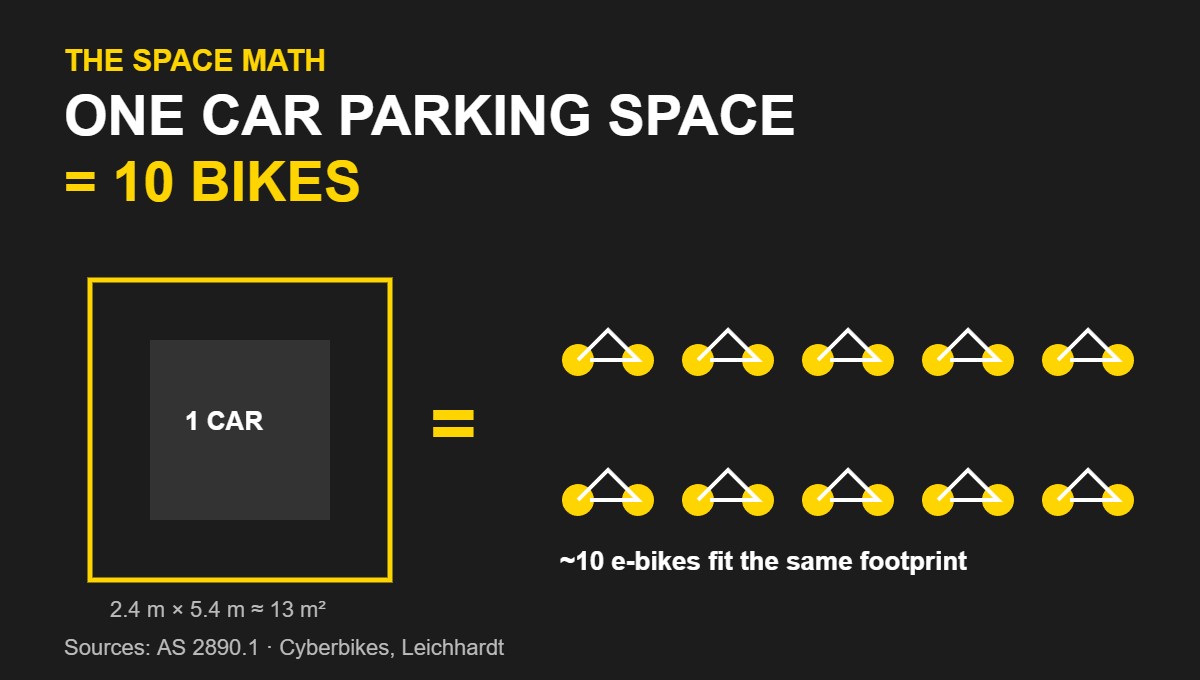
A standard Australian parking bay is 2.4 metres wide by 5.4 metres long under AS 2890.1 — about 13 m² of sealed ground. But a single bay understates the real footprint. Once you add the aisles cars need to reach the bay, planners typically allow 25 to 30 m² per space in a car park. And because a car has to be stored wherever it stops, cities effectively provide multiple spaces per vehicle.
That same 13 m² tells a very different story on two wheels. Around ten bicycles fit in the space of one parked car. So every car space converted to bike parking can serve roughly ten riders instead of one idle vehicle.
How much of Sydney is frozen for parked cars?
Start with the fleet. As of the last national count, New South Wales had about 5.9 million registered motor vehicles, and 84% of Greater Sydney households own at least one car. Each of those cars needs somewhere to rest at home, and usually somewhere to rest at its destinations too.
We do not have a clean Sydney-wide land audit, but the international numbers are telling. In Los Angeles County, parking is estimated to cover about 14% of incorporated land — around 1.4 times the area taken by roads. Anyone who has circled Leichhardt or Newtown looking for a kerbside spot knows the Inner West feels the same squeeze: narrow terraced streets where both kerbs vanish under parked cars, leaving little room for trees, wider footpaths or a protected bike lane.
That is the hidden trade-off. Land given to a stationary car cannot also be a pocket park, a loading zone, an outdoor dining space or a safe lane for someone riding to work. It is some of the most valuable real estate in Australia, and we hand a lot of it, rent-free, to vehicles that spend most of the day doing nothing.
What could Sydney reclaim with fewer parked cars?
Quite a lot — and you do not need everyone to give up their car, just to park one less of them. If a household that currently keeps a second car in Sydney swaps it for an e-bike, that is one space freed at home and several more freed across the city every day. Repeat that across a suburb and streets start to breathe: room for a calmer, low-traffic street layout, kerbside greenery, and lanes that make riding feel safe.
This is where an e-bike earns its keep. Most of the trips that fill our streets and car parks are short — exactly the short Sydney trips that belong on an e-bike, not on two tonnes of idle metal. A commuter model like the Cyberbikes Centauro ($4,249) is built for exactly this: a 250W hub motor and a UL 2271-certified 48V 25Ah (1,200Wh) Samsung battery, a welded rear rack and a 150 kg rider-and-cargo load, so it can carry the shopping or a kid on the back — all while parking ten to a car space and staying inside NSW’s 25 km/h pedal-assist limit.
None of this is anti-car so much as pro-space. Every car we can leave at home, or not buy in the first place, is a little more of Sydney handed back to the people who live here.
Frequently Asked Questions
How much of the time is a car parked?
On average about 95% of the time. Studies of travel behaviour consistently find the typical private car is in motion for only around 5% of the day and parked for the rest, at home and at its destinations.
How big is a car parking space in Australia?
A standard bay is 2.4 metres wide by 5.4 metres long under Australian Standard AS 2890.1 — roughly 13 square metres. Counting the aisles needed to reach it, planners usually allow 25 to 30 square metres per space in a car park.
How many bikes fit in one car parking space?
About ten. The footprint of a single car space can hold roughly ten bicycles or e-bikes, which is why converting even a few car bays to bike parking serves far more people.
Curious what parking one less car would look like for you? Come see us at Cyberbikes, 281 Parramatta Road, Leichhardt, and take a Centauro for a spin — the best way to feel how much room a short trip really needs.
#Cyberbikes #eBikeSydney #Leichhardt #CarFreeSydney #UrbanPlanning #Parking #InnerWest #Centauro #RideDontDrive