A cadence sensor switches the motor on based on whether you’re pedalling and how fast the cranks spin; a torque sensor measures how hard you push and scales the motor’s power to match your effort. Neither is universally better. A torque sensor feels natural and athletic, like the bike is amplifying your legs. A cadence sensor gives steady, near-effortless assist that you dial up or down from a handlebar button. The right choice comes down to how you want to ride around Sydney — and this guide, built on the engineering references at Grin Technologies (ebikes.ca), walks through exactly how each one works.
Torque sensor vs cadence sensor: the quick comparison
Both are types of PAS — Pedal Assist System — the electronics that power the motor automatically when you pedal, without touching a throttle. The difference is what they measure and how the ride feels.
| Feature | Cadence sensor | Torque sensor |
|---|---|---|
| Measures | Crank rotation (speed only) | Pedal force + rotation |
| Power delivery | Fixed level once you pedal | Scales with how hard you push |
| Feel | Steady, scooter-like, set-and-forget | Responsive, natural, “bionic legs” |
| Control | Handlebar assist button | Your own pedal effort |
| Typical cost | Lower | Higher |
| Best for | Relaxed commuting, steady cruising | Fitness riders, hills, “earned” power |
What is a cadence sensor and how does it work?
A basic cadence sensor (the most common type of PAS) uses a ring of magnets fixed to the crank arm or spindle, with a pickup that counts the magnets passing as you pedal. The electronics know one thing: how fast the cranks are turning. They don’t know how hard you’re pushing, so the system simply delivers a set amount of power whenever it detects pedalling.
The critical spec here is the number of magnetic poles on the ring. Early sensors had just 5 or 6 magnets, so you had to turn the cranks nearly half a rotation before the motor woke up — and there was a noticeable lag before it cut out again when you stopped. Modern sensors use 12 poles as standard, and increasingly 24 or more, which makes the response far quicker and smoother. Better sensors also use a two-wire “quadrature” signal so the system can tell forward pedalling from backward, meaning the motor won’t lurch when you roll the bike backwards out of a rack.
The payoff is a ride that decouples your effort from the terrain. Set the assist level you want, and the motor holds that output whether you’re climbing or cruising. You pedal at a comfortable, even effort and let the button — not your legs — decide how much help you get. For a lot of Sydney commuters, that’s exactly the point of an e-bike.
What is a torque sensor and how does it work?
A torque sensor adds a second measurement: the actual force you apply to the pedals. Most aftermarket versions are a replacement bottom bracket with force-sensing built in, though the force can also be read at the chainring, the chain tension, the rear dropout, or the rear axle. Grin lists at least nine distinct sensing methods — from strain gauges and magnetostrictive spindles to the axle-flex approach BionX pioneered — but they all get grouped under the single label “torque sensor.”
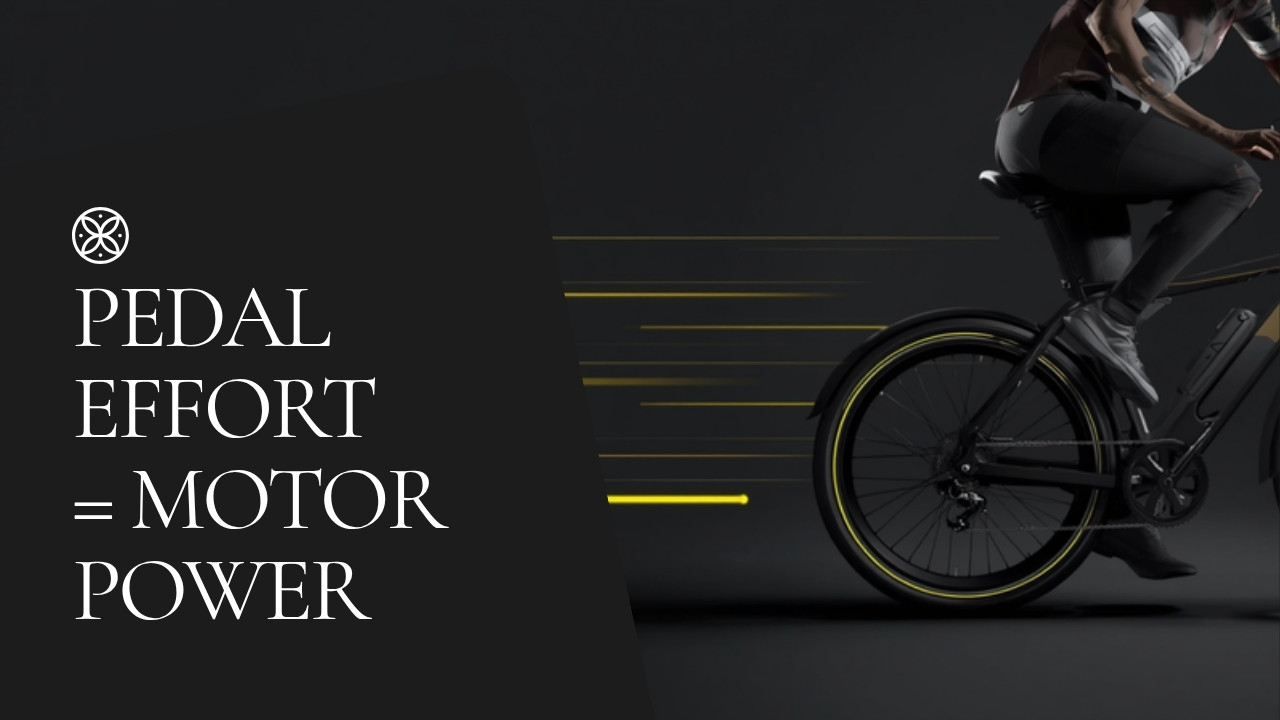
Here’s the engineering that matters to you as a rider: your human power output equals torque multiplied by cadence (roughly, watts = how hard × how fast). A torque sensor reads that effort in real time and the controller applies a multiplier — say 1:1, or 2:1, so every watt from your legs becomes two from the motor. Pedal harder and you instantly get more power; ease off and it fades away. Many systems add a small offset threshold so light pedalling gives no boost at all, and the motor only kicks in when you genuinely lean into a hill.
Crucially, a torque sensor always includes a cadence signal too — both for calculating your power (torque × rpm) and for safety, so the bike can never drive itself forward from a drifting force reading while you’re standing still. The result is a ride that feels like a stronger version of a normal bike: you sweat going up and take it easy going down, but everything happens faster.
Which feels better to ride?
This is the “it depends” question, and honestly, both camps are right. Many people assume the torque sensor is the gold standard and the cadence sensor is the cheap compromise. Grin’s own engineers push back on that, and after years of test rides at our Leichhardt shop, so do we.
A torque sensor couples motor power directly to your legs. Going uphill you must pedal hard to get the power to climb; on the flat, pedalling hard gives you motor power you may not want. That’s fantastic if you want a workout and a bike that rewards effort. A cadence sensor, paired with an easy handlebar adjustment, does the opposite — it lets the motor make up the difference between your steady effort and what the hill demands, so you arrive at work without changing your shirt. One isn’t better; they’re built for different riders. The best way to know which suits you is to feel both, which is exactly what a test ride is for.
Does the sensor type change your e-bike’s range?
It can, and this is where the two philosophies diverge again. Because a torque sensor only feeds the motor in proportion to your effort, a rider who pedals moderately often draws less power than they would on a cadence bike set to a high fixed level — which can stretch range on the same battery. But it’s not automatic: hammer a torque-sensor bike and you’ll burn watts fast, while a cadence rider who sits on a low assist level all day can be very efficient too.
Range is really governed by energy, not sensor type. Your battery’s capacity in watt-hours (volts × amp-hours) divided by your consumption in watt-hours per kilometre gives your real-world range. The Cyberbikes Centauro, for example, carries a 48V 25Ah Samsung pack — that’s 1,200Wh — so at a typical 10–15Wh/km you have a very generous cushion regardless of which sensor is driving the motor. Grin’s free trip simulator lets you model this for any voltage, terrain and rider weight if you want to see the numbers.
See how e-bike pedal assist actually feels
Reading about assist is one thing; watching it in action is another. Our full Centauro review shows the pedal-assist system doing its job around Sydney — how quickly it engages, how it handles hills, and why it replaces a lot of short car trips.
What should Sydney riders choose?
If you ride mostly to stay fit, love hills, and want the bike to feel like an extension of your body, a torque sensor is worth paying for. If your priority is arriving relaxed, carrying cargo, or handling stop-start city traffic where you’d rather set your assist and forget it, a well-tuned cadence system is genuinely excellent — and it’s why so many practical commuter and cargo e-bikes use one. The Centauro is built as a do-everything commuter, cargo and cross-country bike with a 250W rear hub motor, so it leans into that steady, dependable, load-hauling character. Come and ride one at Cyberbikes in Leichhardt and you’ll feel the difference within a block.
Want the bigger picture on drive systems first? Our guide to mid-drive vs hub motors explains how the motor itself shapes the ride, and if you’re wondering about the other kind of sensor inside the motor, see sensored vs sensorless e-bike motors.
Frequently Asked Questions
Can you tell which sensor an e-bike has just by riding it?
Usually, yes. On a torque-sensor bike the power builds and fades with your pedal pressure and feels instant and proportional. On a cadence bike the motor comes on at a steady level a fraction of a second after you start pedalling and holds that output until you change the assist level or stop. A quick test ride makes it obvious.
Does a torque sensor give more range than a cadence sensor?
Often, but not always. A torque sensor only draws power in proportion to your effort, so a moderate rider tends to use less battery than on a cadence bike set to a high fixed assist. Range ultimately depends on your battery’s watt-hours and your watt-hours per kilometre, not the sensor alone.
Can you add a torque sensor to a cadence-sensor e-bike?
Sometimes, on conversion-friendly bikes, by fitting a torque-sensing bottom bracket and a controller that can read it (such as a Cycle Analyst). On most sealed, turn-key commuter e-bikes it isn’t practical — the electronics are matched to the original sensor. Ask our Leichhardt workshop before assuming a swap is possible.
Ride both before you decide
The only way to know whether torque or cadence suits your legs is to feel them back to back. Come in for a test ride at Cyberbikes, 281 Parramatta Road, Leichhardt, browse the range at cyberbikes.com, or ask about our rent-to-own plans from $99/week. Call us on 0491 794 668 or visit Tuesday–Saturday.
#eBikeSydney #ElectricBikeLeichhardt #Cyberbikes #TorqueSensor #CadenceSensor #PedalAssist #CentauroEbike #eBikeTech