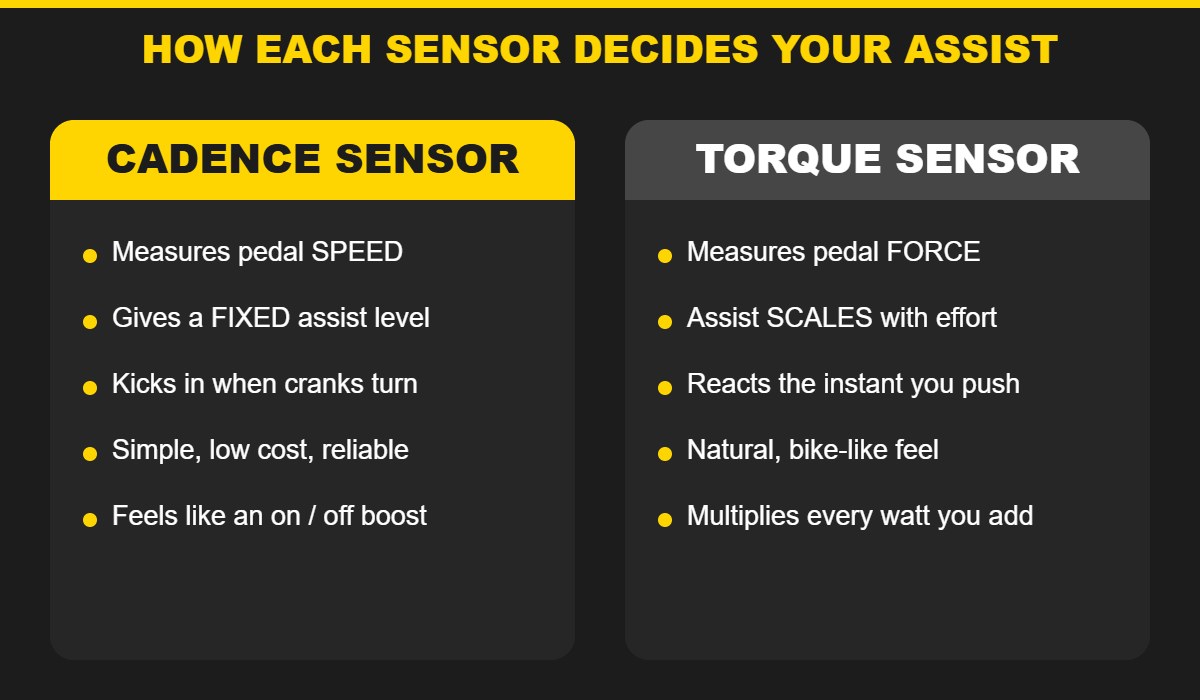
A cadence sensor measures how fast you spin the pedals and delivers a preset level of assist, while a torque sensor measures how hard you push and multiplies that effort into motor power. In plain terms: cadence gives you a steady, almost on-or-off boost the moment the cranks turn; torque gives you a natural, proportional push that rises and falls with your legs. Neither is universally better — the right choice in the torque sensor vs cadence sensor debate depends on how and where you ride. At Cyberbikes in Leichhardt, Sydney, it is the question we hear most once riders move past range and price, so let’s settle it properly.
| Cadence sensor | Torque sensor | |
|---|---|---|
| What it measures | Pedal speed (cranks turning) | Pedal force (how hard you push) |
| How assist is applied | Fixed level for the chosen setting | Scales in proportion to your effort |
| Feel | Steady boost, slight on/off character | Natural, bike-like, responsive |
| Response time | Depends on sensor poles (12–24+) | Near-instant — reads force directly |
| Cost & complexity | Lower, very reliable | Higher, more sophisticated |
| Best for | Set-and-forget cruising, hills without extra effort | Riders who want an earned, connected feel |
What a cadence sensor actually measures
A cadence sensor — also called a basic pedal-assist sensor, or PAS — does one job: it counts how fast the cranks are turning. The usual design is a magnet ring on the crank arm or built into the bottom bracket, with a fixed pickup that fires a pulse each time a magnet passes. The controller therefore knows that you are pedalling and roughly how quickly, but it has no idea how hard you are pushing. So it simply applies a set amount of assist for the level you have dialled in on the handlebar.
Resolution is everything here. According to Grin Technologies at ebikes.ca, early sensors used just 5–6 magnets, so you had to turn the cranks nearly half a rotation before the motor woke up, with a matching lag when you stopped. Modern sensors use 12 poles as standard, and 24-pole (and higher) units are increasingly common for near-instant response. Cadence systems also come in two flavours: constant power, where each level gives a fixed wattage, and constant throttle, where each level effectively caps your speed rather than your power draw.
What a torque sensor actually measures
A torque sensor measures force — how hard you press the pedals — and feeds that into the motor in proportion to your effort. Pedal harder and you get more power; ease off and the motor eases off with you. Grin describes this as a multiplier on your own output: a 1:1 setting matches your legs watt-for-watt, while a 2:1 setting doubles every watt you put in. Many systems add an offset threshold, so the motor only engages once you are pushing past, say, 50–200 watts, letting the bike ride like a normal bicycle under gentle effort and only surging in when you really need it climbing or accelerating.
To put the forces in perspective, ebikes.ca notes that a 60 kg rider standing with all their weight on a horizontal 165 mm crank produces about 97 Nm of torque — the kind of peak these sensors are engineered to read cleanly, hundreds of times a second.
How the numbers actually work
Two simple relationships explain the whole system. Motor power follows Watts = Volts × Amps, so a 48V e-bike drawing 10 amps is delivering roughly 480 watts. Your own contribution follows power = torque × cadence — which is exactly why a torque sensor also needs a cadence signal: force on its own is not power, it is force at a given pedalling speed. Your battery is the fuel tank, measured in watt-hours (Volts × Amp-hours). The Centauro’s 48V 25Ah pack, for example, stores 1200Wh. Burn 12 Wh per kilometre and that is roughly 100 km of theoretical range; lean on full power and it drops fast. Sensor type changes how the power is delivered, but physics decides how far it takes you.
Which feels better for Sydney riding?
Honestly, it depends. A torque sensor couples motor power to your effort, so climbing the back streets around Leichhardt you have to push to get the push — sweat going up, take it easy coming down, just like a normal bike but amplified. If you want that earned, connected feel (and enjoy watching your own watts), it is superb. But one of the real joys of an e-bike is decoupling terrain from effort: cruising at one easy, steady effort whether the road tilts up or down. As Grin points out, a basic cadence sensor with a handlebar assist dial does that beautifully, giving you independent control of power and effort without ever holding a throttle. In stop-start traffic, a cadence system’s on/off character can occasionally nudge the motor when you would rather it stayed quiet — worth knowing before you choose.
Does a torque sensor give you more range?
Not by magic. Range on any e-bike comes down to that same sum: battery watt-hours divided by the watt-hours you burn per kilometre. A torque sensor can help in practice, because it only draws power in proportion to your effort, so gentle pedalling sips from the pack. A poorly set cadence system, by contrast, can serve up a fixed chunk of power whether you need it or not. But a rider who leans on maximum assist will flatten either battery at a similar rate. On the Centauro’s 1200Wh pack, the difference between a light and a heavy right hand matters far more than the sensor label.
Can you have both a throttle and pedal assist?
Yes — plenty of e-bikes run both, and it is worth understanding how they interact and what the law allows. We cover whether your e-bike can legally run a throttle and pedal assist in NSW in detail. The short version for Australia: a road-legal e-bike gives pedal assist up to 25 km/h, and where a throttle is fitted it is limited to 6 km/h (walk-assist speed). Importantly, a torque sensor always carries a cadence signal too — that is a safety feature, so the bike cannot take off from a drifting force reading alone without the pedals actually turning.
Why does my pedal assist lag before it kicks in?
That pause is almost always about sensor resolution. A low-pole cadence sensor has to see several magnets pass before it is confident you are pedalling forward, so power arrives late and lingers after you stop. Higher-pole (24+) sensors respond within a fraction of a crank turn, and torque sensors react the instant you press. If your assist feels laggy, surges oddly, or drops out, it is worth diagnosing — we walk through the common causes of an e-bike cutting out and how to fix them.
How does the sensor know which way you’re pedalling?
Clever wiring. If pedalling backwards — say, rolling the bike out of a rack — triggered the motor, you would get a nasty surprise. Basic single-wire sensors simply ignore reverse rotation. Grin’s sensors and most bottom-bracket units use a two-wire quadrature signal (two pulses out of phase), so the controller reads direction from their sequence and can even use backward pedalling as a control input for features like regenerative braking.
What sensor setup does the Cyberbikes Centauro use?
The 2026 Cyberbikes Centauro e-bike runs a 250W rear-hub motor with pedal assist tuned to Australia’s 25 km/h limit, paired with a 48V 25Ah (1200Wh) Samsung battery and UL 2849 and UL 2271 certification. Live specs and current pricing are listed on the product page, which is always the source of truth. The best way to judge any pedal-assist feel is with your own legs, though — numbers on a page never quite capture how an assist system behaves under you.
Power is also where this whole topic gets misunderstood. Our team explains why the watt rating everyone argues about often measures the wrong thing:
Frequently Asked Questions
What’s the main difference between a torque sensor and a cadence sensor?
A cadence sensor detects how fast you are turning the pedals and gives a fixed level of assist, so power feels like a steady boost. A torque sensor detects how hard you are pushing and scales the motor to your effort, giving a more natural, proportional, bike-like feel.
Is a torque sensor worth it for commuting?
For many commuters, yes — the proportional response feels smoother and more intuitive in traffic and on hills, and it can be gentler on the battery when you ride lightly. But a well-tuned cadence system with a handlebar assist dial is cheaper, very reliable, and lets you cruise at a steady effort without pushing harder on climbs.
Do all e-bikes have a torque sensor?
No. Many affordable and turn-key e-bikes use a cadence (basic PAS) sensor because it is simpler and cheaper, while premium and performance models more often use torque sensors. Always check the spec sheet, and ideally test-ride both before deciding which feel you prefer.
Test-ride the difference in Leichhardt
The fastest way to know which system suits you is to feel them back to back. Come in for a test ride at Cyberbikes, 281 Parramatta Road, Leichhardt, or browse the Centauro e-bike and ask us about rent-to-own plans. We have spent more than a decade selling, renting and repairing e-bikes in Sydney, and we are happy to talk you through exactly what is under the bike you are buying.
#eBikeSydney #Cyberbikes #ElectricBikeLeichhardt #TorqueSensor #CadenceSensor #PedalAssist #CentauroEbike #eBikeTech