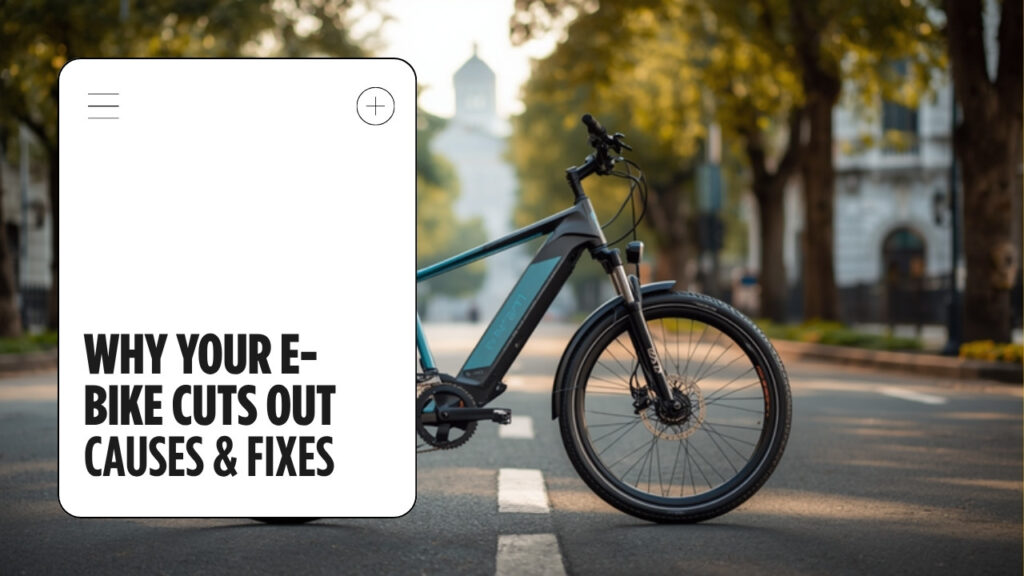
If your e-bike keeps cutting out, the usual culprits are a low or sagging battery hitting its low-voltage cutoff, a loose or corroded connector, or a faulty hall sensor or brake cut-off switch — not a dead motor. Nine times out of ten, a sudden power loss is an electrical connection or a protection circuit doing its job, and most causes are quick to track down at home or at our Leichhardt workshop. Below are the six real reasons an e-bike loses power, how to tell them apart in about a minute, and what to do about each — grounded in the engineering documented by motor specialists Grin Technologies (ebikes.ca).
What “cutting out” actually means
There is a difference between a bike that gradually fades and one that suddenly dies. A slow fade on a long climb is usually the motor easing back on purpose as it warms up — a protective “thermal rollback” the controller applies to save itself. A hard stoppage is different: power vanishes instantly, sometimes with a jolt or a flashing error code, then may return when you stop, wiggle a cable, or restart. That on/off behaviour points at electricity — a connection, a sensor, or a safety cutoff — rather than a worn-out motor.
Your e-bike’s brain is the controller (and, on bikes fitted with a Cycle Analyst display, that too). It constantly watches battery voltage, current, throttle, pedal-assist and brake signals, and it will cut motor power the instant any reading falls outside safe limits. Working out which reading tripped is the whole game. For the big picture on how these parts talk to each other, our guide to how e-bikes actually work — motors, sensors and controllers is a good primer.
The 6 most common reasons an e-bike cuts out
Match your symptom to the most likely cause first — it saves a lot of guessing:
| What you notice | Most likely cause | First thing to check |
|---|---|---|
| Cuts out near empty or pulling away uphill | Low-voltage cutoff from voltage sag | Charge fully; watch the battery voltage |
| Power drops over bumps or after rain | Loose or corroded connector | Reseat and dry the motor & battery plugs |
| Jerks or stutters, then quits under load | Faulty hall sensor / signal wire (e.g. Bafang Error 30) | Check the motor signal connector |
| Dies the instant you touch a brake | Brake cut-off switch stuck or misaligned | Adjust or unplug a brake sensor to test |
| Throttle dead or erratic | Throttle or PAS sensor fault | Test the throttle output; check the PAS magnet gap |
| Fades then cuts on long climbs | Controller thermal rollback or over-current | Let it cool; reduce sustained load |
1. A low or sagging battery (the low-voltage cutoff)
This is the number-one cause. Every lithium battery has a low-voltage cutoff (LVC): when the pack drops to its minimum safe voltage, the battery management system (BMS) or controller shuts the motor off to protect the cells from over-discharge. The catch is voltage sag. Under a heavy load — pulling away, or climbing on full throttle — current spikes and the pack voltage momentarily drops. On a nearly empty battery that dip can cross the cutoff even though the display still showed a bar or two, so the motor drops out for a second, then returns once you ease off. Grin’s Cycle Analyst even lets riders set their own low-voltage cutoffs per battery, and shows the live volts and amps (input power is simply volts × amps) so you can watch the sag happen. Fix: charge fully; if it only happens near empty or on the steepest hills, it is normal protection — plan your range. If it cuts out with plenty of charge showing, a tired pack or one weak cell may be to blame and needs testing.
2. Loose, corroded or melted connectors
E-bikes are full of plug-and-socket joins, and there is no industry standard for them. A single loose pin in the motor or battery plug interrupts power exactly like a switch. Grin Technologies, who standardised their own systems after years of kit-building, explain that connectors pushed past their current rating — or cheap knock-offs — can soften and melt, leaving an intermittent, unreliable contact; and that the small signal plugs used for the hall, throttle, brake and pedal-assist wires are not waterproof, so their pins can corrode over time. That is why a bike often drops power over bumps (a plug jiggling loose) or after riding in the wet (moisture in a signal connector). Fix: power down, unplug and firmly reseat the battery and motor connectors; look for green corrosion, bent pins or melted housings; dry and protect signal plugs. Grin’s ebike connector guide shows what good and bad contacts look like.
3. A faulty hall sensor — the “Error 30” family
Most e-bike motors use three hall sensors to tell the controller where the rotor is, so it can energise the coils in the right order. If one hall signal drops out — a broken wire, a bad connector or a failed sensor — the controller loses track of the motor and cuts power, usually with a stutter or jolt under load, and often throws a communication error such as Bafang’s Error 30. ebikes.ca publishes hall-sensor and throttle test procedures for exactly this. Fix: check the motor’s signal connector first (it is the usual offender), then test the hall wires. Our own Bafang mid-drive problems and fixes post covers the common Bafang faults, and the short workshop video further down shows an Error 30 repair from start to finish.
4. A brake cut-off switch stuck “on”
Most e-bikes cut motor power the instant you touch the brakes — a safety feature wired through a small sensor in each brake lever, which the controller (or Cycle Analyst) reads directly. If that sensor sticks, corrodes or slips out of alignment, the bike thinks you are braking all the time and withholds power, or cuts out intermittently as the lever moves. Fix: check both brake levers and their sensors; a quick test is to unplug one brake cut-off connector and see if power returns (reconnect before you ride).
5. A throttle or pedal-assist sensor fault
A dead or erratic throttle, or a pedal-assist (PAS) sensor that has slipped its magnet gap, can also cause cut-outs or no power at all. Because these run on the same non-waterproof signal plugs as the hall wires, water and vibration are common triggers. Fix: inspect the throttle connector and test its output; check the PAS magnet disc and sensor spacing on cadence systems, or the torque-sensor wiring on torque-sensing bikes.
6. Controller protection: over-current, thermal rollback or a blown MOSFET
The controller sets the ceiling on how much current reaches the motor. As ebikes.ca explains, an e-bike’s peak power occurs right where the controller hits its battery-current limit; push past that — or let the motor get too hot — and the controller pulls power back to protect itself. Because doubling the current quadruples the heat in the copper windings (the I²R relationship), sustained hard riding on a warm day heats a motor quickly and can trip a thermal rollback that feels like a dropout on long climbs. In the worst case a controller MOSFET fails and output stops entirely. Fix: let the system cool, ease off sustained full-throttle climbs, and if power never returns have the controller bench-tested.
A 60-second diagnostic: battery, wiring or motor?
Work from the simplest cause outward:
- Charge and re-test. If a full charge fixes it, it was the low-voltage cutoff.
- Wiggle test. With the bike safely on a stand and the wheel spinning under low power, gently flex each connector. If power drops when you move a specific plug, you have found a loose or corroded connection.
- Brake test. Squeeze and release each brake lever; unplug a brake cut-off to rule it in or out.
- Read the error code. A code on the display (like Error 30) points straight at the motor and hall side.
- Still losing power? It is likely the controller or a hall sensor — a job for a workshop. Our complete e-bike maintenance and repair guide covers the tools involved, or bring it in for e-bike repair in Sydney.
Watch: fixing a Bafang “Error 30” cut-out
Error 30 is one of the most common fault codes on Bafang-powered bikes, and it almost always traces back to the motor signal connection. Here is the quick DIY repair from the Cyberbikes workshop:
How to prevent e-bike cut-outs
Most cut-outs come down to connection quality and battery health, so a well-built bike simply has far fewer of them. It pays to buy hardware with sealed, properly rated connectors and a certified battery. The Cyberbikes Centauro, for example, pairs a 250W rear hub motor with a 48V 25Ah (1200Wh) Samsung battery; the pack carries UL 2271 safety certification and the whole bike meets EN 15194 — the standard that keeps it road-legal in NSW at 250W continuous with pedal assist to 25 km/h (and 6 km/h on throttle). Good habits help too: keep connectors clean and dry, don’t store the battery flat, and top up before it is completely empty to avoid nuisance low-voltage cutoffs.
Frequently Asked Questions
Why does my e-bike cut out when I go up a hill?
Climbing draws peak current, which makes the battery voltage sag and heats the motor. On a low battery that sag can trip the low-voltage cutoff; on a hot motor the controller applies a thermal rollback. Both feel much the same. Charge fully, ease into your start, and let the motor cool between big climbs.
Is an e-bike that cuts out dangerous or expensive to fix?
It is rarely dangerous and usually inexpensive. Most come down to a loose connector, a low battery, or a brake or hall sensor — all cheap parts. A blown controller is the priciest outcome but also the least common. A quick diagnostic at a shop like Cyberbikes in Leichhardt sorts most cases the same day.
Can I fix an e-bike that keeps cutting out myself?
Often, yes. Recharge the battery, reseat the motor and battery connectors, check both brake levers, and read any error code on the display — that resolves the majority of them. If it still cuts out under load or shows a hall or communication error, have the motor and controller tested.
Cutting out and can’t pin it down? Bring your bike to Cyberbikes at 281 Parramatta Road, Leichhardt and we’ll diagnose it on the spot. Browse the range or ask about rent-to-own plans from $99.99/week at cyberbikes.com, or call 0491 794 668 (Tuesday to Saturday).
#Cyberbikes #eBikeSydney #eBikeRepairSydney #Leichhardt #CentauroEbike #electricbike #eBikeMaintenance