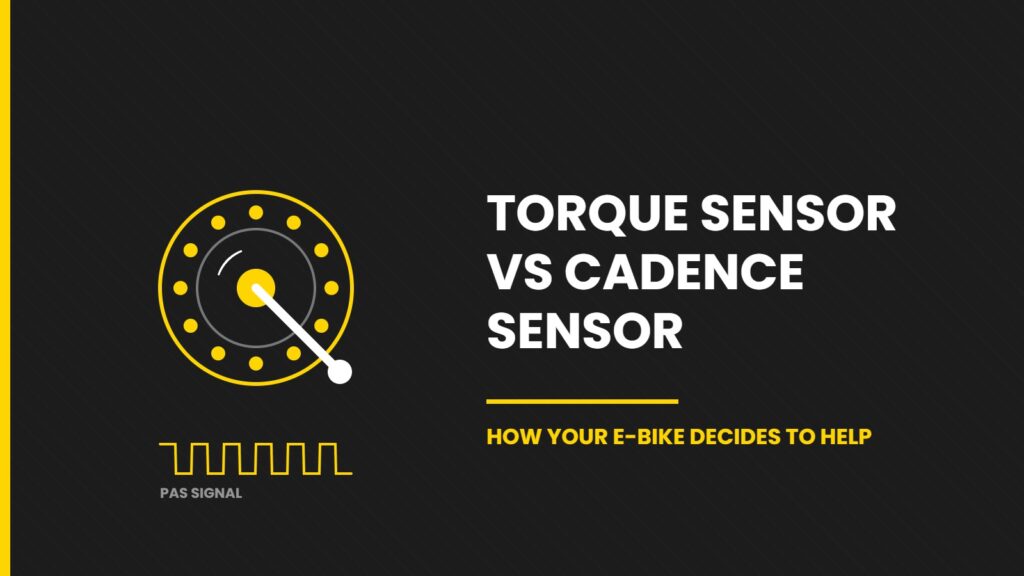
A torque sensor measures how hard you push the pedals and multiplies that effort; a cadence sensor only measures whether the cranks are turning and delivers a preset amount of power. That single difference in what gets measured is why one e-bike feels like your legs got stronger and the other feels like a quiet motorbike that waits for permission. In the guide to how e-bikes actually work — motors, sensors and controllers we covered the whole drivetrain; here we go deep on the one component that decides how your bike feels every single time you push off from a light on Parramatta Road.
Grin Technologies, who build the Cycle Analyst and publish the most detailed public reference on pedal-assist hardware, put it bluntly: a basic cadence sensor “does not know how much force you are actually applying” (ebikes.ca). Everything below follows from that.
What is the real difference between a torque sensor and a cadence sensor?
Both sensors answer a question for the controller, but they answer different questions.
- Cadence sensor (basic PAS): detects crank rotation speed only. Usually a magnet ring on the crank arm or spindle. It reports “pedalling / not pedalling” and, on better systems, how fast.
- Torque sensor: detects rider force, usually via a replacement bottom bracket. Grin notes that “most of these sensors aren’t directly measuring torque itself” — they read the tiny deflection that your force creates — but the output is an analogue voltage proportional to effort.
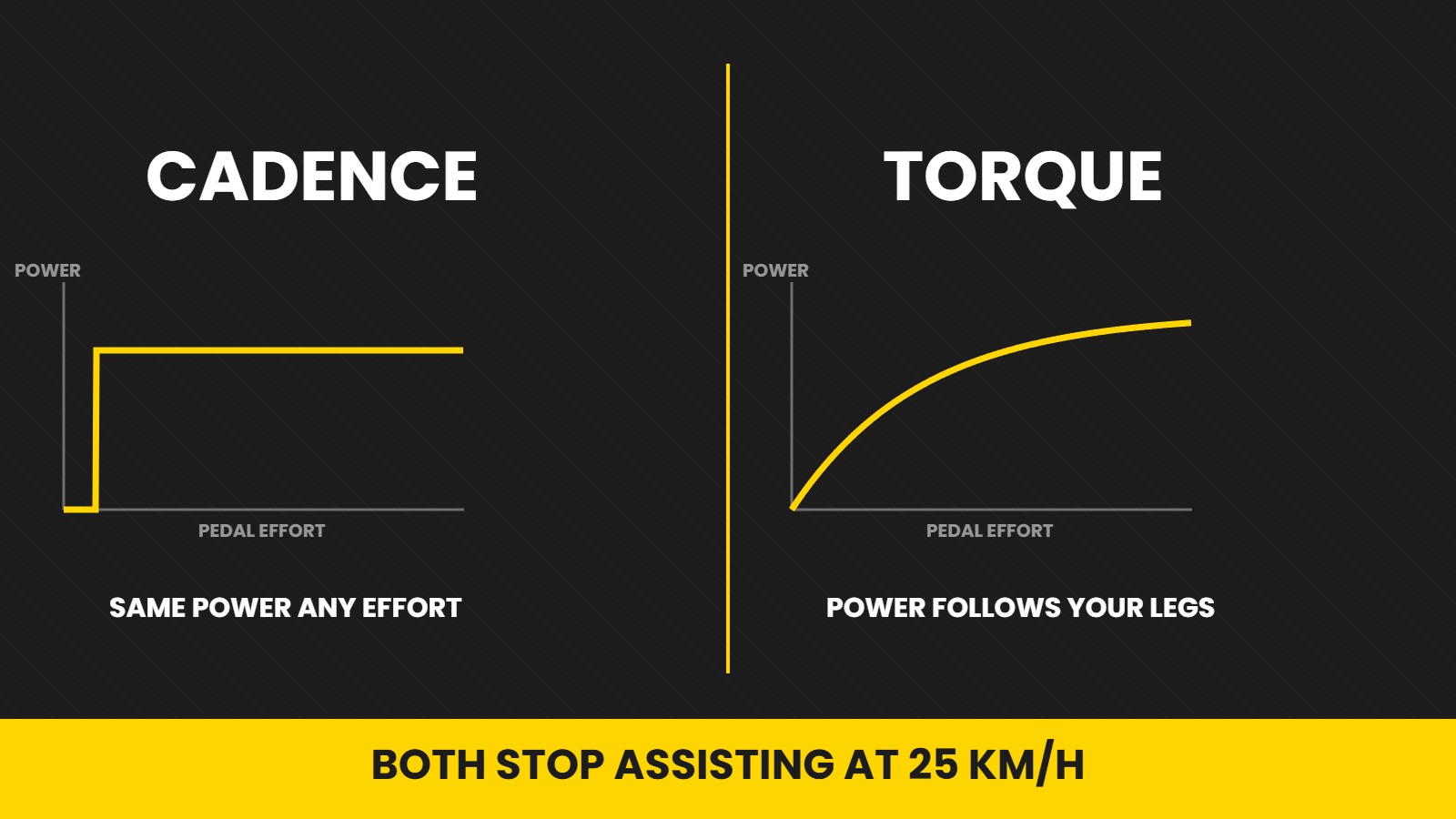
The practical consequence: on a cadence bike, spinning lightly on a descent summons the same assist as grinding up Norton Street. On a torque bike, soft-pedalling gives you almost nothing. Grin describes a good torque system as a “Bionic connection” between bike and legs, and cadence as giving “independent control of motor power and your pedal effort like a throttle” — without holding one.
Why do cheap cadence sensors feel laggy, and what fixed it?
Lag on a cadence system is a resolution problem, measured in magnets. Early sensors had “just 5 or 6 magnets,” which meant roughly half a crank rotation before the motor woke up, plus a noticeable delay when you stopped pedalling. Per ebikes.ca, “these days 12 poles is the norm,” with some sensors at 24 poles or more, and “these higher pole sensors enable a control system to have much faster pedal response.”
Wiring matters too:
- Single-wire: pulses only when pedalled forward, ignores reverse, and works on one side of the frame only.
- Single-wire with pulse-width variant: the controller has to discern direction from relative pulse width, which “adds a slightly longer startup delay.”
- Two-wire quadrature: direction comes from pulse order, works on either side of the frame, and can even turn backward pedalling into a control input such as regen. Needs 4 wires total.
If a second-hand bike surges half a crank turn after you start pedalling and keeps pushing after you stop, that is a low-pole single-wire sensor — not a dying motor.
How does a torque sensor turn your legs into watts?
It scales your pedal force by a multiplier you choose. Grin expresses it as a ratio — 1:1 or 2:1 — with handlebar settings typically offering something like 0.5X, 1X or 2X boost. Some systems add an offset: a human-power threshold you must clear before the motor contributes at all, with “a low threshold of like 50 watts” or “a 200 watt threshold” given as examples.
The numbers are less abstract than they sound. Grin’s own worked example: a 60 kg person standing on a 165 mm crank produces (60 × 9.8 × 0.165) = 97 Nm of torque. That is the scale a bottom-bracket sensor has to resolve, which is why Grin warns that sensors reading only left-side torque need their Nm/V scaling doubled, and that a drivetrain stiff enough to behave “shouldn’t move the end of the crank by more than 5-10mm.”
Turning torque into power is straightforward arithmetic. Mechanical output is torque × angular speed, or in practical units Power (W) ≈ torque (Nm) × RPM × 0.104. Grin’s example: 20 Nm at 100 rpm is about 209 W, while the same 20 Nm at 300 rpm is about 628 W. Same force, triple the cadence, triple the power — which is exactly why a torque-sensing bike rewards keeping your legs spinning rather than mashing a tall gear.
One safety detail worth knowing: torque sensors carry both a torque and a cadence signal, because the bike “could be powered from the torque signal alone even in the absence of any pedal rotation.” Standing on a pedal at a red light should not launch you into the intersection — the cadence channel is what prevents it.
Which sensor actually gives you more range?
Neither sensor stores energy — but a torque sensor usually stretches a charge further, because it spends watts only when you do. Range is just battery energy divided by consumption. Energy is Wh = V × Ah: the Centauro’s 48 V 25 Ah pack is 1200 Wh, a figure listed on its Centauro product page along with Samsung cells and a claimed range of up to 120 km at 25 km/h on flat road with a 75 kg rider and no headwind.
Divide those and you get the number that predicts your commute: 1200 Wh ÷ 120 km = 10 Wh/km under those gentle conditions. Real inner-west riding — lights, hills, headwind up Victoria Road — lands most riders well above that. Here is where sensor type bites:
- Cadence, constant-power mode: Grin’s example is “autoPAS set to 200watts,” which delivers 200 W regardless of speed. Pedal for one hour and you have spent roughly 200 Wh — about a sixth of a 1200 Wh pack — whether you needed it or not.
- Cadence, constant-throttle mode: the assist level behaves like a throttle setpoint, effectively setting a top speed.
- Torque, multiplier mode: consumption tracks your effort. Soft-pedalling downhill draws almost nothing; the 2X setting on a climb draws plenty.
There is a thermal angle too. Grin’s power-ratings page notes that copper winding resistance causes most of a motor’s internal heat, and that doubling the current quadruples it, because I²R heat scales with the square of current (ebikes.ca). A torque system that lets you feather power on a long grind is doing your motor a favour; a cadence system pinned at full assist cooks windings. Our breakdown of e-bike watts versus Nm goes further on spec-sheet numbers.
Does the sensor change what is legal in NSW?
No — the law caps power and speed, not how the bike senses your pedalling. Transport for NSW currently sets “a maximum continuous rated power of 500 watts,” with the motor permitted to assist while you pedal up to 25 km/h and required to stop providing power above it. Throttle-only assistance must cut out at 6 km/h. From 1 March 2029 the continuous limit drops to 250 W and only EN 15194 certified e-bikes will be allowed on NSW roads (transport.nsw.gov.au).
The sting is in the wording: “E-bikes that exceed any of these limits are illegal, even if the power or speed is restricted by software.” A dealer telling you a 1500 W bike is fine because it ships in a limited mode is describing an illegal bike. Both sensor types stop assisting at exactly the same 25 km/h — after that, your legs are the only motor, whichever sensor you bought.
For reference, the Centauro is listed at 250 W continuous against EN 15194, with UL 2849 for the system, UL 2271 for the battery and ISO 4210 for the frame — the certifications that still matter in 2029.
On the 25 km/h ceiling, from @cyberbikesau.
Torque or cadence: which should you actually buy?
Buy a torque sensor if you want the bike to feel like a bike, and a cadence sensor if you want the motor to do a fixed job regardless of your legs. Grin is refreshingly even-handed on this, listing real downsides for both.
| What you care about | Cadence sensor | Torque sensor |
|---|---|---|
| What it measures | Crank rotation speed only | Rider force (plus a cadence channel) |
| Feel | Motor-led; preset power while pedalling | Proportional; amplifies your effort |
| Steady effort on hills | Better — power does not demand you push harder | Harder — climbing requires hard pedalling |
| Energy use | Spends the setpoint whether needed or not | Tracks effort, so usually thriftier |
| Response off the line | Depends on pole count: 12 poles is the norm, 24+ is faster | Near-immediate, from force not rotation |
| Fitting | Magnet ring; easy to retrofit | Usually a bottom-bracket replacement |
One honest caveat from the source: with a torque system “motor power follows terrain,” so climbs demand that you work. Riders who want steady effort regardless of gradient are genuinely better served by basic PAS — which is why cadence still dominates cargo and delivery bikes.
From fitting and servicing both at Cyberbikes Leichhardt: the complaint about cadence bikes is surging and lag; the complaint about torque bikes is that they ask too much of tired legs at the end of a long day. Neither is a defect — and a ten-minute ride tells you which one is yours faster than any spec sheet.
Frequently Asked Questions
Can you tell which sensor an e-bike has without taking it apart?
Usually yes, by riding it. Lift the rear wheel, set a mid assist level and spin the cranks by hand with no load: a cadence system will spin the motor up anyway, while a torque system will barely respond because you are applying almost no force. On the road, soft-pedal on a flat — if the assist keeps pushing hard regardless, it is reading cadence.
Does a torque sensor make an e-bike faster?
No. Top speed is set by the controller, battery voltage and the law, not the sensor. In NSW the motor must stop assisting above 25 km/h regardless of sensor type, and continuous rated power is capped at 500 watts, dropping to 250 watts from 1 March 2029. A torque sensor changes how smoothly you reach the limit, not where the limit sits.
Is a torque sensor worth it for a hilly Sydney commute?
It depends which problem you have. A torque sensor gives smoother, more natural power delivery and generally better efficiency because it only draws watts in proportion to your effort. But Grin notes that with a torque system climbing requires hard pedalling, so if your goal is to arrive at work without sweating up a steep grade, a cadence system that holds a steady power setpoint may suit you better.
Ride both before you choose
Sensor feel is the one spec you cannot read off a page. Come and test ride at Cyberbikes, 281 Parramatta Road, Leichhardt — we are open Tuesday to Saturday, and you can call us on 0491 794 668. If you would rather spread the cost, our rent-to-own plans start from $99.99 per week. Have a look at the 2026 Centauro full-suspension step-through first, then come and feel the difference for yourself.
Sources: Grin Technologies (ebikes.ca) pedal-assist and power-ratings pages; Transport for NSW e-bike rules; Centauro specifications read live from the product page.
#ebike #CyberbikesLeichhardt #torquesensor #cadencesensor #ebikeSydney #pedalassist #ebikeTech #Centauro #SydneyCommute #InnerWest