An e-bike controller is the small electronic brain wired between your battery and motor, and it quietly decides how your bike rides. It does two jobs: it converts your battery’s steady DC voltage into the fast, precisely timed pulses that make the motor spin, and it enforces a current limit that caps how much power the whole system can ever produce. That current limit — not the number stamped on the motor — is the single biggest factor in how hard your bike accelerates and how much grunt it has on a hill.
On a 250W e-bike like the Cyberbikes Centauro, the controller is exactly what holds the motor to 250W of continuous power and eases the assist off at 25 km/h, keeping the bike road-legal right across NSW. Swap in a controller with a higher current limit, or raise the battery voltage, and you change the entire character of the bike — even with the identical motor bolted in.
At Cyberbikes in Leichhardt we get asked “how many watts is it?” almost every day. The honest answer, which we’ll unpack below using data from the motor engineers at ebikes.ca, is that the motor’s watt rating tells you far less than the controller and battery feeding it.
The controller is your bike’s power gatekeeper
Think of the three big electrical parts as a team. The battery is the fuel tank, the motor is the muscle, and the controller is the throttle valve and traffic cop combined. Every electron that reaches the motor passes through the controller first, and the controller decides — thousands of times a second — exactly how much gets through. Because it sits in the middle, it sets the ceiling on performance. A brilliant motor fed by a weak controller behaves like a weak motor; a modest motor fed by a strong controller punches well above its sticker rating.
How an e-bike controller works, step by step
Turning battery DC into three-phase motor power
Your battery supplies direct current at a fixed voltage — 48V on the Centauro. But the brushless motor in almost every modern e-bike needs alternating current delivered across three separate phase wires, switched in the right sequence and timed to the exact position of the spinning rotor. The controller handles this with a bank of fast electronic switches (MOSFETs) that chop the battery’s DC and route it to each phase at precisely the right instant. It knows where the rotor is using small Hall-effect sensors inside the motor, or by reading the motor’s own back-EMF. This orchestration is called commutation, and doing it smoothly is what makes a good controller run quietly and efficiently.
Reading your throttle, pedal-assist and safety inputs
The controller is also constantly listening. It reads your throttle, your pedal-assist sensor, your speed and your brake cut-off switches, then works out how much current to release. As ebikes.ca explains, a pedal-assist system (PAS) powers the motor automatically as you pedal — either from how fast you spin the cranks or how hard you push on them — without you touching a throttle. Whatever the input, the controller translates your intention into a current command and never lets that current exceed its programmed limit. That limit is the crucial number, and it’s where real-world power actually comes from.
Why the controller — not the motor — sets your real power
Here’s the counter-intuitive part. The same motor can be a gentle 600-watt cruiser or a punchy 1,000-watt climber, depending entirely on the controller and battery you pair it with. The engineers at ebikes.ca demonstrate this with their motor simulator using a single Crystalyte hub motor:
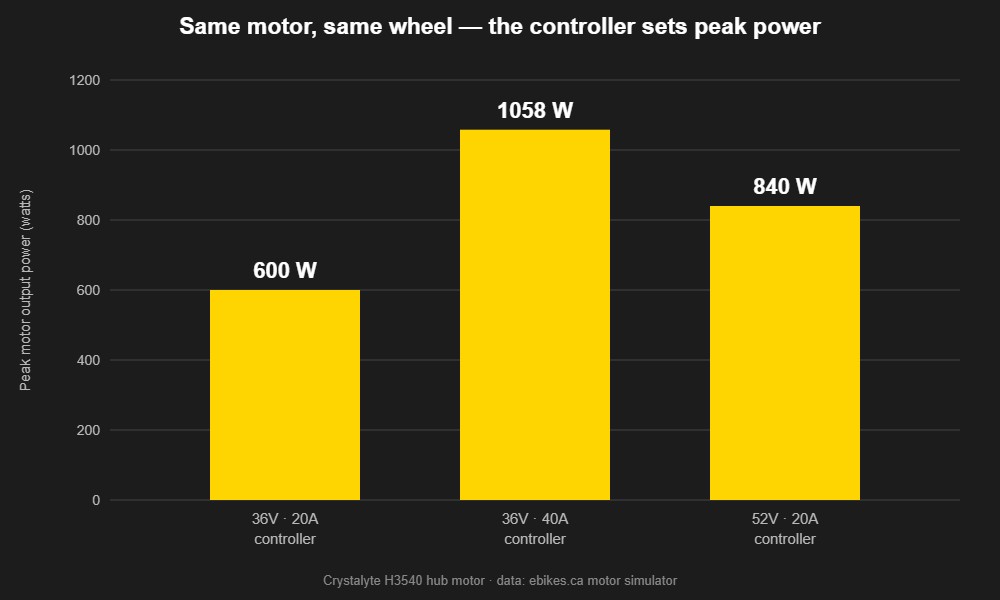
- 36V battery, 20A controller: the system draws a steady 744W of electrical input and the motor peaks at about 600W of output power at 40 km/h.
- Same motor and battery, 40A controller: peak input roughly doubles to a nominal 1,440W and output climbs to 1,058W — an 80% jump in peak power, purely from the controller.
- Original 20A controller, 52V battery: peak output is 840W, and because the higher voltage lets the motor spin faster, the bike feels stronger and reaches a higher top speed.
The motor never changed. As ebikes.ca puts it, this peak power “is not a motor property… it’s actually mostly a function of the motor controller and battery pack.” That’s why comparing bikes on the motor’s watt number alone is close to meaningless — and why we always talk you through the whole system when you visit the shop. If you’re weighing up power for your commute, our guide to whether a 250W e-bike motor is actually powerful enough puts these numbers in everyday context.
Volts, amps and watts: reading your controller’s numbers
The maths behind all this is refreshingly simple. Electrical power in watts equals voltage multiplied by current: watts = volts × amps. So a 48V battery paired with a controller that allows around 5–6 amps of continuous current works out to roughly 250–290W — which is how the Centauro stays inside its 250W continuous rating. Push the controller to allow 20A on the same 48V and you’d be asking for nearly 1,000W, well outside what a legal Australian e-bike is allowed to deliver.
Two more numbers matter. Your battery’s energy is voltage times amp-hours: the Centauro’s 48V, 25Ah pack holds 48 × 25 = 1,200Wh of energy. And your consumption is measured in watt-hours per kilometre (Wh/km). Divide the pack size by your Wh/km and you get range — for example, 1,200Wh at a gentle 12 Wh/km is around 100 km. The controller influences this indirectly: ride in a high-power assist mode and you pull more amps, burn more Wh/km, and cover fewer kilometres per charge.
Why more controller amps means far more heat
If more amps means more power, why not just fit the biggest controller you can? Because heat rises far faster than power. The warmth generated inside the motor windings follows the I²R relationship — double the current and you don’t double the heat, you quadruple it. Ebikes.ca is blunt about the consequence: sustain too much current for too long and “insulation burns off the copper enamel, nylon gears soften and strip, or magnets start to demagnetise” — you’ve cooked the motor.
This is the real reason the controller’s current limit exists. It isn’t there to hobble your fun; it’s there to keep the motor within the thermal envelope it was designed for. A 250W hub motor matched to a sensibly sized controller can shrug off short bursts up hills and cool down again. Bolt an oversized controller to that same small motor and you’re writing cheques the windings can’t cash. We dig into that trade-off further in our explainer on e-bike torque versus power and what Nm really means.
What the controller does to keep your Centauro legal in NSW
In New South Wales, a road-legal pedal-assist e-bike must comply with the EN 15194 standard: a motor rated to 250W of continuous power, pedal-assist that tapers to nothing by 25 km/h, and any throttle limited to 6 km/h. Every one of those limits is enforced in software by the controller. The Cyberbikes Centauro is built to EN 15194 for exactly this reason, and its battery and full system also carry UL 2271 and UL 2849 safety certification. When people ask whether an e-bike is “legal,” they’re really asking whether its controller is programmed to the right numbers — and on a compliant bike, it is.
See the engineering, not the marketing
The takeaway is to judge an e-bike on how its controller, battery and motor work together, not on a single headline wattage. Our short video below busts a few common myths and shows why the engineering matters more than the look:
Frequently asked questions
Can I upgrade my e-bike controller for more power?
You can physically fit a higher-current controller, but on a NSW road you shouldn’t. A road-legal e-bike must stay at 250W continuous and cut assist at 25 km/h. A bigger controller can push the bike past those EN 15194 limits, which makes it illegal on the road and can void your warranty, and it risks overheating a motor that was never designed for the extra current. Talk to the team at Cyberbikes before changing anything.
What does the controller’s amp rating mean?
It is the maximum current, in amps, that the controller will let flow from the battery to the motor. Because power equals volts times amps, that amp limit combined with your battery voltage sets your system’s peak power. A 48V battery with a 15A controller tops out near 720W of electrical input, while the same battery with a 6A limit stays around 290W.
Does a bigger controller drain the battery faster?
At the same steady cruising speed, not really. A higher-amp controller mainly increases peak power for acceleration and hill-climbing. Your average consumption in watt-hours per kilometre at a legal 25 km/h stays similar, so everyday range does not change dramatically. The difference shows up in how quickly you get up to speed, not in how far you can go.
Want to feel the difference a well-matched controller, battery and motor make? Come in for a test ride at Cyberbikes, 281 Parramatta Road, Leichhardt, or browse the Cyberbikes Centauro online. Ask us about rent-to-own plans from $99.99/week — call 0491 794 668 or drop by Tuesday to Saturday.
#Cyberbikes #eBikeSydney #eBikeController #ElectricBikeLeichhardt #CentauroEbike #eBikeTech