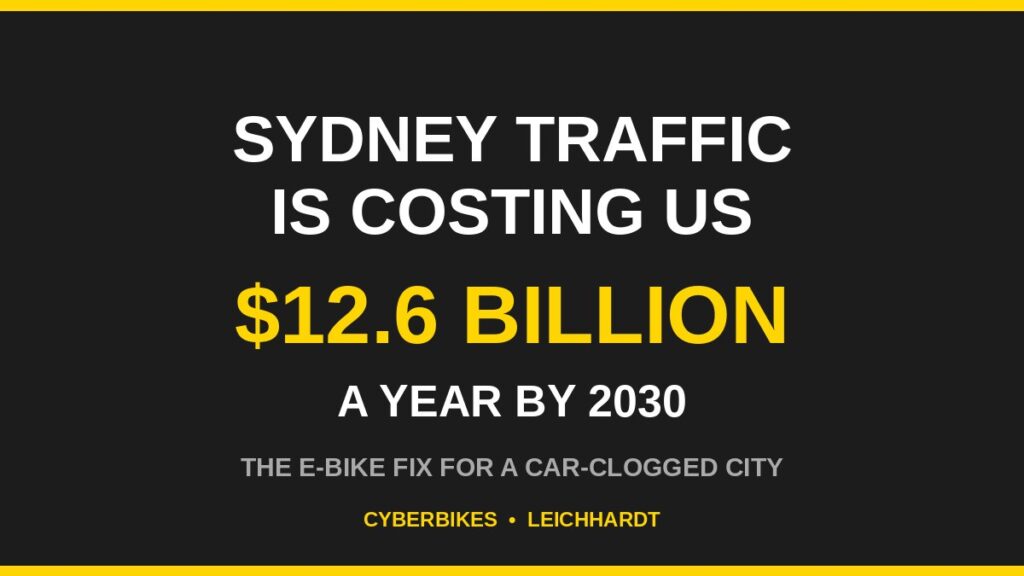
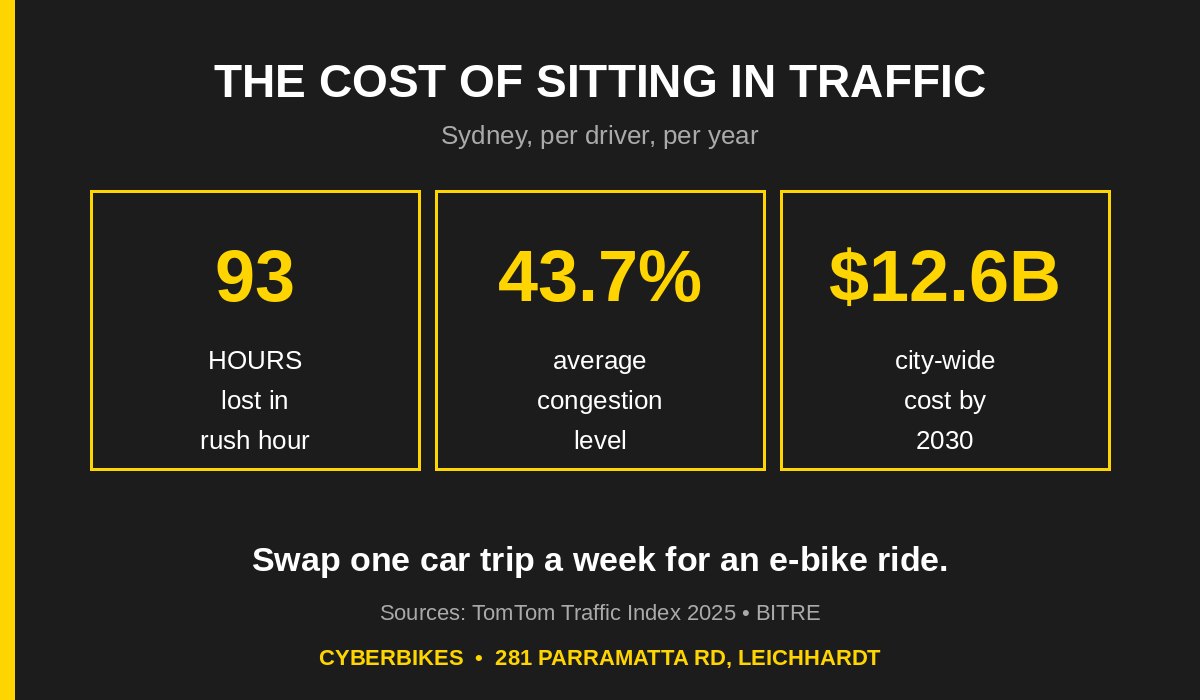
Sydney’s traffic congestion is on track to cost roughly $12.6 billion a year by 2030, according to projections from the Bureau of Infrastructure and Transport Research Economics (BITRE) — up from a baseline of about $6.1 billion a year. That is not an abstract number. It is wasted time, wasted fuel, delayed freight and dirtier air, and every household pays for it whether or not they own a car.
The uncomfortable truth is that we cannot build our way out of it. The cheapest tool to take pressure off Sydney’s roads is already sitting in our bike racks. At Cyberbikes in Leichhardt, we see it every day on Parramatta Road: the trips that clog the city are mostly the short, local ones an e-bike does better, cheaper and faster.
What is Sydney’s traffic congestion actually costing us?
BITRE measures the avoidable social cost of congestion — the value of the extra travel time, unreliable trips, higher running costs and worse air quality that would disappear if traffic flowed freely. For Sydney, that avoidable cost is the highest of any Australian capital, projected to climb toward $12.6 billion a year by 2030 under a business-as-usual scenario, with the national capital-city total heading for as much as $37.3 billion.
Drivers feel it in hours, not just dollars. The 2025 TomTom Traffic Index found Sydney motorists lost about 93 hours — nearly four full days — sitting in rush-hour traffic over a year, with the city running at a 43.7% congestion level. That is time not spent with family, working or resting, burned in a queue that keeps getting longer.
Who actually pays for a car-clogged city?
Everyone does. Congestion is a shared cost, not a private one. When freight trucks crawl through gridlock, the delay is priced into the goods on every supermarket shelf. When exhaust hangs over arterial roads, the health bill lands on the whole community, including people who never drive. And because a single moving car needs far more road and parking space than a bike or a bus seat, the more we prioritise private cars, the less room there is for everything — and everyone — else.
This is why simply adding lanes rarely works: new capacity fills with new trips, a pattern traffic engineers call induced demand. Sydney has spent decades trying to widen its way to free-flowing roads, and the congestion bill has kept rising anyway. If the supply of road space can’t outrun demand, the smarter lever is to change what those trips are made in.
Could e-bikes really ease Sydney’s congestion?
Yes — and the leverage sits in the short trips. A large share of urban car journeys are only a few kilometres, exactly the distance where an e-bike matches or beats a car door-to-door once you count parking. Shift even a slice of those to two wheels and you free up road space for the trips that genuinely need a vehicle: tradies, deliveries, people with mobility needs. For the full breakdown, see our e-bike vs car Sydney commuting comparison, and why Sydney became so car-dependent in the first place.
An e-bike also uses a fraction of the space a car does — several bikes park in a single car bay — and produces no tailpipe emissions. Modern models make the swap realistic for everyday life, not just fair-weather cycling. Our Cyberbikes Centauro runs a 250W rear hub motor and a 48V 25Ah (1200Wh) Samsung battery for long-range everyday riding, is fully NSW-legal to EN 15194 (250W continuous, 25 km/h pedal-assist), and carries the shopping, the kids’ gear or a work bag with room to spare. It sells for $3,999.99, or you can start on rent-to-own from $99.99/week in Sydney — less than most people spend on fuel and parking.
Frequently Asked Questions
How much does traffic congestion cost Sydney?
BITRE projects Sydney’s avoidable congestion cost — lost time, unreliable trips, higher vehicle running costs and worse air quality — to reach around $12.6 billion a year by 2030 under business-as-usual, the highest of any Australian capital city. The 2025 TomTom Traffic Index found Sydney drivers also lost about 93 hours each in rush-hour traffic.
Can e-bikes actually reduce traffic congestion?
Yes. Many car trips in Sydney are only a few kilometres — the exact range where an e-bike is competitive door-to-door. Shifting those short trips off the road frees space and takes vehicles out of peak-hour queues, while each e-bike needs far less road and parking space than a car.
Are e-bikes legal to commute on in NSW?
Yes. A pedal-assist e-bike that meets EN 15194 with a 250W continuous motor and assistance cut off at 25 km/h is road-legal across NSW with no licence or registration. The Cyberbikes Centauro is built to that standard.
Sydney’s congestion problem is really a design problem — and it is fixable one trip at a time. Swap one car trip a week for an e-bike ride and see what changes. Curious what going car-lighter would look like for you? Come see us at Cyberbikes, 281 Parramatta Road, Leichhardt, or take the Centauro for a spin.
#Cyberbikes #EbikeSydney #Leichhardt #CarFreeSydney #SydneyTraffic #UrbanMobility #Centauro #RideDontDrive