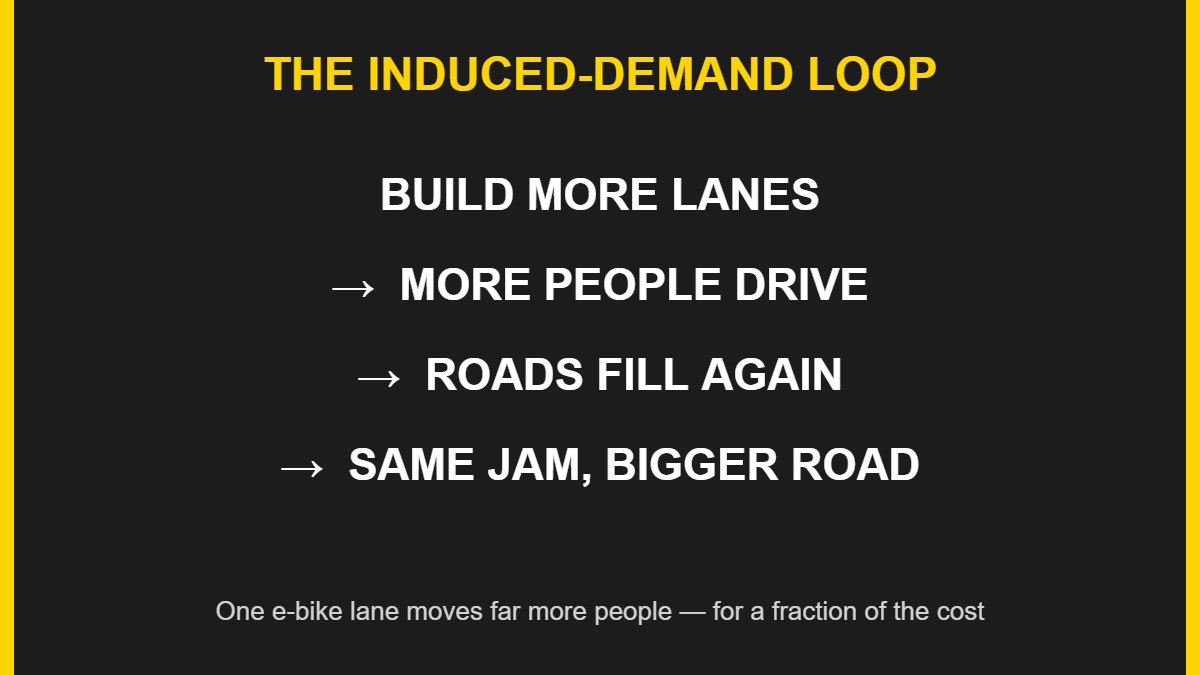
Building more roads won’t fix Sydney’s traffic. Decades of evidence show that every new lane fills with new cars within a few years — economists call it induced demand — so congestion returns to where it started, just with a bigger, costlier road to maintain. The faster fix is moving more people through less space, and for most short Sydney trips an e-bike does exactly that.
What is induced demand, and why do new lanes fill up?
Induced demand is the well-documented tendency for new road capacity to generate its own extra traffic. In their landmark study The Fundamental Law of Road Congestion (American Economic Review, 2011), economists Gilles Duranton and Matthew Turner found that vehicle-kilometres travelled rise almost one-for-one with new lane-kilometres: add 1% more highway capacity and you get roughly 1% more driving. The extra traffic comes from residents driving more, more freight on the road, and people relocating to newly accessible areas — and they found no evidence that building public transit cut vehicle travel either. The result has since been replicated across hundreds of European cities, so it isn’t a US quirk. It’s close to a physical law of how cities move.
Hasn’t Sydney already tried to build its way out?
Repeatedly — and the results line up with the research. Sydney has poured tens of billions into new motorways and rail, yet a 2024 University of Sydney analysis, “Funnelling congestion,” found much of that spend shifted congestion around the network rather than removing it. WestConnex, at roughly $16.8 billion, is the most expensive road project in Australian history, and Sydney’s earlier motorways — the M2, the M5, the Harbour Tunnel — each filled to capacity soon after opening. Meanwhile the cost of sitting in traffic keeps climbing: the Bureau of Infrastructure and Transport Research Economics projects Sydney’s avoidable congestion will cost about $12.6 billion a year by 2030. You cannot pour concrete fast enough to outrun that maths.
What moves more people through Sydney’s traffic?
Space is the real constraint, and the private car is the least efficient way to use it. A car in Sydney typically carries about one person while taking up more than 10 square metres of road. Hand the same strip of road to bikes, e-bikes or buses and it moves several times as many people per hour. We crunched the numbers on how many people one Sydney road can actually move, and the gap is stark. The lesson is simple:
- Cars are space-hungry. One lane of moving cars carries far fewer people than the same lane given to bikes or buses.
- E-bikes are space-thin. They flatten Sydney’s hills, need almost no parking, and let riders keep pace with city traffic.
- Better streets beat bigger roads. Reallocating road space moves more people without the multi-billion-dollar price tag.
Can an e-bike really replace a Sydney car trip?
For a huge share of trips, yes — most car journeys in Australian cities are short enough to ride comfortably. The Cyberbikes Centauro is built for exactly this: a 250W rear-hub motor and a 48V 25Ah (1,200Wh) Samsung battery deliver pedal assistance up to the NSW legal limit of 25 km/h, while a frame-welded rear rack rated to 50 kg — part of a 150 kg total load capacity — swallows the shopping, the gym bag or a child seat. The battery is UL 2271-certified, the bike is EN 15194 compliant, and it’s priced at $3,999 with rent-to-own available. Swap a few car trips a week onto one and you personally shrink the jam — no new lane required. For the full picture of what you’d save, see our breakdown of what owning a car in Sydney really costs.
Frequently Asked Questions
Does adding lanes reduce traffic congestion?
Usually not for long. Research on the fundamental law of road congestion shows traffic rises almost in proportion to new road capacity, so any relief from a wider road is typically erased within a few years as extra driving fills the space.
What is induced demand in simple terms?
Induced demand means making driving easier — by adding lanes or roads — encourages more people to drive more often and further. The new capacity creates new trips, which is why bigger roads rarely stay uncongested.
Can an e-bike replace a car for commuting in Sydney?
For most short-to-medium trips, yes. An e-bike like the Cyberbikes Centauro assists up to 25 km/h under NSW law and carries cargo on a 50 kg-rated rack, turning a typical inner-Sydney commute into a fast, cheap, traffic-proof ride.
Sydney won’t build its way out of congestion — but every ride that leaves the car at home is one less vehicle in the jam. Curious what going car-lighter would look like for you? Come talk to us at Cyberbikes, 281 Parramatta Road, Leichhardt, and take a Centauro for a spin.
#Cyberbikes #eBikeSydney #InducedDemand #Leichhardt #CarFreeSydney #Centauro #SustainableTransport