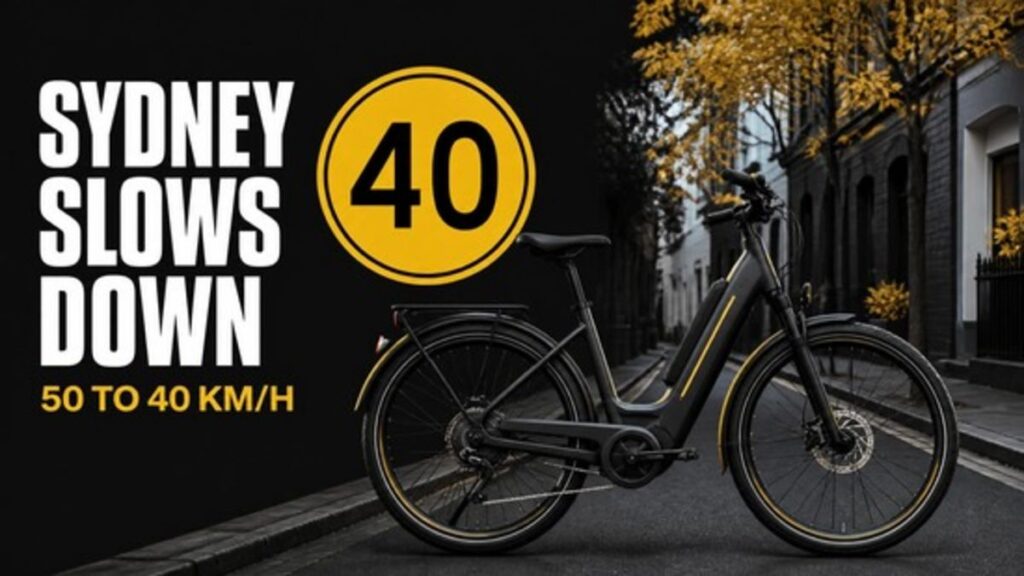
Sydney speed limits are dropping to 40 km/h because 50 was never a safety number — it was a default nobody ever had to justify. Transport for NSW puts the stopping distance for a car at 50 km/h at 37 metres, against 27 metres at 40 km/h, and the survival chance for a person struck at 50 km/h at about 10% — rising to roughly 60% at 40 km/h and 90% at 30 km/h. Ten km/h buys back ten metres of road and five lives in every ten. That is the whole argument, and it has been sitting in the government’s own safety material the entire time.
From 17 September 2026 that argument reached the streets at the end of ours. Here is what changed, and why slower streets matter more to people on bikes than to anyone else.
What just changed on the streets around Leichhardt?
Two Transport for NSW speed reviews, published on 17 September 2026, drop local streets in our own backyard from 50 km/h to 40 km/h:
- Haberfield — all local roads inside the block bounded by Iron Cove Creek, Dobroyd Parade, the City West Link, Hawthorne Canal and Parramatta Road. Ramsay Street and Marion Street drop to 40 km/h as regional roads.
- Lilyfield and Rozelle — all local roads bounded by the Parramatta River, Victoria Road, the City West Link and Dobroyd Parade, plus Balmain Road, Catherine Street, Gordon Street, Lilyfield Road and the Darling Street run from Denison Street to Victoria Road.
If you ride out of Leichhardt, that is most of your commute. The limits take effect only once the new signs are physically installed, so you will see 50 and 40 signs coexisting for a few weeks. None of this is radical: the City of Sydney reports that about 75% of the local and regional roads it manages are already 40 km/h or lower, up from 5% in 2004. Sydney has been doing this quietly for twenty years. The only new thing is the pace.
Does 10 km/h really change who walks away?
Yes, and not by a little. Speed does two jobs in a crash: it decides whether the crash happens at all, and how much energy lands on the person outside the car. Transport for NSW publishes both halves.
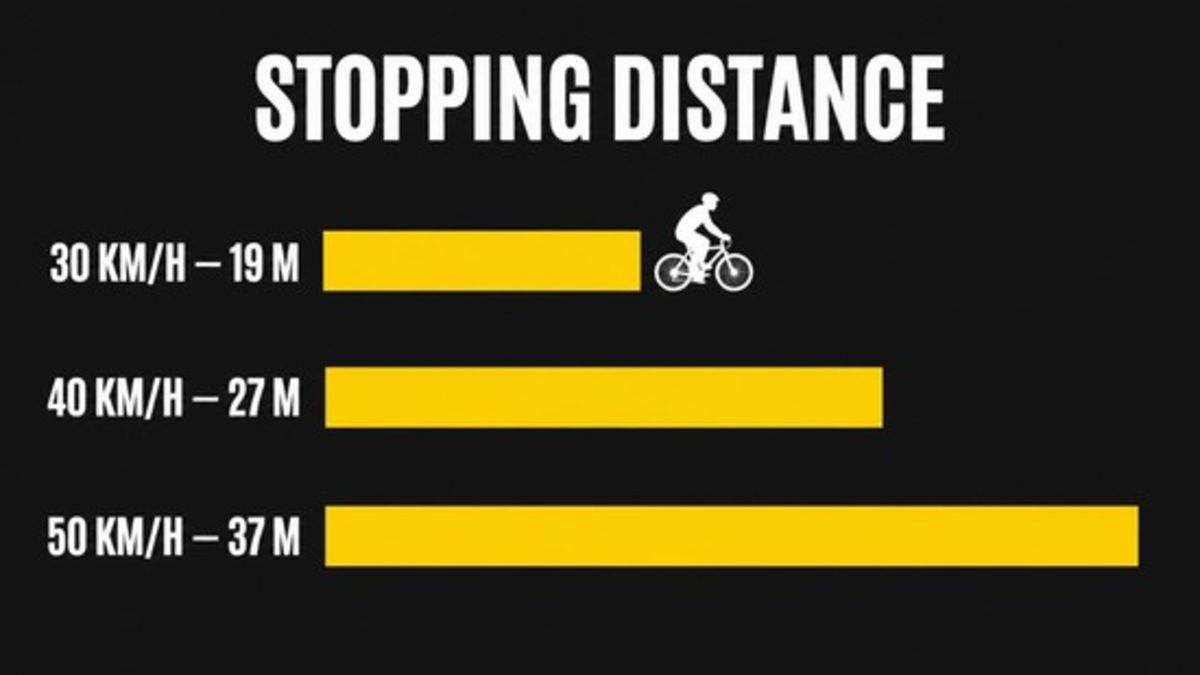
| Speed | Stopping distance | Survival chance if a person is struck |
|---|---|---|
| 30 km/h | 19 m | ~90% |
| 40 km/h | 27 m | ~60% |
| 50 km/h | 37 m | ~10% |
| 60 km/h | 56 m | — |
Transport for NSW attributes about 42% of road deaths and 25% of serious injuries to speeding, and the national picture is going backwards: the NRMA reports 355 deaths on NSW roads in 2025, up 28 on the year, cyclist deaths up 200% in NSW, and 49 riders killed nationally — a 32.4% jump. Note where it happens: UNSW’s researchers point out that 60% of fatal crashes in metropolitan NSW are on local and collector streets signed at 50–60 km/h — the ordinary residential streets we treat as the safe part of the network. Five straight years of rising national deaths is not bad luck. It is a system producing what it was built to produce.
Won’t slower streets just make Sydney’s traffic worse?
The numbers do not support it. UNSW cites research finding that on a typical 26-minute commute, the difference between 50 km/h and 30 km/h limits is less than one minute. You are not losing your evening to a speed sign — you are losing it to intersections, signal phasing and the number of single-occupant cars competing for one lane.
The emissions objection fails too: Transport for London’s research on 20 mph (32 km/h) zones found no net negative emissions effect, because smoother driving and less hard braking offset the lower cruising speed. The upside, meanwhile, is quantified — UNSW reports modelling that 30 km/h limits on local residential streets could cut the Australian road toll by 13%, worth roughly $3.5 billion a year. Nor is it a fringe position: about two-thirds of Australians told a national poll they want lower limits on local streets.
What do slower streets mean if you ride an e-bike in Sydney?
More than for anyone else, because what makes riding feel unsafe is not speed — it is the difference in speed. A legal e-bike in NSW stops assisting at 25 km/h. On a 50 km/h street that is a 25 km/h closing speed in your back. At 40 the gap halves to 15. At 30 you are simply traffic, moving at the pace of everything around you.
Worth knowing exactly where you stand under the current NSW e-bike laws: Transport for NSW sets the maximum continuous rated power at 500 W today, falling to 250 W with mandatory EN 15194 certification from 1 March 2029; pedal assist must cut out at 25 km/h and throttle-only power at 6 km/h; helmets are compulsory. Since 21 August 2026, police can seize and dispose of illegal e-bikes — and a bike over the limits is illegal even if an app or switch restricts the output. Our own Centauro is built to sit inside today’s line: UL 2849 for the electrical system, UL 2271 for the 48 V 25 Ah 1,200 Wh Samsung battery, ISO 4210 for the frame, assist cutting at 25 km/h and throttle at 6 km/h.
Where should Sydney’s speed limits go next?
To 30 km/h where people actually are. The City of Sydney’s draft access strategy already proposes a 40 km/h maximum on every street it manages, with 30 km/h or lower in the city centre and other high-activity areas. Norton Street, Marrickville Road, Crown Street — where the footpath is full and the shopfronts are the point — are 30 km/h streets everywhere that has worked this out.
But a sign is the cheap half. Geometry speaks louder than metal: a wide lane with a long sightline and a generous kerb radius says 60 whatever the sign says. Slower streets stick when the street is narrowed, the corners tightened, the crossings raised and the parking lane handed to something else. That is a design budget and a road-space decision — and that is where the argument belongs, not on whether ten km/h is too much to ask. The full case for going car-lighter here is in our guide to car-free e-bike commuting in Sydney.
Frequently Asked Questions
What is the speed limit on local streets in Sydney?
The default limit on an unsignposted built-up street in NSW is 50 km/h, but most inner-Sydney councils have moved below it. The City of Sydney says about 75% of the local and regional roads it manages are already 40 km/h or lower. From 17 September 2026, Transport for NSW also reduced local roads in Haberfield, Lilyfield and Rozelle from 50 km/h to 40 km/h, effective once the new signs are installed.
How fast can an e-bike legally go in NSW?
The motor must stop assisting at 25 km/h, and a throttle must cut out at 6 km/h. Maximum continuous rated power is 500 W now, dropping to 250 W with mandatory EN 15194 certification from 1 March 2029. You can legally pedal faster than 25 km/h under your own legs — the limit is on the motor, not on you — and an approved helmet is compulsory.
Do 40 km/h speed limits make Sydney commutes longer?
Barely. UNSW cites research showing that on a typical 26-minute commute, the difference between 50 km/h and 30 km/h limits is less than one minute, because urban travel time is dominated by intersections and queuing rather than cruising speed.
Sydney spent sixty years designing streets around how fast a car could leave them. Dropping to 40 — and to 30 where people walk, shop and ride — is just the first bill coming due. If you’re ready to be part of a car-lighter Sydney, come see us at Cyberbikes, 281 Parramatta Road, Leichhardt.
#eBikeSydney #CyberbikesLeichhardt #SydneySpeedLimits #VisionZero #InnerWestSydney #CarFreeSydney #BikeLanes #40kmh