Yes — a 250W e-bike motor is genuinely powerful enough. The motor was never the problem. The problem is a government cap that throttles that motor back to a crawl exactly where you need it most: climbing a hill, in traffic, beside cars that weigh around fifty times as much and travel three times as fast. Australia’s 250W, 25 km/h rule isn’t keeping riders safe — it’s doing riders, and the city, a disservice.
At Cyberbikes in Leichhardt we get asked “is 250W powerful enough?” almost every day. The honest engineering answer is that a good 250W bike delivers far more than its label suggests — and that the law, not the hardware, is what holds Sydney riders back. Here’s the physics, kept practical, drawing on the motor-power research from Grin Technologies at ebikes.ca.
Why “250W” doesn’t mean what you think
The single most important fact: there is no standard or consistent way to give an e-bike motor a “watt rating.” As ebikes.ca puts it plainly, you can see the exact same motor listed as 250W, 500W and 1000W by different vendors — and each has a justification. The rating stamped on a motor tells you almost nothing about how it performs.
That’s because an electric motor doesn’t produce a fixed power the way a 60W lightbulb draws 60 watts. Spin a motor with the wheel off the ground and it makes zero power. Load it down — a hill, a headwind, hard acceleration — and it slows slightly, produces torque, and its output power climbs. Keep loading it and, past a point, power falls again. The real output depends on how hard the bike is working and how much current the controller allows, not on a number printed on a sticker.
So when a rider asks “how many watts is this motor,” the honest answer is: it depends on the battery voltage, the controller’s current limit, the terrain and your speed. A watt is a watt no matter where it comes from — 600 real watts moves a bike the same whether it’s from a small geared hub, a big direct-drive hub, or a strong tailwind.
Watts, torque and the number that actually matters
Two words get muddled constantly: power and torque. Torque is twisting force — it’s what launches you from the lights and drags you up a hill. Power is how fast work gets done, and it’s the product of torque and rotational speed:
Power (watts) ≈ torque (Nm) × RPM × 0.104
The same motor making 20Nm of torque produces about 209 watts at 100 rpm, but roughly 628 watts at 300 rpm — same torque, triple the power, just because it’s spinning faster. That’s exactly why one “rated watts” figure can’t capture a motor: the power depends on the speed you run it at. Hold that thought — it’s the key to why the legal cap fails on hills.
The other half of the story: it’s torque, not power, that heats a motor up and eventually cooks it. Heat comes from current in the copper windings, and there’s a brutal relationship — double the current for double the torque and you get four times the heat (the I²R relationship). A motor can throw out big power for a short burst up a hill with no problem, because it takes one to two hours for a hub motor to actually reach a steady overheating temperature, while the longest climbs you’ll meet in Sydney are over in minutes. In other words, the hardware is more than willing. It’s the rulebook that says no.
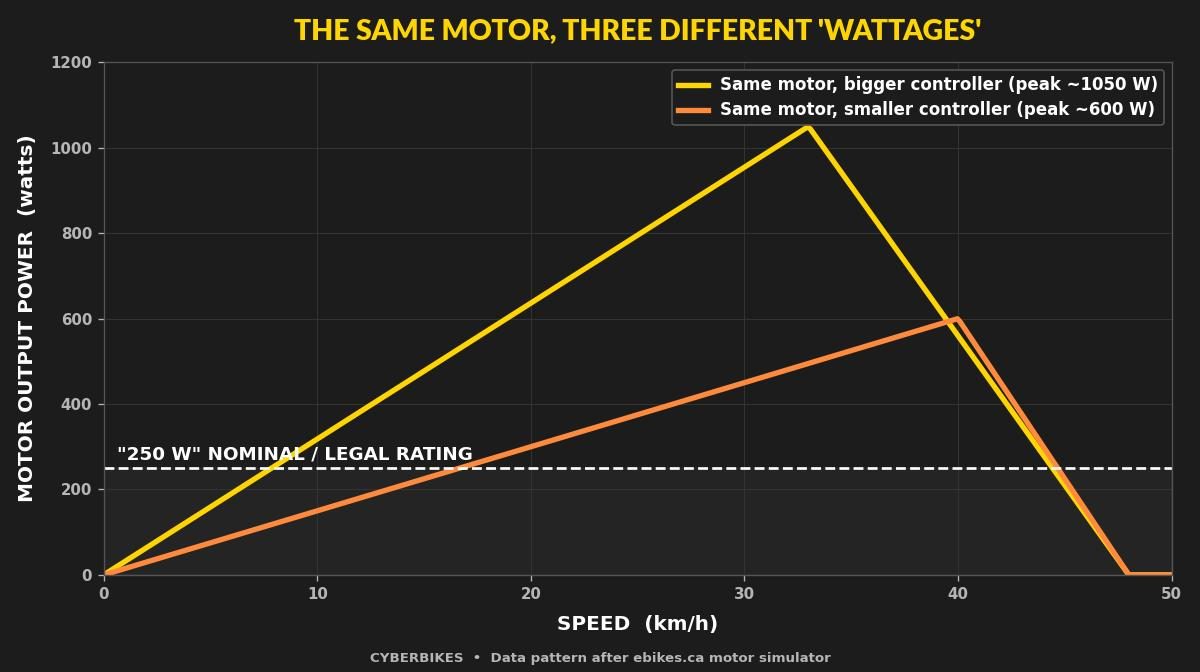
Peak vs continuous vs input: the three “wattages”
When a vendor quotes watts, they could mean any of three very different things. This is where the marketing games — and the regulator’s blunt instrument — live.
| Rating type | What it means | Honest? |
|---|---|---|
| Peak input power (V × A) | Battery volts times controller amps — the biggest, showiest number. Often 30% to 200% more than real output. | Misleading |
| Peak output power | The most mechanical power the motor briefly delivers. Well-defined, but mostly set by the controller and battery — not the motor. | Partly useful |
| Continuous power | What it can sustain indefinitely without overheating. The figure the law fixates on — yet it’s the hardest to standardise (depends on RPM, ambient heat, cooling). | Fairest, but abused |
ebikes.ca gives a telling example: keep one motor but swap a 20A controller for a 40A one and peak output jumps from about 600W to over 1050W — an 80% bigger number, from the very same motor. If you want the deeper mechanics of how that current limit shapes power, our guide on how an e-bike motor controller actually works breaks it down.
So where’s the problem? The law, not the motor
Here’s the law. A pedal-assist e-bike in Australia is limited to 250 watts of continuous rated power, with the motor cutting all assistance at 25 km/h (throttle-only bikes are capped even lower, at 200W). Stay inside that and you’re road-legal. Step outside it and you’re breaking the rules.
Now watch what that does on a hill. Remember power = torque × rpm. On the flat you cruise near the 25 km/h cutoff, the wheel spins fast, and 250 continuous watts is plenty. Start climbing and the bike slows — to 15, 12, even 10 km/h on a steep Inner West pinch. At half the wheel speed, that same legal power ceiling delivers roughly half the sustained assistance right when the gradient demands the most. The result is a rider crawling uphill at 12 km/h — not because the motor can’t do better, but because the law forbids it. A tiny lift of the continuous cap would let a compliant motor hold a safe, traffic-matching speed up any Sydney hill. The hardware is ready. The regulation isn’t.
This is where the 250W, 25 km/h rule stops being a safety measure and becomes a genuine disservice. It was written for gentle European bike paths, then copy-pasted onto a city with steep hills, no legal footpath riding, and roads dominated by heavy, fast traffic. It penalises the safest vehicle on the road and leaves its riders exposed.
The real danger isn’t the e-bike — it’s the car
Regulators love to frame fast e-bikes as “the menace.” The physics says otherwise. Danger in a crash is about kinetic energy — ½ × mass × velocity² — and on both terms a car dwarfs an e-bike.
A loaded e-bike and rider weigh maybe 110 kg; the bike alone around 30 kg. A typical car weighs 1,500 kg or more — around fifty times the mass of the bike. And because that energy scales with the square of speed, a car doing 60 km/h against an e-bike doing 25 isn’t a bit more dangerous — it carries orders of magnitude more crash energy. Add the size and sightlines of an SUV and it’s obvious which vehicle is the hazard. Yet it’s the e-bike — quiet, light, clean, taking up a fraction of the space — that gets throttled to a crawl and forced to share a lane with all of that.
And consider the double standard. An 18-year-old who has passed a written Driver Knowledge Test and a short driving test can legally climb into a car that does well over 200 km/h — with no speed limiter and no cap on the vehicle’s power. Meanwhile a 250W e-bike that stops assisting at just 25 km/h is treated as the thing that needs reining in. We wave through two tonnes of metal capable of 200-plus km/h, then throttle a 30 kg bicycle to a crawl. The priorities are backwards.
And the tired excuse that we can’t allow quicker e-bikes until we “build the infrastructure” gets it backwards. The infrastructure is already built. Every road in Sydney exists and is paid for. E-bikes don’t need new tarmac — they need rules that let them keep pace on the roads we already have, instead of being legislated into the gutter beside two-tonne traffic. Freeing e-bikes to climb hills at a safe, traffic-matching speed costs nothing to build and would make the roads safer overnight.
And if the real objection is insurance, registration and licensing, that is a solved problem too. Australia already has L1 and L2 licence categories built for exactly this kind of faster light vehicle — a sensible middle tier could let capable e-bikes travel a little quicker under light-touch rules, instead of forcing riders to choose between crawling uphill and breaking the law. We lay out the full case in our post on why the 25 km/h e-bike cap is making riders less safe.
Follow the money: why you won’t hear this on the news
Ask why the case for faster, safer e-bikes gets so little airtime, and it pays to follow the money. Mainstream media runs on advertising revenue — and few industries spend like the car industry, with its wall-to-wall TV, radio and billboard campaigns for the latest SUV. Governments, meanwhile, collect around 50 cents of fuel excise on every litre of petrol sold, on top of stamp duty and registration on every new car. Cars are a revenue engine for both the media and the treasury. A $4,000 e-bike you buy once and recharge for a few cents simply isn’t profitable to them — so why would either go out of its way to talk it up?
So ask yourself: when did you last see an e-bike in a prime-time TV commercial? Never. The only time an e-bike reaches the news is when the footage shows an erratic teenager doing something reckless — never the nurse riding home after a night shift, the parent doing the school run, or the tradie gliding past the traffic. That framing isn’t an accident; it follows the incentives. Sydney deserves an honest conversation about the cleanest, safest, most space-efficient vehicle on its roads — not one shaped by whoever buys the ad space.
See it in action
Understanding the motor helps you trust it — and see how much capability the cap is holding back. This short clip from our Leichhardt workshop shows the hands-on motor work our team does every week:
So is a 250W e-bike right for Sydney?
The bike, absolutely — the rules are what need to change. Within the law, a well-built 250W machine like our Cyberbikes Centauro is a superb everyday ride: its live spec sheet lists a 250W rear hub motor, a big 48V 25Ah (1200Wh) Samsung battery, full-suspension step-through frame and 4-piston hydraulic brakes, priced at $3,999.99. That large battery and 48V system let the controller feed strong current on demand, so it accelerates and climbs about as well as any legal bike can — which only makes it clearer how much more these motors could safely give if the cap were sensible.
Two ways to see the truth for yourself. Use the free ebikes.ca motor simulator to watch real output power collapse as speed drops on a climb, or — far better — come and test ride. Thirty seconds up a hill tells you more than any spec sheet. For the wider picture on drivetrains, sensors and controllers, see our full guide on how e-bikes actually work: motors, sensors and controllers.
Frequently Asked Questions
Is a 250W e-bike fast enough for commuting in Sydney?
On flat ground, yes — a 250W pedal-assist e-bike gives smooth assistance up to the 25 km/h legal cut-off, a fine commuting speed. The weakness shows on hills, where the bike slows and the legal continuous-power cap limits how much the motor may deliver, so you can drop to 10 to 12 km/h. That’s a limit imposed by the law, not the motor, which could safely do far more.
Why do some e-bikes claim 1000W or more?
Those numbers usually quote peak input power (battery volts × controller amps), the largest and least meaningful figure, and generally aren’t road-legal in Australia, where pedal-assist bikes are capped at 250W continuous. A real 250W motor frequently matches a poorly built “1000W” one on the road, because actual power depends on the controller, battery and efficiency — not the sticker.
Is the 250W speed limit actually safe?
We don’t think the current cap serves riders well. On Sydney’s hills a 250W bike can crawl at 12 km/h while forced to share the road with cars that weigh around fifty times as much and travel far faster, carrying vastly more crash energy. Letting compliant e-bikes hold a safe, traffic-matching speed uphill would make the roads safer — and needs no new infrastructure, since the roads already exist.
The bottom line
A 250W e-bike motor is more than enough — the hardware is not what’s holding Sydney back. Australia’s 250W, 25 km/h cap is a blunt, borrowed rule that leaves riders crawling uphill beside the genuinely dangerous vehicles on our roads, and it does society a disservice by throttling the cleanest, safest, most space-efficient transport we have. The roads are already built. What we need is the political will to let e-bikes use them properly.
Come in for a test ride at Cyberbikes, 281 Parramatta Road, Leichhardt. Feel what a well-built 250W e-bike actually does — and why we think it deserves better rules. Ask our team about rent-to-own plans from $99.99/week, call us on 0491 794 668, or browse the range at cyberbikes.com.
#Cyberbikes #eBikeSydney #ElectricBikeLeichhardt #CentauroEbike #250WMotor #eBikeTech #SydneyCommute #RideElectric