The difference between a geared and a direct-drive hub motor comes down to one thing: gears. A geared hub motor hides a small, fast-spinning motor behind internal planetary gears, so it stays light, makes strong low-speed torque and freewheels the moment you stop pedalling. A direct-drive hub motor has no gears at all — the wheel is the motor — so it is heavier and near-silent, and it can push energy back into the battery through regenerative braking. At Cyberbikes in Leichhardt we build and service both, and for most Sydney riders the choice is more about your route than the spec sheet.
Hub motors 101: two ways to spin a wheel
A hub motor is an electric motor built straight into the centre of a wheel, so there are no external brackets or chains — the wheel bolts onto your bike like any other. Almost every hub motor is a permanent-magnet brushless machine, and according to Grin Technologies (ebikes.ca), they come in just two families: direct-drive and geared. Everything else — the ride feel, the weight, whether you get regen — flows from that single design decision.
How a geared hub motor works
Inside a geared hub, a compact “outrunner” motor spins very fast — often over 3,000 rpm — and drives a set of internal planetary gears that step that speed down to the roughly 200 rpm your wheel actually turns. Because a small motor spinning fast can make the same power as a big motor spinning slowly, the geared design packs a lot of grunt into a light, tidy package. Grin notes that geared hubs typically weigh about 50% less than an equally powerful direct-drive motor and often make more torque — some geared units reach around 80 N·m, versus roughly 35 N·m for a typical direct-drive hub.
There are two trade-offs. Almost every geared hub has a freewheel inside, so when the motor is off the wheel spins with barely any drag — great for coasting or pedalling unpowered — but that same freewheel makes regenerative braking impossible. And because there are real gears turning, they add a faint whine and are a wear item over the life of the motor. The Cyberbikes Centauro uses a 250W geared rear hub for exactly these reasons: light, punchy from a standstill, and efficient in stop-start traffic.
How a direct-drive hub motor works
A direct-drive hub is about as simple as machines get. Imagine an electric motor where you hold the axle still and let the body spin, then lace a rim onto that spinning body — that is the whole motor, with no moving parts other than the wheel itself. Because the wheel turns slowly (around 200 rpm) and a motor’s power density rises with the speed between its magnets and windings, a direct-drive hub has to be physically large and heavy to make useful power.
The upside of being permanently, mechanically engaged is that every direct-drive hub can do regenerative braking — feeding energy back to the battery on descents and giving a little “engine braking” feel. The downside is drag: even switched off, a direct-drive hub carries a cogging/rolling resistance of roughly 0.3–1 N·m, so you are always fighting a touch of that when pedalling unpowered. In return you get silky-smooth, near-silent power that shines at steady speed on flat, open roads.
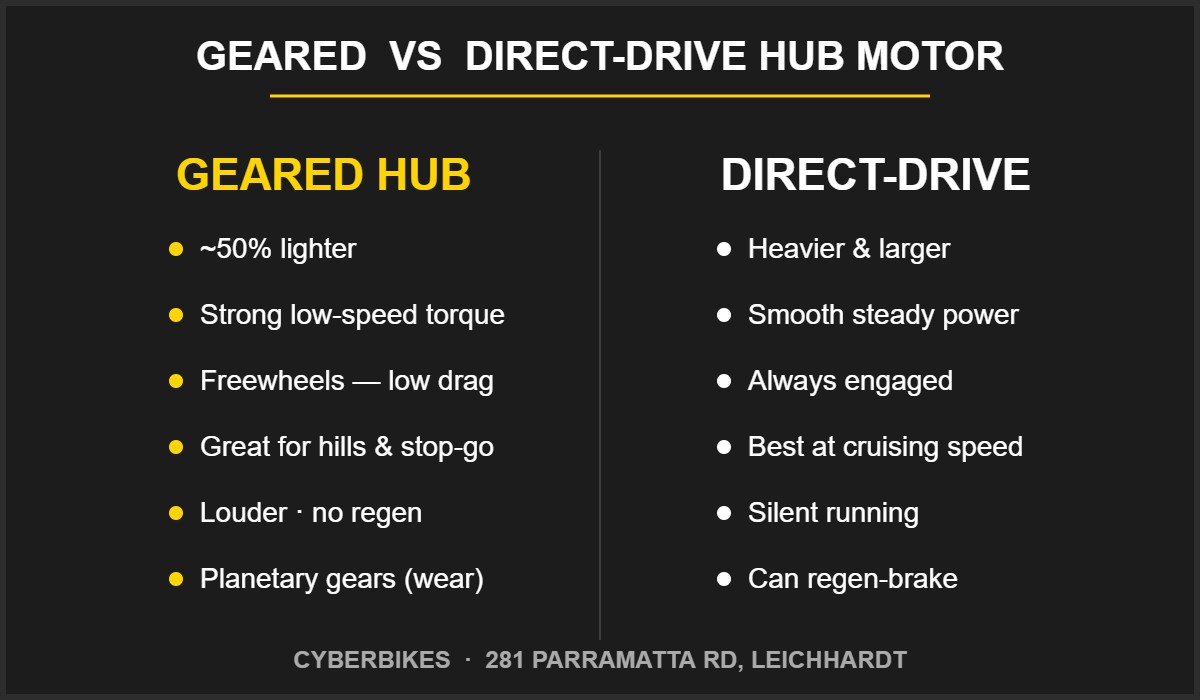
Geared vs direct-drive: the differences that matter
| Feature | Geared hub motor | Direct-drive hub motor |
|---|---|---|
| Weight | Lighter (~50% less) | Heavier & larger |
| Low-speed torque | Stronger — great on hills | Softer off the line |
| Coasting drag | Freewheels — very little | Always engaged — some drag |
| Regen braking | No | Yes |
| Noise | Faint gear whine | Near-silent |
| Moving parts | Planetary gears (wear item) | None but the wheel |
| Best for | Hilly, stop-start city riding | Fast, flat, long steady runs |
The physics: why gears change the feel
In any permanent-magnet motor, torque is proportional to current — push twice the amps and you get roughly twice the twist. But heat is the catch: because the copper windings have resistance, doubling the current to double the torque generates four times the heat (the I²R relationship Grin describes on its motor power ratings page). That is why it is torque, not raw watts, that ultimately cooks a motor. A geared hub sidesteps this by letting a small motor spin fast and multiply its torque mechanically, so it can climb a hill at lower current — and lower heat — than a direct-drive hub asked to do the same job at wheel speed.
Two more numbers worth knowing: your battery’s energy is simply volts × amp-hours, so the Centauro’s 48V 25Ah pack holds about 1,200 Wh, and the motor controller’s current limit sets how much punch the system can deliver before it taps out. None of this changes the legal limit — it just changes how the same 250W feels underneath you.
Which hub motor is right for Sydney riding?
In New South Wales, a road-legal power-assisted pedal cycle is capped at 250W of continuous rated power with assistance cutting out at 25 km/h, so both motor types are built to the same ceiling here — the difference is purely in how they deliver it. Sydney is hilly and stop-start, which plays to a geared hub’s strengths: light weight, strong take-off torque at the lights, and a freewheel that doesn’t punish you when the battery’s flat. That is why the Centauro e-bike pairs its 250W geared rear hub with a 48V 25Ah (1,200 Wh) UL 2271-certified Samsung battery, 4-piston hydraulic brakes on 180 mm rotors, an ISO 4210-rated 6061 alloy frame and an 18-month warranty — a practical package for real Sydney commuting at $3,999.99.
Prefer long, flat cruising, want quiet running and a bit of regen on descents? A direct-drive hub earns its extra weight. Want the full picture of how the motor, battery and controller work together? Read our deeper guide on how e-bikes actually work: motors, sensors and controllers, or compare drive positions in our mid-drive vs hub motor explainer.
See how a geared hub motor works
Our workshop opened up a geared hub motor to show the planetary gears in action and what to look for when you buy — worth a watch before you choose:
Frequently asked questions
Is a geared or direct-drive hub motor better for hills?
A geared hub motor is usually better for hills. Its internal gears let a fast-spinning motor multiply torque, so it produces strong pulling power at low wheel speed while drawing less current — and generating less heat — than a direct-drive hub climbing the same grade.
Can you get regenerative braking on a geared hub motor?
No. Almost all geared hub motors have an internal freewheel that disconnects the motor when you stop driving it, which removes drag but also makes regen impossible. Only direct-drive hubs, which are always mechanically engaged, can feed energy back to the battery.
Which is heavier, a geared or direct-drive hub motor?
Direct-drive hubs are heavier. Because they turn at low wheel speed, they must be physically large to make power, and a geared hub of equal power typically weighs around 50% less.
Come and feel the difference
The best way to understand geared torque is to ride it. Come in for a test ride at Cyberbikes, 281 Parramatta Road, Leichhardt, browse the Centauro e-bike online, or ask about our rent-to-own plans from $99.99/week. Call us on 0491 794 668 or visit Tuesday–Saturday.
#CyberbikesSydney #eBikeSydney #HubMotor #GearedHubMotor #ElectricBikeLeichhardt #CentauroEbike #eBikeTech