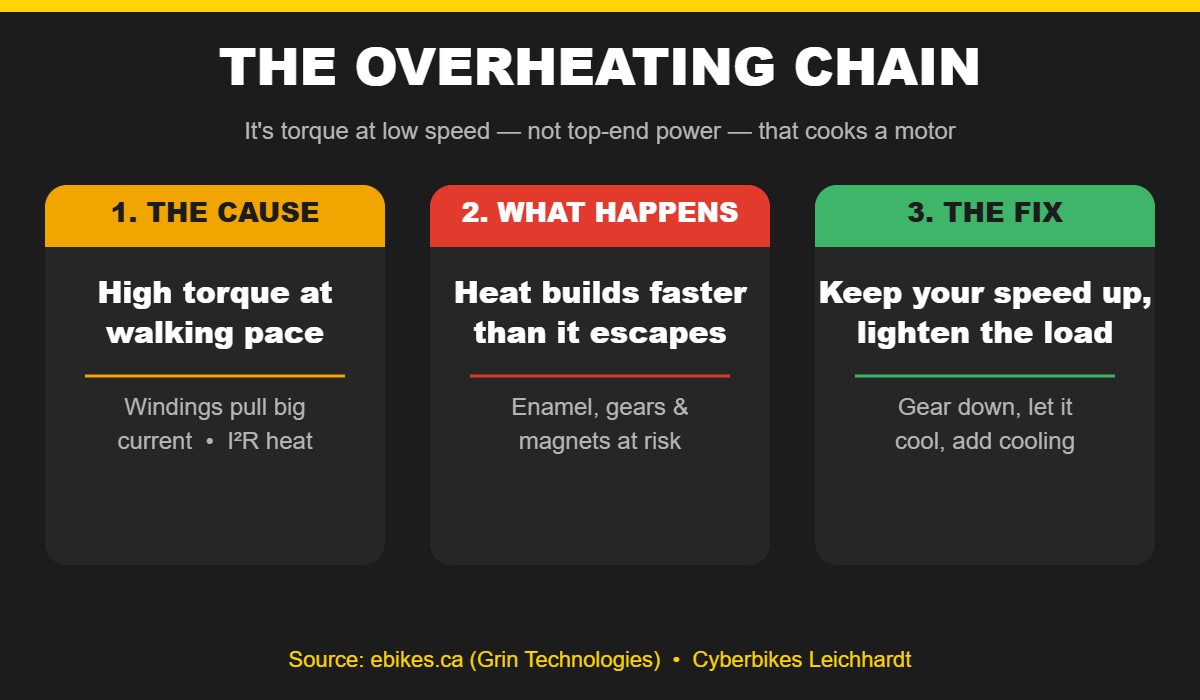
E-bike motors overheat when they are forced to make high torque at low speed for too long — think grinding up a steep hill, heavily loaded, at walking pace. The current flowing through the copper windings turns into heat, and because of the I²R relationship, doubling the current quadruples the heat produced. If that heat builds faster than the motor can shed it, the enamel on the windings, the internal gears or the magnets start to fail. The good news: on a road-legal 250W e-bike ridden sensibly around Sydney, it almost never happens — and the habits that prevent it are simple.
The short answer: it’s torque, not power, that cooks a motor
Riders assume a “powerful” motor runs hot and a small one stays cool, but that’s not how the physics works. As the motor engineers at Grin Technologies (ebikes.ca) put it, it is the output torque — not the output power — that heats a motor and eventually destroys it. Torque is how hard the motor is twisting; making more of it means pushing more current through the windings, and current is what generates heat. This is the same reason we explain the difference between torque and power to so many customers: two motors rated at the same watts can behave completely differently on a hill.
Why heat builds inside an e-bike motor (the I²R rule)
When a motor is loaded up to make torque, it draws more current, and the copper windings have electrical resistance. Resistance plus current equals heat — specifically, heat rises with the square of the current (the I²R relationship). Double the current for double the torque, and you generate four times the heat inside the motor.
Does more power always mean more heat? No. A motor spinning fast on the flat can put out plenty of power while staying cool, because the current stays low. The danger zone is the opposite case — lots of torque at very low RPM — where current is high and, because you’re barely moving, there is almost no airflow over the motor to carry the heat away. That’s why a slow, loaded hill climb is the classic overheating scenario, while a fast cruise never is.
What actually happens when a motor “cooks”
Motors are big lumps of metal, so they soak up short bursts of heat without much of a temperature rise. The problem is sustained high current: if the heat keeps accumulating, temperatures climb until something inside gives way. Per ebikes.ca, the three failure modes are:
| What overheats | What goes wrong | Result |
|---|---|---|
| Copper windings | Enamel insulation burns off | Short circuits, dead motor |
| Nylon planetary gears (geared hubs) | Gears soften and strip | Motor spins but drives nothing |
| Magnets | Begin to demagnetise | Permanent loss of torque and efficiency |
Whether any of this happens depends not just on how many amps flow, but on how long they flow for. A 30-second effort is fine; a 15-minute grind at full load is what does the damage.
The real triggers on Sydney roads
Around Leichhardt and the Inner West you’ll meet plenty of short, sharp pinches, and the approaches to the harbour and to Sydney’s ridgelines can be long. The situations that actually push a motor hard are: long, steep climbs taken at walking pace; carrying heavy cargo or a passenger up those climbs; relying on throttle alone without pedalling so the motor does all the work; and mechanical drag from under-inflated tyres or a rubbing brake, which makes the motor fight resistance even on the flat. Notice the common thread — all of them mean high torque held for a long time.
How to stop your e-bike motor overheating
Prevention is mostly about keeping the motor spinning and the load reasonable:
- Keep your speed up on climbs. A motor turning faster runs cooler and gets more cooling airflow. Slowing to a crawl is the worst thing you can do.
- Pedal — don’t just hold the throttle. Your legs share the load, so the motor draws less current for the same hill.
- On a mid-drive, gear down. Dropping to a lower gear lets the motor spin quickly while you climb slowly, which is exactly the cool, efficient zone.
- Lighten the load and fix drag. Inflate your tyres, make sure no brake is rubbing, and don’t overload beyond the bike’s rating.
- Give it a rest. On a really long climb, ease off or stop for a minute and let the motor shed heat before carrying on.
Can I add cooling to a hub motor? Yes. ebikes.ca notes that adding ferrofluid (Statorade), heat-sink hardware, or drilling vent holes in a direct-drive hub’s side plates all improve thermal dissipation, letting the motor sustain more power without overheating. For most riders, though, the free fixes above are more than enough. If you want the full picture of how the drivetrain fits together, our guide to how e-bikes actually work — motors, sensors and controllers ties it all together.
Watch: preventative motor care
Here’s a quick preventative-maintenance tip from the Cyberbikes workshop so you can keep your motor healthy:
Does a 250W e-bike like the Centauro overheat?
In everyday NSW riding, no. Because the law limits pedal-assist e-bikes to 250W with assistance cutting out at 25 km/h, a compliant bike simply never sustains the enormous currents that cook a motor. The Cyberbikes Centauro ($3,999.99) runs a 250W rear hub motor fed by a 48V 25Ah (1200Wh) UL 2271-certified Samsung battery, with hydraulic disc brakes and full suspension. Pair sensible current limits with hydraulic brakes that won’t drag, and thermal problems basically disappear — you’d have to deliberately abuse it to get there. If you ever do feel your motor getting hot, the team at Cyberbikes in Leichhardt can check your controller settings and brakes in person.
Frequently Asked Questions
Can a 250W e-bike motor overheat?
It is very unlikely under normal use. A road-legal 250W pedal-assist e-bike in NSW cuts power at 25 km/h, so sustained current stays modest. Overheating usually only appears when a low-powered motor is pushed far beyond its design — heavy loads on long, steep climbs at walking pace, or a dragging brake adding constant resistance.
How do I cool down an overheating e-bike motor?
Stop and let it rest. Reduce the assist level, get off and walk the steepest part, or ride at a higher speed where airflow over the motor is greater. Never spray a hot motor with cold water. If it happens often, lighten the load, fix any dragging brake, and ask about cooling upgrades or a controller current limit.
Does riding my e-bike in the rain cause overheating?
No. Overheating is about electrical load and time, not the weather — if anything, cool, damp air helps a motor shed heat. What causes overheating is sustained high torque at low speed, such as a heavy climb, regardless of whether it is wet or dry.
Worried your e-bike is running hot, or just want one that never will? Come in for a test ride at Cyberbikes, 281 Parramatta Road, Leichhardt, or browse the Centauro online.
#Cyberbikes #eBikeSydney #electricbikeLeichhardt #eBikeRepairSydney #CentauroEbike #eBikeTech #motorcooling