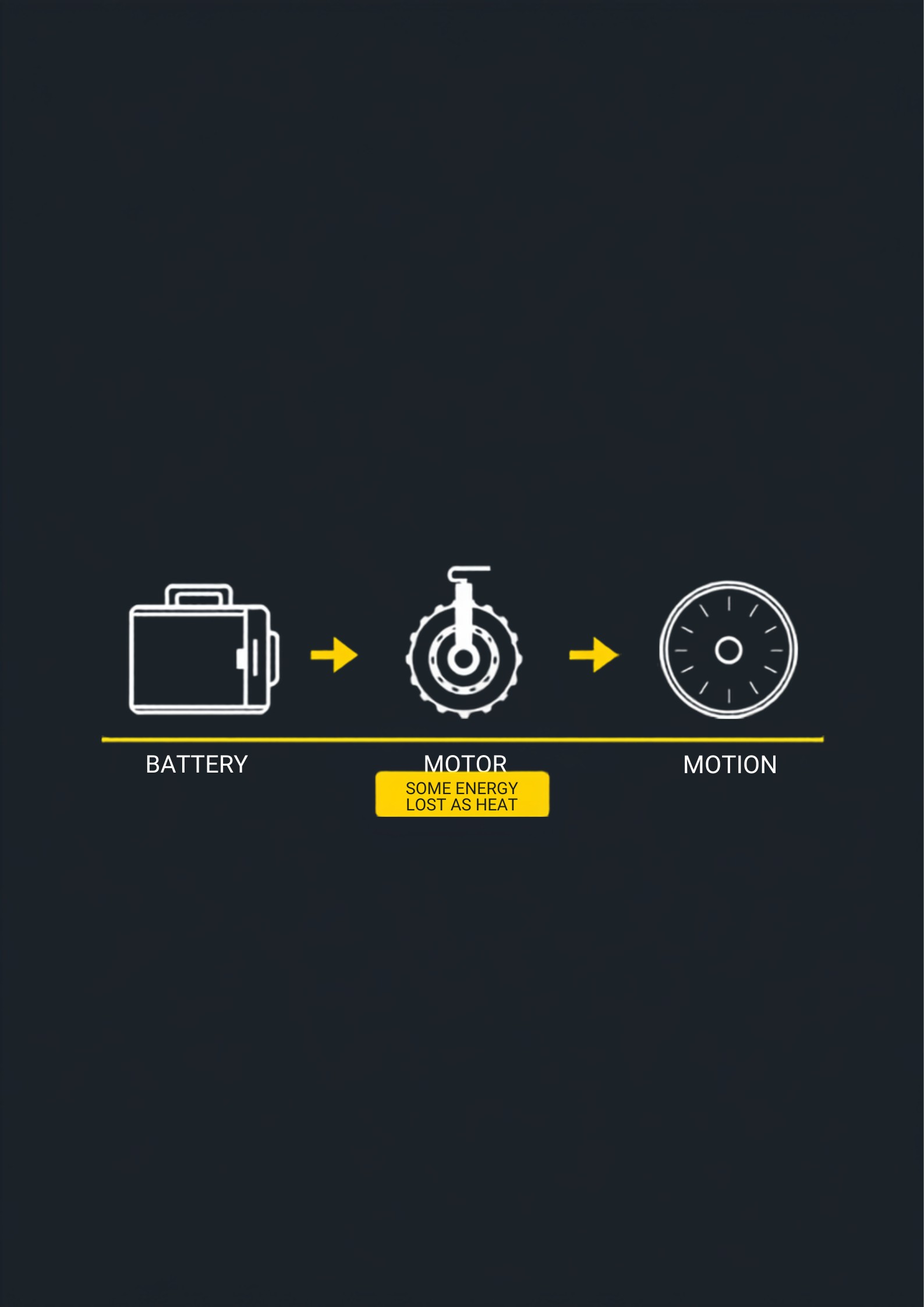
A good e-bike hub motor turns roughly 75–85% of the electrical energy your battery hands it into forward motion when you’re cruising — the rest escapes as heat. That efficiency is at its best at a steady cruising speed and drops sharply when you crawl up a steep hill or grind along at low speed under heavy load. Understanding where the energy actually goes is the single clearest way to explain your real-world range, why hills drain the battery, and why a “bigger number” on the spec sheet doesn’t always mean a better ride. Here’s the engineering, in plain English, from the Cyberbikes workshop in Leichhardt.
The short answer: input power in, motion out, heat in between
Every e-bike has two different “power” numbers, and telling them apart is the whole game. Input power is what the battery pushes into the system — volts multiplied by amps (V × A), the figure a display or Cycle Analyst shows you. Output power is the mechanical power that actually reaches the road — torque multiplied by how fast the motor spins. Motor efficiency is simply output divided by input. The gap between the two is energy lost, and almost all of it becomes heat in the copper windings.
Grin Technologies’ motor-power explainer at ebikes.ca gives a clean worked example. Take a typical hub motor on a 36V battery with a 20A controller at full throttle: the display shows a steady 744 watts of input power, while the motor’s peak output is about 600 watts at 40 km/h. That’s roughly 80% efficient at the sweet spot — 600 out of 744 watts doing useful work, and around 144 watts turning into heat. Not bad for a machine the size of a large orange.
Where does the lost energy go? (Almost all of it is heat)
When a motor is loaded up to produce torque, it draws current through its copper windings, and copper has electrical resistance. That resistance is where the losses live. The relationship is not gentle: double the current to get double the torque, and you quadruple the heat. Engineers call this the I²R relationship — heat rises with the square of the current. It’s why an e-bike motor barely warms up on the flat but can get genuinely hot dragging a heavy load up a long climb.
A subtle but important point from the same source: it’s the motor’s torque, not its power, that generates the damaging heat. Power is torque times rotational speed. Using ebikes.ca’s own numbers, a motor making 20 Nm of torque at 100 rpm produces about 209 watts, but the exact same 20 Nm at 300 rpm produces about 628 watts. Same heat-producing torque, three times the useful power — purely because the motor is spinning faster. That’s the key to the next section.
Why efficiency drops on hills and at low speed
Here’s the counter-intuitive bit. When your controller is holding a fixed input power and the motor slows down — because you’ve hit a hill and the load has increased — the mechanical output falls faster than the input does, so efficiency drops the slower the motor turns. On the ebikes.ca power curve you can watch the efficiency line sag as speed falls below the peak-power point. The battery is still pouring in the watts; more and more of them are just leaving as heat instead of pushing you up the hill.
This is exactly why “why does my e-bike use so much more battery uphill?” is one of the most common questions we hear. On a climb you need high torque at low wheel speed — the least efficient corner of the map — so your Wh-per-kilometre shoots up. It’s also the core reason mid-drive motors exist: by driving through your gears, a mid-drive keeps its own rpm high and efficient even when the bike is barely moving, while a hub motor is stuck turning at wheel speed. If you want the full mechanical breakdown, our guide on how e-bikes actually work — motors, sensors and controllers walks through each part in order.
What efficiency means for your real-world range
Range is really an efficiency question wearing a different hat. Your battery stores a fixed amount of energy in watt-hours: Wh = volts × amp-hours. The Cyberbikes Centauro, for example, carries a 48V 25Ah Samsung pack — that’s 48 × 25 = 1,200 Wh of stored energy, driving a 250W rear hub motor. How far that goes depends entirely on how many watt-hours you burn per kilometre.
A worked example makes it concrete. If you ride efficiently — steady speed, sensible assist level, decent tyre pressure — an everyday commuter might average somewhere around 10–14 Wh per kilometre from the battery. Divide 1,200 Wh by that and you get very roughly 85–120 km of range. Ride hard, always on the highest assist, into headwinds and up hills, and your Wh/km climbs, so the same battery gives you far fewer kilometres. Nothing about the battery changed — only how efficiently the motor was being asked to work.
Where a battery’s watt-hours actually go
| Riding scenario | Motor efficiency | What you feel |
|---|---|---|
| Steady cruise on the flat, ~25 km/h | Highest (~80%+) | Long range, motor stays cool, low Wh/km |
| Gentle rolling hills | Good | Slightly higher battery use, still comfortable |
| Steep, slow climb under load | Lowest | High Wh/km, motor heats up, range drops fast |
| Stop-start city riding | Mixed | Frequent acceleration spikes raise average draw |
Hub vs mid-drive: which wastes less energy?
At their best operating point, a quality hub motor and a quality mid-drive reach broadly similar peak efficiency — both are far better than any petrol engine. The difference is what happens away from that sweet spot. A hub motor spins at wheel speed, so on a slow steep climb it’s forced into its inefficient, hot low-rpm zone. A mid-drive pushes its power through your bike’s gears, so you can shift down and keep the motor spinning fast and efficient even at a crawl. For flat-to-rolling Sydney commuting, a well-matched hub motor like the Centauro’s is efficient, quiet and low-maintenance; for relentless steep terrain, a geared mid-drive holds its efficiency better. The controller matters too — it decides how much current reaches the motor — which we cover in how an e-bike motor controller actually works.
Does NSW’s 250W limit hurt efficiency?
No — and this is where the “power ratings” myth does the most damage. As ebikes.ca argues at length, there is no consistent standard for stating a motor’s watt rating; the very same motor gets sold as 250W, 500W or 1000W by different vendors depending on which number flatters the marketing. What actually determines performance is the real output power over your whole speed range, not a single sticker figure. In NSW, a road-legal e-bike is a 250W (nominal) pedal-assist bike that stops assisting at 25 km/h. Within those limits, a well-designed 250W system is highly efficient — it’s tuned to deliver its useful power exactly where you ride, rather than dumping current into heat chasing a bigger headline number. The Centauro is built to that standard and is designed to comply with UL 2849, UL 2271, ISO 4210 and EN 15194 for the system, battery and frame.
How to squeeze more real-world efficiency out of your e-bike
Because efficiency is highest at steady, moderate loads, a few habits make a measurable difference: hold a smooth, consistent speed instead of surging and braking; drop to a lower assist level when you don’t need the boost; keep your tyres pumped to the recommended pressure (soft tyres waste energy as rolling resistance); shift to an easier gear before a climb so the motor and your legs both stay in their efficient range instead of lugging; and keep the battery healthy and reasonably charged, since a tired or very cold pack sags under load. None of this changes the physics — it just keeps the motor working in the efficient part of its map more of the time.
See it in action
Efficiency isn’t just a motor thing — it’s a whole-vehicle thing. This short Cyberbikes video makes the point vividly: a 35kg e-bike does real transport work on a tiny fraction of the energy a 300 km/h supercar burns to do the same trip. It’s the same principle as the motor curves above, scaled up to the whole machine.
Frequently Asked Questions
Are e-bike motors more efficient than car engines?
Yes, dramatically. A good e-bike electric motor converts roughly 75–85% of its electrical input into motion at cruising speed, while a typical petrol car engine converts only about 20–30% of the fuel’s energy into motion, wasting the rest as heat and exhaust. That efficiency gap, on top of the huge weight difference, is why an e-bike moves a person on a tiny fraction of the energy a car uses.
Does a bigger battery make my motor more efficient?
No. Efficiency is set by the motor, controller and how hard the motor is loaded — not by battery size. A bigger battery stores more watt-hours, so it gives you more range, but each kilometre still costs the same amount of energy at a given speed and load. To improve efficiency you change how you ride, not how big the pack is.
Why does my e-bike drain the battery so much faster uphill?
Climbing needs high torque at low wheel speed, which is the least efficient part of a motor’s operating range. Higher torque means higher current, and because heat rises with the square of current, more of the battery’s energy is lost as heat instead of forward motion. Your watt-hours-per-kilometre climb steeply, so range drops fast on sustained hills.
The Cyberbikes take
Don’t be dazzled by the biggest wattage on a spec sheet. What matters is how efficiently a motor turns your battery’s stored energy into kilometres — and that comes down to matching the motor, controller and battery to how you actually ride. At Cyberbikes in Leichhardt we’re happy to open the hood on any of this and show you the numbers on a real bike. Come in for a test ride at Cyberbikes, 281 Parramatta Road, Leichhardt, browse the Centauro e-bike online, or ask about our rent-to-own plans from $99.99/week.
#Cyberbikes #eBikeSydney #electricbikeLeichhardt #eBikeTech #eBikeEfficiency #CentauroEbike #rideelectric