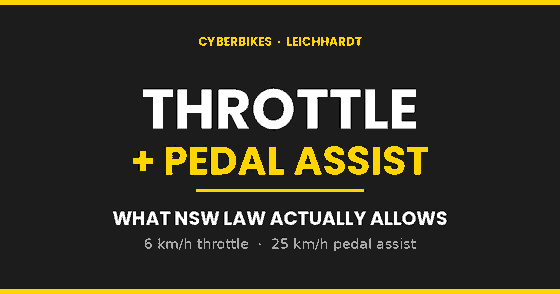
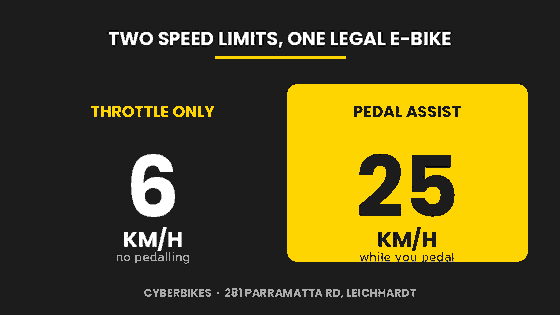
Yes — a modern e-bike can run both a throttle and pedal assist at the same time, and in NSW a road-legal e-bike is actually allowed to have both. The catch is how far each one is allowed to take you. Under NSW law (updated in March 2026), a throttle that drives the motor without pedalling must cut out at 6 km/h, while pedal assist can keep helping you up to 25 km/h. So the two systems do different jobs: the throttle is a low-speed walk-and-start helper, and pedal assist is what quietly carries you along the road. At Cyberbikes in Leichhardt we get asked this almost daily, so here is exactly how a throttle and pedal assist work, what the controller is doing behind the scenes, and where the law draws the line.
The short answer: yes, but the throttle is capped at 6 km/h
On most e-bikes the throttle and the pedal-assist sensor are two separate inputs feeding one motor controller, so having both fitted is completely normal. What changed in 2026 is not whether you can have a throttle, but what it is allowed to do on its own. In NSW a throttle can legally move the bike from a standstill up to walking pace — around 6 km/h — for wheeling out of a lift, nudging across a driveway, or getting rolling on a hill. Past 6 km/h, the motor is only allowed to help while you are actually pedalling. That is the single rule that decides whether your e-bike is a legal bicycle or an unregistered motorbike.
How a throttle and pedal assist actually work
A throttle is a direct command. It is usually a small hall-effect sensor under a twist grip or thumb lever that sends the controller a rising 0–5V signal. Squeeze it and the controller pushes current to the motor immediately, whether or not your legs are moving. As the pioneers at Canadian motor specialist Grin Technologies (ebikes.ca) put it, a throttle gives you “100% control of the motor power at any instant” — instant, analog, and entirely up to your hand.
Pedal assist (PAS) is automatic. Instead of a hand control, a sensor at the cranks tells the controller that you are pedalling, and the motor engages on its own. There are two families of PAS sensor. A basic cadence sensor uses a ring of magnets on the crank — early ones had 5–6 magnets, but 12 poles is now the norm and 24-pole sensors are increasingly common for faster response — and simply detects that the pedals are turning. A torque sensor goes further and measures how hard you are pushing, then multiplies your effort, so pedalling twice as hard delivers roughly twice the assist. Either way, you are not holding anything; you interact with the system only when you press the assist-level button to ask for more or less help.
Both inputs land at the same place: the controller. It reads the throttle voltage or the crank signal, decides how many amps to send, and switches power to the motor. That is why a bike can carry both — the controller just prioritises whichever input is asking for power, usually blending them so the throttle can top up when you want an extra push.
Can you legally use a throttle on an e-bike in NSW?
Yes, within limits. According to Transport for NSW, a road-legal e-bike must have a maximum continuous rated power of 500W (dropping to 250W from 1 March 2029), a motor that does not provide power above 25 km/h, and a throttle-only function that cuts out at 6 km/h. In plain terms: a throttle is fine as a 6 km/h walk-and-start assist, but a throttle that drives you along at full speed without pedalling makes the bike illegal — even if you cap it with an app or a switch. From 1 February 2026, e-bikes and batteries sold in NSW must also meet the European Standard EN 15194, and from March 2029 only EN 15194–certified e-bikes will be road-legal.
This is why the throttle on a compliant Australian e-bike feels deliberately gentle at low speed and then hands over to pedal assist. It is not a weak throttle — it is a legal one.
Throttle vs pedal assist: which should you actually use?
There is no single winner — it depends on the riding. A throttle shines in stop-and-go traffic, tight sharing with pedestrians, and pulling away from lights, where instant, precise low-speed control is genuinely useful. Pedal assist shines on the open run: you set an assist level and simply ride, without the wrist fatigue of holding a throttle for a whole commute. Grin’s own view is that neither is the “gold standard” — riders who like to earn their power prefer torque-sensing pedal assist, while riders who want power on tap prefer a throttle or a simple cadence system.
| Throttle | Pedal assist | |
|---|---|---|
| How it triggers | Hand lever, direct 0–5V signal | Crank sensor, engages when you pedal |
| NSW speed cap | 6 km/h without pedalling | Up to 25 km/h while pedalling |
| Best for | Starts, walking pace, stop-go traffic | Effortless cruising and commuting |
| Rider effort | None required | You keep pedalling |
| Battery use | Higher at a given speed | More efficient |
On battery specifically, leaning on a throttle usually pulls more energy than spinning along under pedal assist, because your legs are adding nothing to the effort. We break that trade-off down in our guide to whether a throttle or pedal assist drains your e-bike battery faster. If you want the full picture of motors, sensors and controllers working together, our deep-dive on how e-bikes actually work — motors, sensors and controllers ties it all together.
What the Cyberbikes Centauro uses
Our own Cyberbikes Centauro is built exactly to this legal shape. It runs a 250W rear hub motor that delivers pedal assist up to 25 km/h plus a 6 km/h throttle walk-assist, so you get both inputs done the compliant way. Power comes from a 48V 25Ah (1200Wh) Samsung lithium-ion battery, and the bike is certified to UL 2849 with a UL 2271 battery, inside today’s NSW power and speed limits. It is a full-suspension step-through with 100mm front and 120mm rear travel, four-piston hydraulic brakes, and a frame rated to a 150kg rider-and-cargo load, priced at $4,249 and available in black, blue, silver and yellow. Watch it in action below.
Frequently Asked Questions
Can you have both a throttle and pedal assist on an e-bike?
Yes. Most e-bikes wire a throttle and a pedal-assist crank sensor into the same controller, so both can be fitted and used on one bike. On a road-legal NSW e-bike the throttle handles movement up to 6 km/h without pedalling, and pedal assist takes over up to 25 km/h while you pedal.
Is a throttle legal on an e-bike in NSW?
A throttle is legal only as a low-speed helper. Transport for NSW requires that a throttle-only function (motor without pedalling) cuts out at 6 km/h. A throttle that powers the bike above 6 km/h without pedalling makes the e-bike illegal, even if limited by an app or switch.
Does a throttle drain your e-bike battery faster than pedal assist?
Generally yes at the same speed, because with a throttle your legs contribute no power, so the motor and battery do all the work. Riding under pedal assist shares the load between you and the motor, which typically stretches range further.
Want to feel the difference between throttle and pedal assist for yourself? Come in for a test ride at Cyberbikes, 281 Parramatta Road, Leichhardt, browse the Centauro online, or ask about our rent-to-own plans from $99/week.
#CyberbikesLeichhardt #ebikeSydney #electricbikeLeichhardt #CentauroEbike #PedalAssist #EbikeThrottle #NSWebikelaw