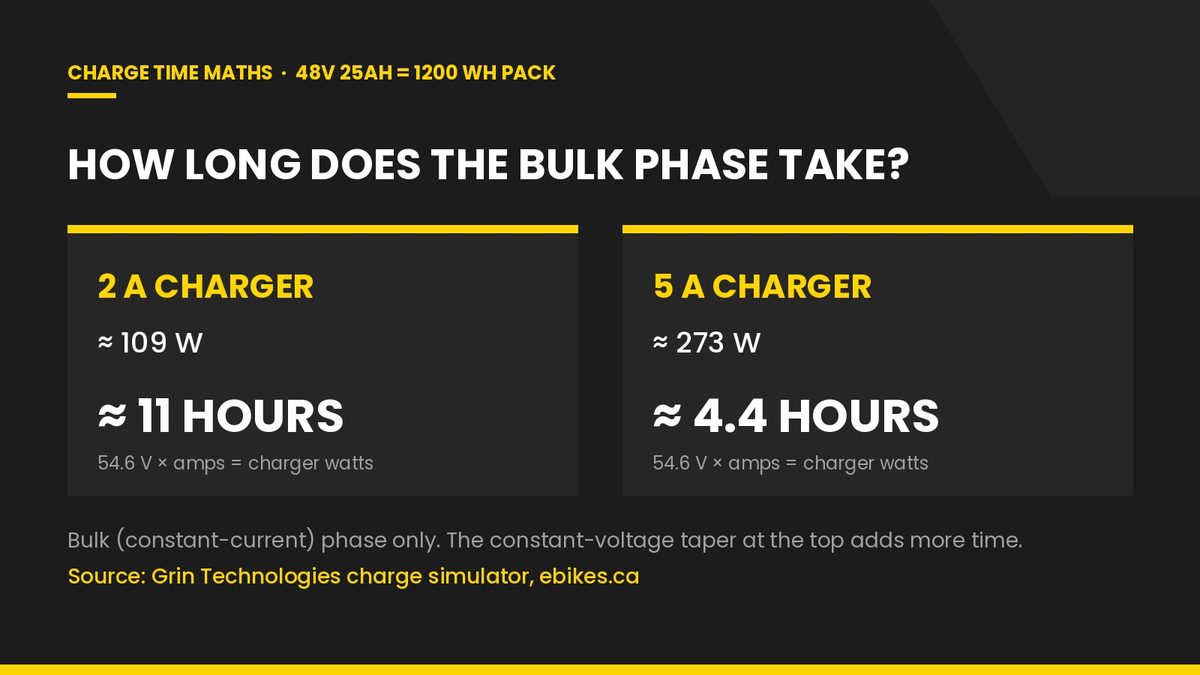
A fast e-bike charger does not give you more range. It refills the same battery sooner. On a 48V 25Ah pack (1200 watt-hours), a 2-amp charger needs roughly 11 hours of bulk charging, while a 5-amp charger does the same work in about 4.4 hours. What you pay for that speed is heat inside the pack, and heat is what quietly shortens a lithium battery’s life.
So the short version: take the fast charger if your day forces a quick turnaround, and keep a standard one for overnight. Below is the engineering behind that answer, along with the four questions riders actually ask us across the bench at Cyberbikes in Leichhardt.
What do the numbers on an e-bike charger actually mean?
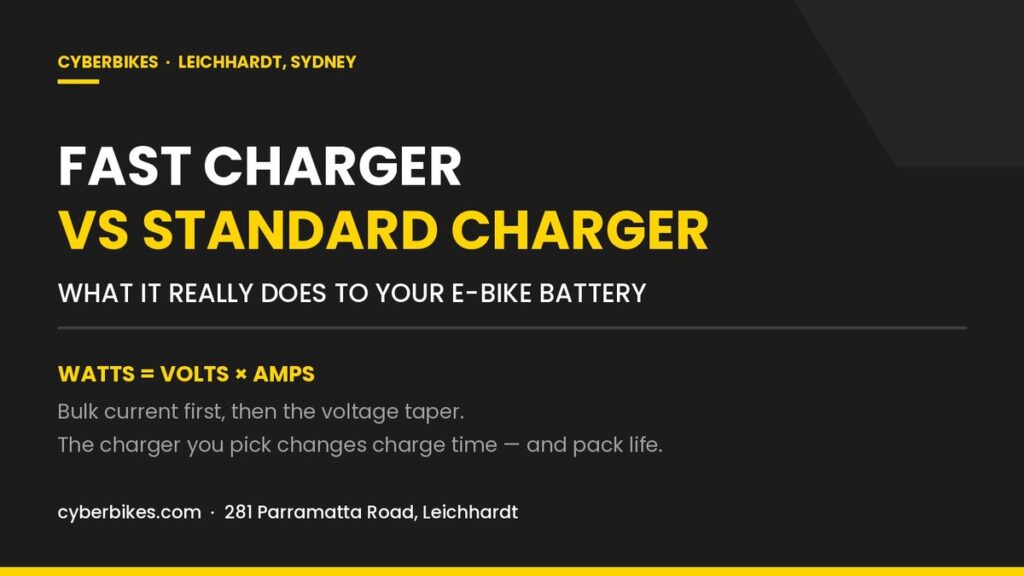
Read the label on the brick and you will see something like 54.6V 2A. Those two numbers multiply to give power: watts = volts x amps. So that charger delivers about 109 watts. The 5A version of the same charger delivers 54.6 x 5, or roughly 273 watts. That ratio, not the brand name, is the whole difference between a “standard” and a “fast” e-bike charger.
Why 54.6V for a battery sold as 48V? A 48V pack is normally thirteen lithium cells wired in series. Each cell sits near 3.7V nominal, as Grin Technologies sets out in its battery primer at ebikes.ca, and tops out at 4.2V. Thirteen times 4.2 is 54.6V. The 48V on the sticker is the nominal figure; 54.6V is what the charger has to push to fill it.
The battery label works the same way: watt-hours = volts x amp-hours. The 48V 25Ah pack on the Cyberbikes Centauro is 48 x 25 = 1200Wh of stored energy. If you want the full picture of cells, capacity and pack construction, our definitive guide to e-bike batteries covers it, and we have also pulled apart amp-hours versus watt-hours on their own.
How much faster is a fast e-bike charger, really?
Divide energy by power and you get the first estimate: 1200Wh divided by 109W is about 11 hours; 1200Wh divided by 273W is about 4.4 hours. Both real charges take a bit longer than that, because a lithium charger works in two stages rather than one.
Grin Technologies’ charge simulator shows the shape plainly. In the bulk stage the charger holds its full rated current while pack voltage climbs. Once the pack reaches the target voltage the charger switches to constant voltage, and current tapers away towards zero. That taper is where the final few percent live, and it takes disproportionately long.
- The gap between a 2A and a 5A charger is widest in the middle of a charge and narrowest at the top.
- Doubling charger amps does not halve total charge time, because the taper does not speed up with it.
- There is a ceiling on the charger side too: Grin’s own Satiator caps out at 8A of bulk current, and that limit comes from its 360-watt power budget rather than from the battery.
Does fast charging wear your e-bike battery out faster?
Two separate things age a pack: heat, and the voltage you hold the cells at. A fast charger touches both.
Heat first. Current through any resistance becomes heat, and the relationship is not linear, it is I squared R. Grin makes the point bluntly in its write-up on motor power ratings: double the current through a winding and you generate four times the copper heating. The same physics governs cells, wiring and connectors while charging. Stepping from 2A to 5A is 2.5 times the current and roughly six times the resistive heating inside the pack. A well-built battery with a competent management system handles that comfortably. A cheap one does not, which is why we are fussy about what we plug into a customer’s bike.
Voltage second, and this is the bigger lever by far. Grin’s charge simulator documentation notes that most lithium chemistries, with lithium iron phosphate the exception, gain substantially in both calendar life and cycle life when they are not parked at the full 4.2V per cell but charged to a lower voltage instead. The difference they describe is between a pack that lasts one to two years and one that lasts four to five.
Should you charge an e-bike battery to 100% every time?
Only when you need the range. Stopping around 80 to 90% skips the slowest part of the charge and keeps the cells away from their most stressful voltage. In practice that means charging to full the night before a long ride out to Parramatta or the Bay Run, and stopping short on ordinary commuting days. If your charger offers selectable charge levels, that is exactly what the feature is for.
Which e-bike charger should you actually buy?
| Charger | Power output | Bulk time on a 1200Wh pack | Best for |
|---|---|---|---|
| 2A standard | about 109W | about 11 hours | Overnight charging, longest pack life, apartment living |
| 4A to 5A fast | about 218W to 273W | about 4.4 to 5.5 hours | Midday top-ups, cargo and delivery riders, back-to-back shifts |
The pattern we see on the workshop bench at 281 Parramatta Road is simple. Riders who commute once a day are better served by the standard charger plugged in overnight; the bike is sitting still for ten hours anyway, so the extra speed buys nothing and the lower current is gentler on the cells. Riders who turn the bike around twice in a day, or who run a cargo setup, get real value from the fast charger and should treat the slower one as the weekend option.
One number worth working out for yourself is your energy use per kilometre. If your riding averages somewhere near 10Wh per kilometre, a 1200Wh pack is around 120km of assistance; heavier loads, hills and headwinds push that figure up quickly. Grin’s trip simulator will model your own route rather than a marketing number. The Cyberbikes Centauro carries that 48V 25Ah Samsung pack, certified to UL 2271 with the wider system certified to UL 2849, a 250W rear hub motor, 4-piston hydraulic brakes on 180mm rotors and a 150kg maximum rider and cargo load.
Does a faster charger change your e-bike’s legal status in NSW?
No. NSW law regulates the bike’s motor, not the charger you plug into the wall. Transport for NSW sets the limits at a maximum continuous rated power of 500 watts, no motor power at all above 25km/h, and throttle-only assistance that cuts out at 6km/h. From 1 March 2029 the cap drops to 250 watts and EN 15194 certification becomes mandatory. Importantly, a bike over those limits is illegal even if an app or a switch restricts it. Charging current appears nowhere in that list, so choosing a fast charger is a workshop decision and not a legal one. Our complete guide to e-bike laws in NSW has the rest.
Frequently asked questions
Can I use a higher-amp charger on my existing e-bike battery?
Only if the battery and its management system are rated for that charge current, and only at the same voltage. The charger voltage must match the pack exactly, so a 54.6V charger belongs on a 48V pack and nothing else. Charge current above what the pack is rated for produces more heat inside the cells, because resistive heating rises with the square of current. If the rating is not printed on the pack, ask the shop that supplied it before you change chargers.
Is it bad to leave an e-bike battery on the charger overnight?
It is not dangerous with a quality charger and a healthy pack, because the charger ends in a constant-voltage stage where current falls to almost nothing. It is not ideal either, since the cells sit at their highest voltage for hours, and that is the condition most associated with faster ageing. Charging to about 80 to 90% and unplugging is kinder to the battery over years of use.
Does a fast charger give my e-bike more range?
No. Range comes from the energy stored in the pack, measured in watt-hours, and from how much energy your riding uses per kilometre. A 1200Wh battery holds 1200Wh whether it took 4 hours or 11 hours to fill. A fast charger only changes how long you wait.
Want to feel the difference rather than read about it? Come and ride a Centauro at Cyberbikes, 281 Parramatta Road, Leichhardt. We are open Tuesday to Saturday, you can call us on 0491 794 668, and rent-to-own starts from $99.99 per week if you would rather not pay for a bike up front.
#Cyberbikes #eBikeSydney #Leichhardt #eBikeCharger #eBikeBattery #CentauroEbike #RentToOwn #SydneyCommute