
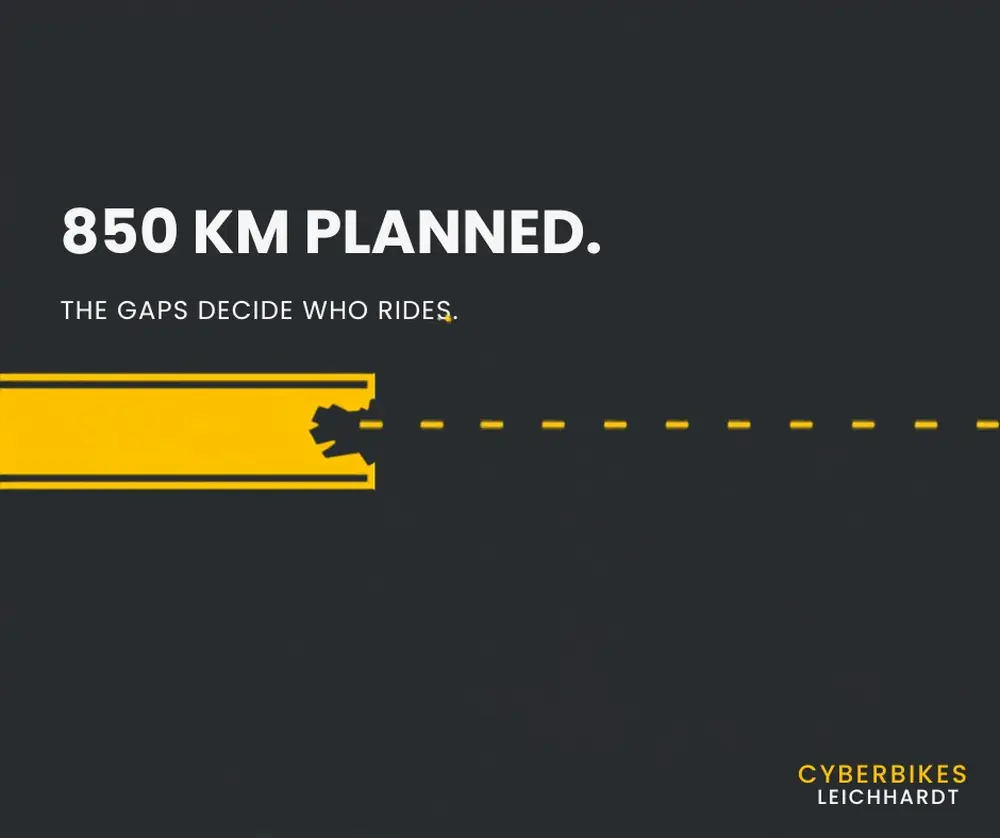
Sydney bike lanes stop because the network was funded and built in disconnected pieces, one council boundary and one budget round at a time — not as a single joined-up route. Transport for NSW has mapped more than 850 kilometres of strategic cycleway corridors across Greater Sydney, but only 100 kilometres of new strategic cycleway is committed by 2028. The paint runs out where the funding did, and that gap is the whole story of who rides in this city and who drives instead.
How big is the gap between Sydney’s planned and built bike network?
Enormous, and it is mapped in public. The Transport for NSW Strategic Cycleway Corridors plan for Greater Sydney identifies over 85 corridors covering more than 850 km. Against that, the near-term commitment is “more than 100 kilometres of new strategic cycleways by 2028”. So roughly one kilometre in eight of the planned network has a date attached. The rest is a line on a map.
The department is not hiding it. The same document lists “immediate opportunities for investigation to fill shorter missing gaps in the network” — an official admission that the fragments are the problem. The Committee for Sydney reached the same conclusion in Making Sydney a Cycling City, describing “a patchwork network of cycle routes protected and separated from motor traffic”, with protection “missing in the vast majority of the metropolitan area”.
Why does one missing block ruin an entire route?
Because people do not average out risk — they avoid it. The Committee for Sydney put it in one line: “A cycling trip is only as attractive as its worst section. Gaps in the network undermine the entire route’s attractiveness.” A nine-kilometre ride with 400 metres of unprotected merge across four lanes is not a nine-kilometre protected ride. For most people it is a no.
Which is why counting total kilometres built misses the point. A network is not a pile of segments; it is a promise you can get from A to B without being asked to gamble. Break the chain once and the chain is worth very little. That is not a failure of nerve in the people who would ride — the same research found 70% of Sydneysiders say they would cycle at least once a week if it was safe to do so. The demand is sitting there. The continuous route is not.
Does closing a gap actually bring riders out?
Yes, and Sydney’s own count data proves it faster than any overseas example. Bicycle NSW’s summary of the biannual Sydney bike counts recorded 55,030 trips in March 2025, up 7% on the 51,271 counted in March 2024, across 78 sites. Of the ten busiest intersections, eight have separated cycleways.
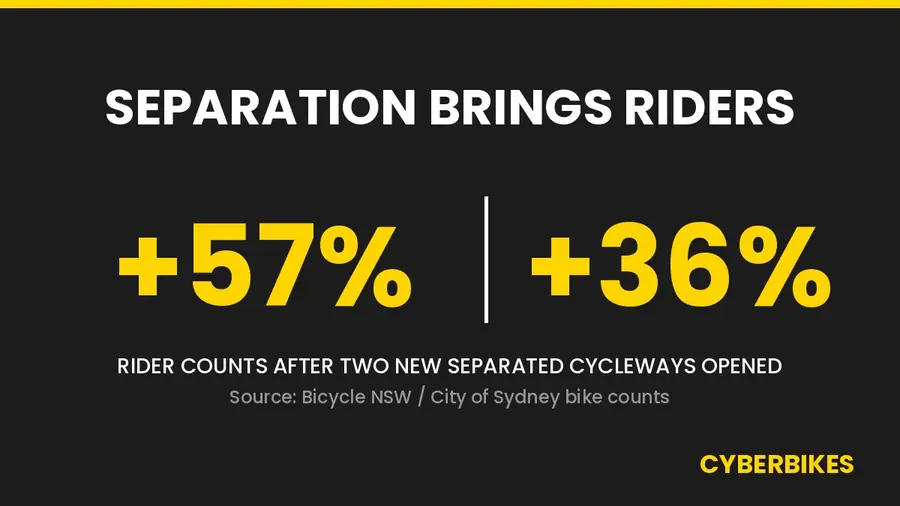
The before-and-after numbers are the ones worth pinning to a wall. After the Ngamuru connection opened, trips at the nearby Portman Street and Geddes Avenue count point rose 57%. When the Castlereagh Street cycleway was extended north to King Street, counts at Goulburn and Castlereagh jumped 36% within six months. Nobody ran a campaign to make those riders appear. A gap closed, and they turned up.
What does a closed gap look like in the Inner West?
It looks like the GreenWay. The 6 km corridor between Iron Cove and the Cooks River at Earlwood opened on 14 December 2025 and did something no amount of encouragement could: it turned two separate rides into one. Before it, the Bay Run’s 7 km Iron Cove loop and the Cooks River Cycleway’s roughly 23 km were two islands. Now they are a single route you can ride from Leichhardt without negotiating Parramatta Road.
That is the whole argument in one corridor. The GreenWay added no destination — the destinations already existed. It added continuity, which is exactly what the rest of the map is short of. Six connected kilometres beat sixty disconnected ones.
What would actually close Sydney’s bike lane gaps?
Road space, and the willingness to reallocate it. Every missing link runs along a street that already exists and already has width — width currently allocated to moving and storing cars. Closing a gap is rarely a construction problem. It is an allocation decision, made street by street.
- Fund missing links first, not new corridors. A 300 m connection that joins two existing routes buys more usable network than 3 km of new cycleway that ends at a roundabout.
- Treat the corridor, not the council boundary. Routes that die at an LGA line are an artefact of who pays, not of where people travel.
- Separate, don’t share. Eight of Sydney’s ten busiest count points have separated cycleways. Shared paths ask walkers and riders to absorb a design failure that belongs to the road.
- Count the trips that are already short enough. The Committee for Sydney found two million car trips under 2 km are made in Sydney every weekday. On an e-bike, 2 km is about six minutes.
None of this asks anyone to give up a car they genuinely need. It asks the network to stop requiring bravery. If you are weighing up whether your trips are already e-bike trips, our complete guide to car-free e-bike commuting in Sydney works through the maths, and the rules that apply on the way are set out in our guide to e-bike laws in NSW and Australia. For what a city looks like once the gaps are closed, see what Sydney can learn from Copenhagen’s cycling success.
What are the rules for riding those gaps legally in NSW?
Worth knowing before you route around a missing link. Per Transport for NSW, a legal NSW e-bike has a maximum continuous rated power of 500 watts, motor assistance that stops at 25 km/h, and any throttle-only function must cut out at 6 km/h. From 1 March 2029 only EN 15194 certified e-bikes will be allowed on NSW roads, with the continuous power limit dropping to 250 W. Helmets are mandatory, and riders aged 16 and over cannot use footpaths unless supervising a child under 16.
The bikes we build at Cyberbikes in Leichhardt are specified to that law rather than around it — the Cyberbikes Centauro runs a 250 W rear hub motor with a UL 2271-certified 48V 25Ah (1200Wh) Samsung battery, and carries ISO 4210, UL 2849 and EN 15194 certification. A compliant bike is the one you can ride on every metre of network that does exist.
Frequently Asked Questions
How many kilometres of cycleway does Sydney actually have planned?
Transport for NSW has identified over 85 strategic cycleway corridors across Greater Sydney covering more than 850 kilometres. Of that, more than 100 kilometres of new strategic cycleway is committed for delivery by 2028, which is roughly one kilometre in eight of the mapped network.
Do new separated cycleways in Sydney actually get used?
Yes. Sydney bike counts recorded 55,030 trips in March 2025, up 7% on March 2024, and eight of the ten busiest count points sit on separated cycleways. After the Ngamuru connection opened, nearby counts rose 57%, and the Castlereagh Street extension lifted counts at Goulburn and Castlereagh by 36% within six months.
Why do Sydney bike lanes end suddenly instead of continuing?
Because cycleways are funded and delivered in separate segments by different agencies and councils rather than as one continuous corridor, so a route often stops at a funding boundary or where road space was not reallocated. Transport for NSW itself lists filling “shorter missing gaps in the network” as a priority for investigation.
Swap one car trip a week for an e-bike ride and see what changes. We are at Cyberbikes, 281 Parramatta Road, Leichhardt.
#EbikeSydney #CyberbikesLeichhardt #SydneyCycling #BikeLanes #ActiveTransport #CarFreeSydney #InnerWest #GreenWay #UrbanPlanning #Centauro