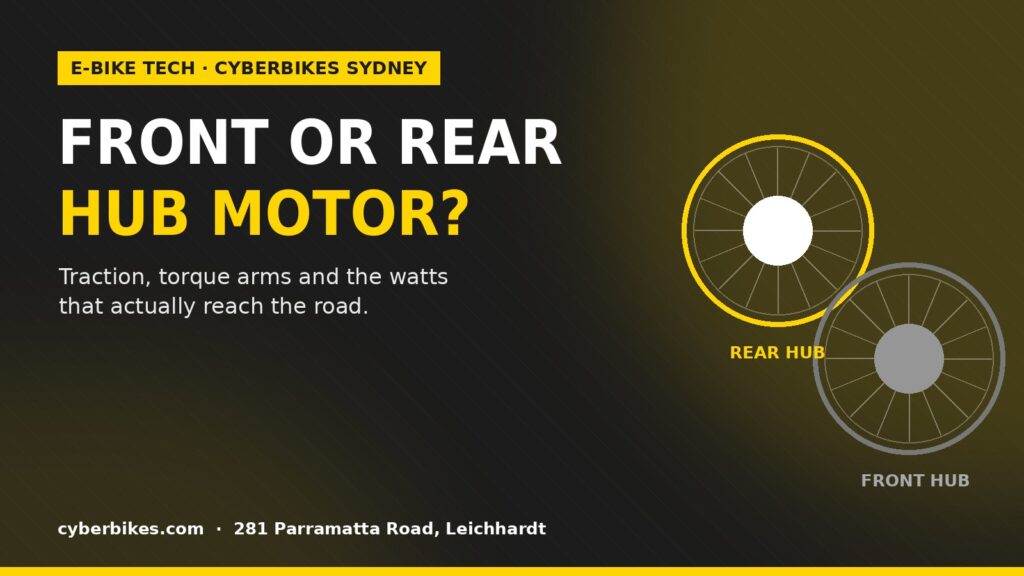
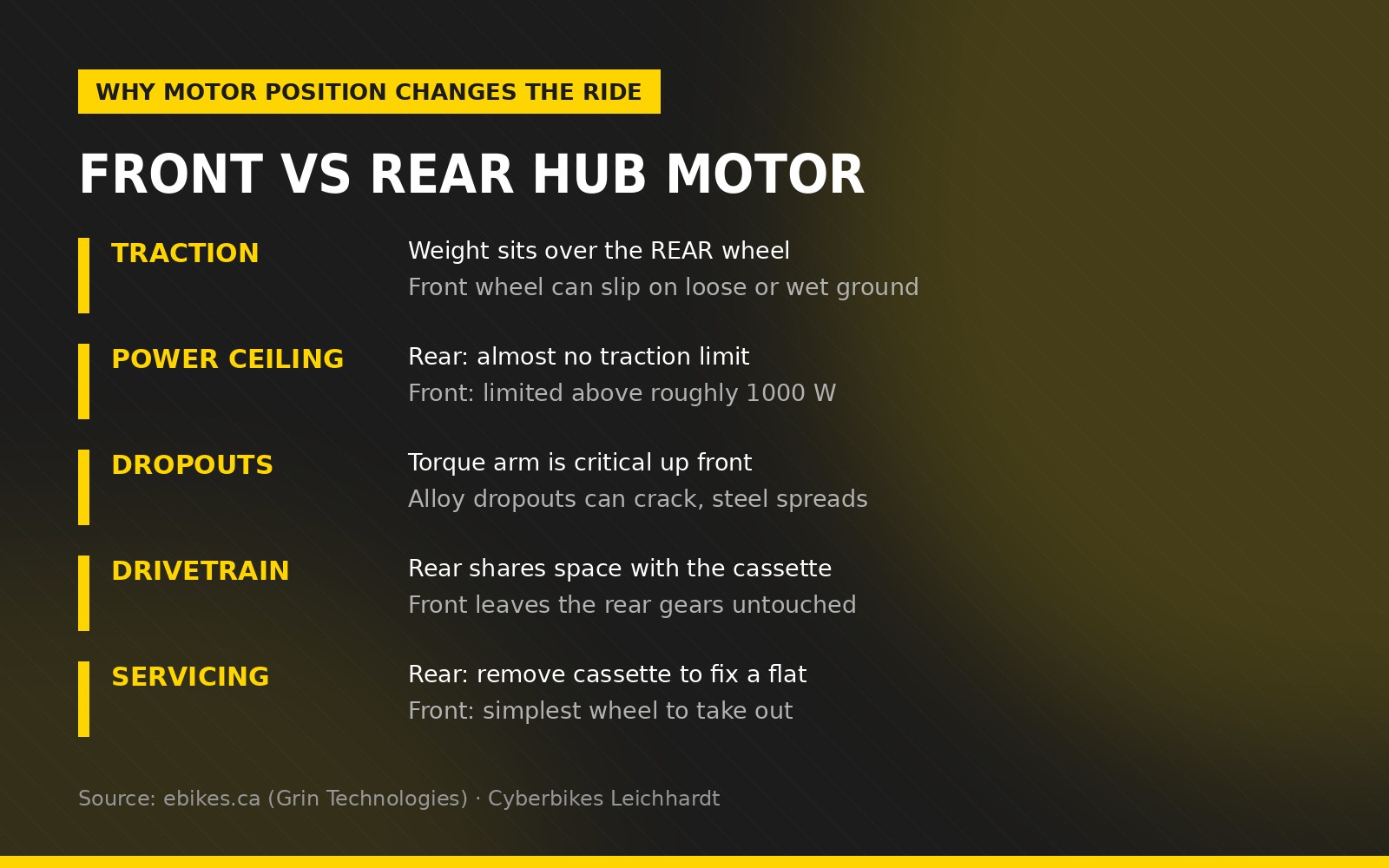
For almost every everyday rider in Sydney, a rear hub motor is the better choice — it sits under your body weight, so it can put down far more torque before the tyre lets go. A front hub motor only makes sense when you want the rear wheel free for an internal gear hub, or you want the simplest possible install. Grin Technologies, who have been building and instrumenting hub motor systems for two decades, put it bluntly: a rear hub has “almost no limit to power capability in terms of traction and handling”, while a front hub has “limited traction for high power (>1000 watts) or loose gravel roads” (ebikes.ca).
That is the short answer. The longer answer is more interesting, because motor position changes four things at once — grip, the safety of your dropouts, what you can do with your gears, and how annoying it is to fix a flat on the Parramatta Road shoulder. Here is how each one actually works, and what it means on a Leichhardt-to-city commute.
What is the actual difference between a front and rear hub motor?
Mechanically, almost nothing. A hub motor is a brushless DC motor built into a wheel hub: a ring of copper-wound stator teeth bolted to the axle, and a shell of permanent magnets spinning around it. Swap it from the back of the bike to the front and the motor itself is unchanged. What changes is everything around it.
- Weight distribution. A seated rider puts most of their mass over the rear wheel. A rear hub motor therefore drives the loaded wheel; a front hub drives the light one.
- Dropout loading. Motor torque tries to spin the axle backwards in the frame. Front forks and rear dropouts are built from different materials and handle that very differently.
- Drivetrain space. A rear hub has to share the axle with a cassette or freewheel. A front hub leaves the rear triangle completely alone.
- Sensing. Some rear direct-drive hubs integrate a torque sensor. A front hub almost always needs a separate pedal-assist sensor at the bottom bracket (ebikes.ca).
If you want the full picture of how the motor, sensor and controller talk to each other before you go further, our guide to how e-bike motors, sensors and controllers actually work is the place to start.
Which hub motor gives you better traction on Sydney’s hills and wet roads?
The rear, and it is not close. Traction is a product of the downward force on the tyre and the friction coefficient of the surface. On a seated rider the rear wheel typically carries the larger share of total weight, and that share increases as you accelerate or climb, because weight transfers rearward. So the rear wheel gets more grip exactly when the motor is asking for more of it.
A front hub does the opposite. Accelerating unloads the front wheel at the same moment the motor is trying to push through it. Grin note that a front wheel “can slip at full throttle, particularly on loose surfaces even at modest power levels”. In Sydney terms: the wet steel tram tracks near Jubilee Park, painted bike-lane markings on Lilyfield Road after rain, and the loose gravel on parts of the Bay Run are all places where a front hub will chirp and spin while a rear hub just goes.
Why do front hub motors need torque arms — and what happens without one?
Because the axle pushes back. As Grin put it, “for all the torque that the motor generates spinning a wheel forwards, there is an equal and opposite torque on the axle causing it to rotate backwards.” Most hub motors resist that with nothing more than two flats machined onto the axle, keyed into the dropout slot.
The numbers are sobering. Grin’s testing puts unreinforced cast aluminium dropouts at failure somewhere around 60–90 N·m of torque, and calculates that a 12 mm axle producing 40 N·m generates roughly 1000 lb of spreading force on each dropout (ebikes.ca). Steel dropouts fail gracefully — they spread open slowly and you notice. Aluminium ones crack.
That asymmetry is the real argument against DIY front hub conversions: the front fork on most modern bikes is aluminium, it is the wheel you cannot afford to eject, and Grin advise against front installs in aluminium dropouts without reinforcement. They flag torque arms as essential above 1000 W, when using regenerative braking (which reverses axle torque every time you slow), or when the motor sits in an alloy fork.
Does motor position change your watts, torque or range?
Not directly — but it changes how much of that power you can actually use. Electrical power is simply volts times amps. A 48 V pack pulling 20 A is drawing 960 W at that instant, whether the motor is at the front or the back. What differs is whether the tyre can convert it into forward motion instead of wheelspin.
Heat is the other half of the story, and it is where riders get caught out. Grin’s power-ratings page makes the key point that “it’s not the output power but the output torque of the motor which causes it to heat up and eventually fail” — because heating follows I²R. Double the current to double the torque, and you generate four times the heat in the windings. That is why a motor grinding up Norton Street at 8 km/h in top assist is working far harder thermally than the same motor cruising the Bay Run at 25 km/h.
It is also why the watt number stamped on a motor tells you less than you think. Grin document the same Crystalyte H3540 hitting 600 W peak on a 36 V 20 A controller and 1,058 W peak on a 36 V 40 A controller — one motor, two completely different “ratings”, decided by the battery and controller rather than the motor (ebikes.ca). If you want to see this for your own setup, Grin’s motor simulator plots power, efficiency, torque and thermal behaviour across the whole speed range, and outputs consumption in Wh/km plus predicted range and an “overheat in” time.
Range itself is just arithmetic: Wh = V × Ah. The Cyberbikes Centauro runs a 48 V 25 Ah Samsung pack, stated on its spec sheet as 1200 Wh. Divide that by your real consumption: at 15 Wh/km that is 80 km, at 20 Wh/km it is 60 km. That is the maths, not a promise. Our definitive guide to e-bike batteries and range shows how to measure your own Wh/km instead of guessing.
What does NSW law say about hub motor power?
In NSW a legal power-assisted pedal cycle has a maximum continuous rated power of 500 W, must not provide power above 25 km/h, and any throttle-only function must cut out at 6 km/h. From 1 March 2029 that drops to 250 W maximum and only EN 15194 certified e-bikes will be allowed on NSW roads (Transport for NSW).
The line that catches people out: Transport for NSW state that e-bikes exceeding any of these limits “are illegal, even if the power or speed is restricted by software (app, switch or code)”. A 1500 W hub dialled down in a display menu is not a legal e-bike. Helmets are mandatory, and riders 16 and over cannot use footpaths unless supervising a child under 16.
Note how the regulation measures continuous rated power — the very number Grin argue is arbitrary. We have made that argument ourselves:
The full state-by-state picture is in our complete guide to e-bike laws in NSW and Australia.
Front or rear hub motor: which should you actually buy?
Here is the honest split, based on Grin’s engineering guidance and what we see come through the workshop at Leichhardt.
| Factor | Front hub | Rear hub |
|---|---|---|
| Traction under power | Limited — slips on wet or loose surfaces | Excellent; effectively no traction ceiling |
| Practical power ceiling | Grin flag problems above ~1000 W | Handles high power without drama |
| Dropout safety | Torque arm essential in alloy forks | Thicker plate dropouts, more margin |
| Gearing options | Frees the rear for an internal gear hub | Must run a cassette or freewheel |
| Fixing a flat | Easiest wheel on the bike to remove | Cassette and motor cable to deal with |
| Pedal-assist sensing | Needs a separate bottom-bracket sensor | Direct-drive hubs can integrate torque sensing |
| Carrying cargo or a child | Rear load makes front grip worse | Rear load presses the driven wheel down |
Choose a rear hub if you commute in Sydney traffic, ride in the wet, climb anything, or carry shopping, a rack load or a child. Choose a front hub if you specifically want a Rohloff or Nexus internal gear hub at the back, you are converting an old steel-forked tourer, and you accept a modest power level with a proper torque arm fitted.
That is why the Cyberbikes Centauro uses a 250 W rear hub motor. The product page lists it with a 48 V 25 Ah (1200 Wh) Samsung battery certified to UL 2271, an ISO 4210 MTB-compliant 6061 aluminium frame, four-piston hydraulic brakes with 180 mm × 2.3 mm rotors, 100 mm front and 120 mm rear travel, and a 150 kg rider-and-cargo load with a frame-welded 50 kg rear rack. It complies with EN 15194 at 250 W continuous, 25 km/h pedal assist and 6 km/h throttle — comfortably inside the current NSW rules and already inside the 2029 ones.
Frequently Asked Questions
Is a front hub motor dangerous?
Not inherently, but it is less forgiving. Grin Technologies advise against installing hub motors in aluminium front dropouts without reinforcement, because aluminium tends to crack suddenly while steel spreads gradually. A correctly fitted torque arm, a sensible power level and properly torqued axle nuts make a front hub safe. Skipping any of those is where failures come from.
Does a rear hub motor make it harder to fix a puncture?
Yes, moderately. You have to deal with the cassette or freewheel and unplug the motor cable, which is more steps than a front wheel. It is a ten-minute job rather than a three-minute one, and it is the single genuine day-to-day advantage a front hub has.
What is the maximum legal e-bike motor power in NSW?
500 watts maximum continuous rated power, with motor assistance stopping at 25 km/h and any throttle-only function cutting out at 6 km/h. From 1 March 2029 the limit becomes 250 watts and EN 15194 certification is required. Transport for NSW state that bikes over these limits are illegal even if restricted by software.
Ride both and feel the difference
Specs settle arguments on paper; your legs settle them on a hill. Come and test ride a Cyberbikes Centauro at 281 Parramatta Road, Leichhardt — take it up a real Sydney gradient with a load on the rack and you will understand the traction argument in about thirty seconds. Call 0491 794 668, Tuesday to Saturday, or browse the range at cyberbikes.com. Rent-to-own starts from $99.99 per week if you would rather ride now and decide later.
Sources: ebikes.ca hub motor options, ebikes.ca torque arms, ebikes.ca motor power ratings, ebikes.ca pedal assist, Transport for NSW e-bike rules.
#ebikeSydney #hubmotor #Cyberbikes #Centauro #LeichhardtEbikes #ebiketech #electricbikeaustralia #NSWebikelaw