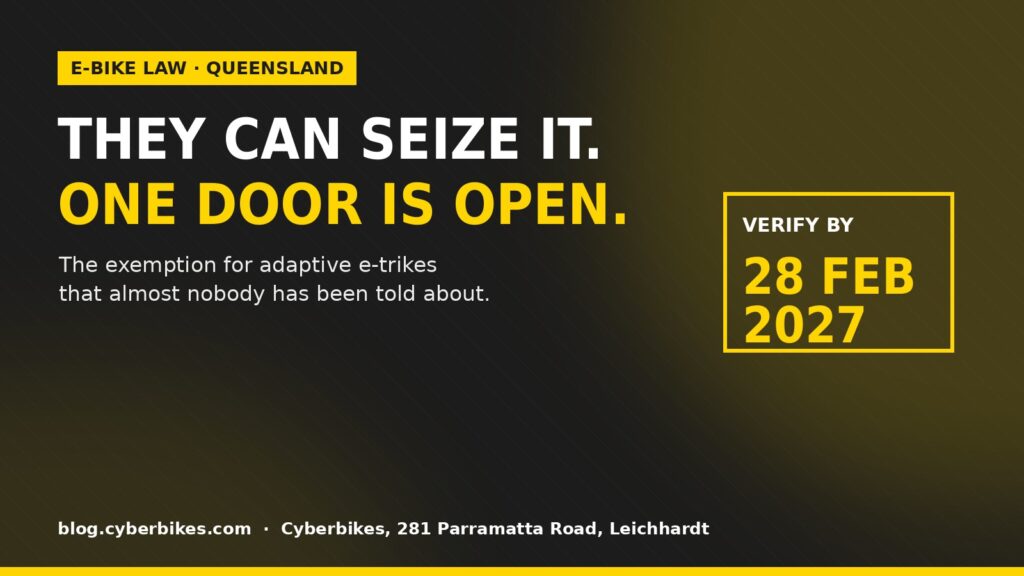
Yes. Since 31 August 2026, Queensland e-bike laws allow police to seize, impound and potentially destroy any e-bike exceeding 250 watts continuous rated power or providing assistance above 25 km/h — regardless of the rider’s age, record or reason for riding. But there is a pathway most riders have never been told about: Queensland’s E-Bike Assurance Scheme includes a category for “non-standard e-bikes designed or modified for riders with a disability or medical condition, such as e-trikes” — and verification closes on 28 February 2027.
We went looking for that pathway because a reader wrote to us. He is in his eighties, he rides an adaptive e-trike in regional Queensland, and he is not a hypothetical.
We have chosen not to identify him — not his name, his town, the path he rides, or the make of his trike. That is not coyness. Describing a non-compliant machine next to a real name and a postcode, in a state where seizure powers are live, is not something we are willing to publish. Notice what that means: a rider in his eighties with a spotless record now has to be treated like a protected source to tell his own story. That is the law working exactly as drafted, and it should bother people more than it does.
Who are these laws actually catching?
Our reader has covered north of 20,000 km on his trike — typically 40 to 50 km every second day — without a single accident. That is more crash-free distance than most riders manage in a lifetime, and he is still adding to it in his eighties. He rides with a joint condition and a lung condition, and describes the riding as therapy for both.
His trike has a throttle. On the current rules, that makes it a prohibited device, and police can now take it and destroy it.
He is not the rider the blitz was designed for. Nobody drafting these rules pictured him. That is exactly the problem.
Why does a throttle matter so much on an adaptive trike?
In public debate a throttle is shorthand for cheating — the component that turns a bicycle into a motorbike. On an adaptive trike it does four jobs, and none of them is speed.
- Getting moving. A low-slung recumbent is hardest to launch from a standing start, particularly on a gradient.
- Climbing. Sustained low-cadence hill work is where a rider with joint disease pays the highest price.
- A safety margin. Pulling clear of a hazard when legs alone will not do it fast enough.
- Getting home. If legs cramp or joints seize mid-ride, the throttle is the difference between finishing and being stranded.
Remove it and you have not made that rider safer. You have turned a 40 km ride into a wager on whether his body cooperates for the whole distance. This is what a rule written around a component cannot see: it looks at the part, never at why the part is fitted.
What exactly changed in Queensland in 2026?
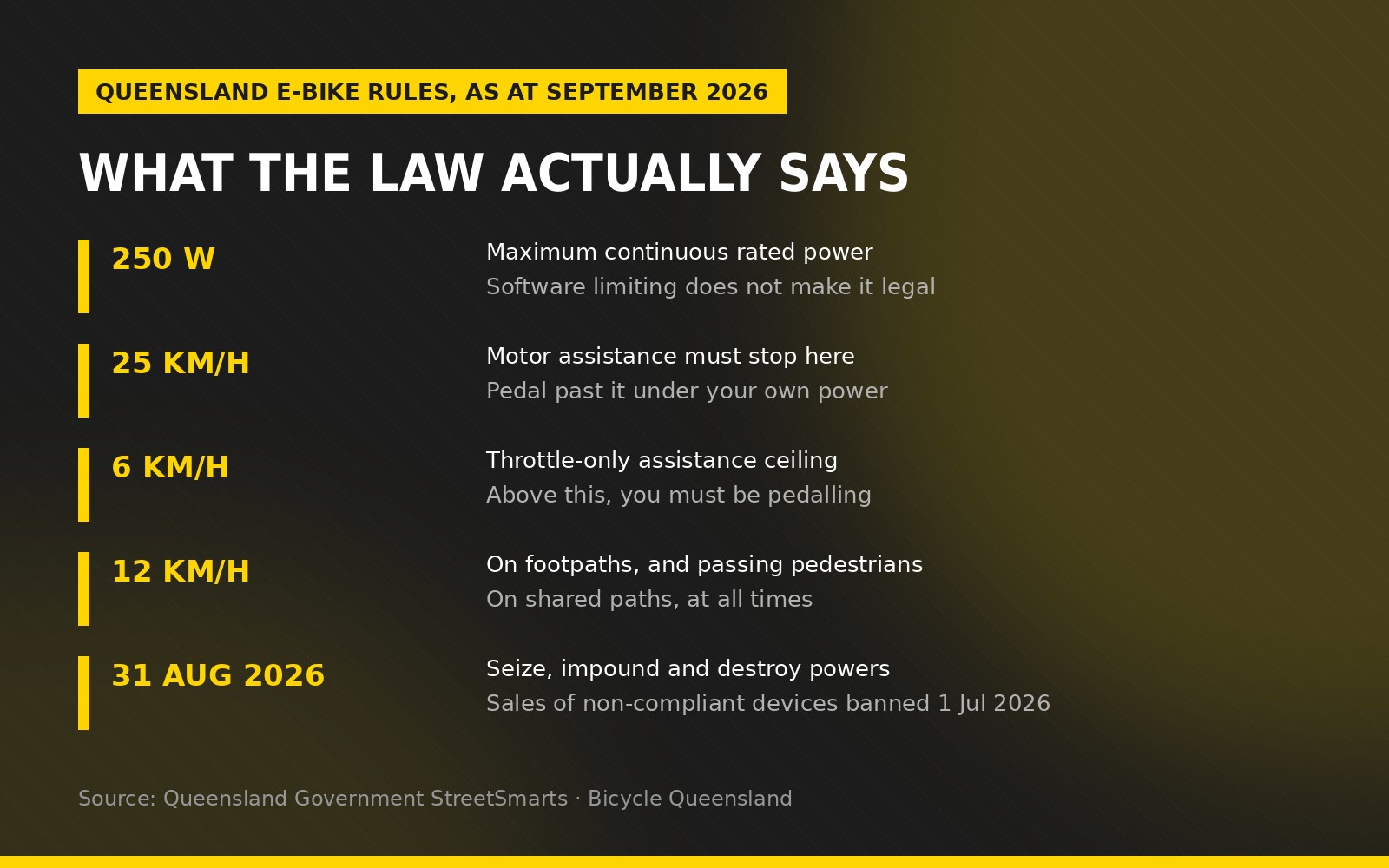
The rules now in force, per Queensland Government StreetSmarts:
- 250 W maximum continuous rated power
- Motor assistance must stop at 25 km/h
- Throttle-only assistance allowed to 6 km/h, to help you start moving
- EN 15194 compliance labelling
- 12 km/h on footpaths, and when passing pedestrians on shared paths
- Riders 16 and over need a valid driver licence (learner or above) — $518 fine otherwise
- Police may seize, impound and potentially destroy prohibited devices
The rider rules commenced 31 August 2026, with a prohibition on selling non-compliant devices from 1 July 2026 (Bicycle Queensland). The obvious workaround is closed: a high-powered device “does not become a legal e-bike simply because its power or speed has been restricted through software.”
If you ride in New South Wales the numbers and dates differ — our complete guide to e-bike laws in NSW and Australia sets out the current position, and how the rules vary between states covers the rest of the country.
Is 250 watts a sensible way to measure danger?
This is a question about measurement rather than politics, and the engineering answer is uncomfortable.
A watt rating is not a fixed property of a motor. Grin Technologies, who have spent two decades instrumenting these systems, state that there is “no standard or even consistent way to provide a numeric ‘watts rating'” for a hub motor. They document the same Crystalyte H3540 producing 600 W peak on a 36 V 20 A controller and 1,058 W on a 36 V 40 A controller — one motor, two ratings, determined by the controller rather than the motor (ebikes.ca). We have written into statute a number the engineering literature treats as close to arbitrary.
There is also the speed-differential problem. Some coastal shared corridors in Queensland carry a 40 km/h limit. A capable rider held to 25 km/h becomes the slow obstacle that drivers make bad decisions around. Traffic engineers have understood for decades that risk on a shared carriageway tracks the spread of speeds, not the absolute number.
And the proportionality question. In the 12 months to April 2025 Australia recorded 1,296 road deaths: 592 drivers, 272 motorcyclists, 195 passengers, 181 pedestrians and 41 pedal cyclists (BITRE / National Road Safety Data Hub). Cyclists are overwhelmingly the people being killed, not the people doing the killing. Enforcement aimed hardest at the lightest vehicles on the road is matching the response to visibility, not to risk.
Are Queensland’s e-bike laws retrospective?
No — and getting this right protects riders rather than hurting them. A high-powered throttle-controlled machine has not been a legal bicycle in Queensland at any point in the last decade. The 250 W pedal-assist standard long predates the 2026 changes. What arrived in 2026 was not a new prohibition but enforcement, with teeth.
The grievance underneath is still real, and it deserves its accurate name. The state left a rule effectively unenforced for over a decade, allowed the parts to be imported and sold in good faith throughout, and has now armed itself to destroy the result. On sellers, Queensland has finally acted — non-compliant devices could not lawfully be sold from 1 July 2026. That arrived years too late for riders who bought in good faith and are now holding the risk alone.
What is the E-Bike Assurance Scheme, and who qualifies?
This is the part every affected Queensland rider needs to know. The scheme covers two categories: e-bikes made before 1 July 2026 that meet the core safety features of EN 15194, and — quoting the Queensland Government directly — “non-standard e-bikes designed or modified for riders with a disability or medical condition, such as e-trikes”.
Two dates matter. Full scheme details were due to be published before 1 October 2026, and verification must be completed by 28 February 2027 for a bike to remain legal.
Be clear-eyed about the limits. The same page states that devices exceeding 250 W and 25 km/h are illegal in Queensland, so this is a door rather than a guarantee, and it may require changes to how a bike is configured or rated. But it is an official, named pathway with the adaptive-cycling use case written into it, and the clock is running.
If you ride an adaptive or medically modified e-trike in Queensland, the most useful thing you can do this month is register your interest with Transport and Main Roads and put your case in writing while the scheme’s detail is still being drafted. A Magistrates Court, after your bike has been impounded, is the worst available ground on which to argue this. Bicycle Queensland is already engaged on the issue, and your local member is another door.
What about the shared paths themselves?
Our reader raises a point almost nobody is making. He rides a long coastal shared path and says he has spent years asking his council for signage explaining how a shared path works — keep left, ring your bell — and knows of barely one such sign, sited where it does least good. He reports being told the rules are common sense anyway.
They are not common sense. Nobody is born knowing them. A shared path without instruction produces exactly what he describes: walkers three abreast, prams turned sideways, dogs on long leads, groups stopped mid-surface. That is not malice — it is the absence of anyone having explained. Where car parks sit on the far side of a path, drivers cross it constantly with no signage indicating who gives way. Painting the path through conflict points is standard practice in many cities.
If this enforcement wave is genuinely about shared-path safety, the near-absence of signage on long shared paths is a fixable causal factor sitting in plain sight. It attracts no blitz and no seizure powers. We are policing the user and leaving the design alone — the same mistake road safety research has spent forty years telling us not to make.
Frequently Asked Questions
Can Queensland Police destroy a seized e-bike?
Yes. Under the rules that commenced on 31 August 2026, Queensland Police can seize, impound and potentially destroy prohibited devices — e-bikes exceeding 250 watts continuous rated power or providing assistance above 25 km/h. Restricting a high-powered device through software does not make it legal.
Does the Queensland E-Bike Assurance Scheme cover adaptive e-trikes?
The scheme includes a category for non-standard e-bikes designed or modified for riders with a disability or medical condition, such as e-trikes, alongside pre-1 July 2026 bikes meeting the core safety features of EN 15194. Full details were due before 1 October 2026 and verification closes on 28 February 2027. Devices exceeding 250 W and 25 km/h remain illegal, so approval is not automatic.
Is a throttle legal on an e-bike in Queensland?
Only up to 6 km/h, to help the rider start moving. Above that speed the rider must pedal for the motor to provide assistance. Throttle-only devices operating above 6 km/h are treated as prohibited devices rather than bicycles.
Ride something nobody can take off you
We will keep arguing that a rule which cannot tell a rider in his eighties with a medical need from a teenager on a pedal-equipped dirt bike is a badly drafted rule. We will also keep telling riders the truth: a non-compliant machine is now a genuine risk to your investment, whatever you think of the law.
The Cyberbikes Centauro is built to sit on the right side of that line: a 250 W rear hub motor, a 48 V 25 Ah (1200 Wh) Samsung battery certified to UL 2271, an ISO 4210 MTB-compliant 6061 aluminium frame, four-piston hydraulic brakes with 180 mm × 2.3 mm rotors, and compliance with EN 15194 at 250 W continuous, 25 km/h pedal assist and 6 km/h throttle.
Come and ride one at 281 Parramatta Road, Leichhardt, or call 0491 794 668, Tuesday to Saturday. Rent-to-own starts from $99.99 per week.
Sources: Queensland Government StreetSmarts, Queensland Government — E-Bike Assurance Scheme, Bicycle Queensland, BITRE / National Road Safety Data Hub, ebikes.ca (Grin Technologies). Our reader’s account of his riding and his correspondence with his council is given as he related it to us, and is published without identifying details at our discretion.
#EbikeLaw #Queensland #AdaptiveCycling #Micromobility #Cyberbikes #EbikeAssuranceScheme #SharedPaths #RoadSafety #EbikeSydney