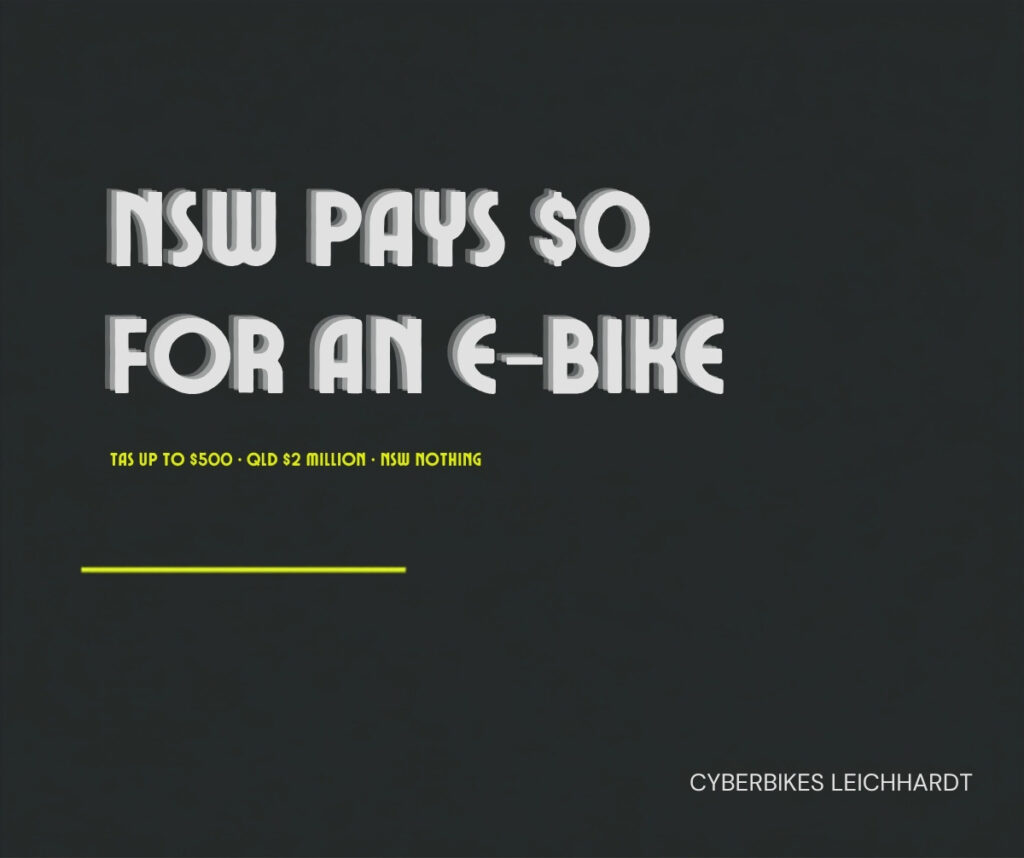
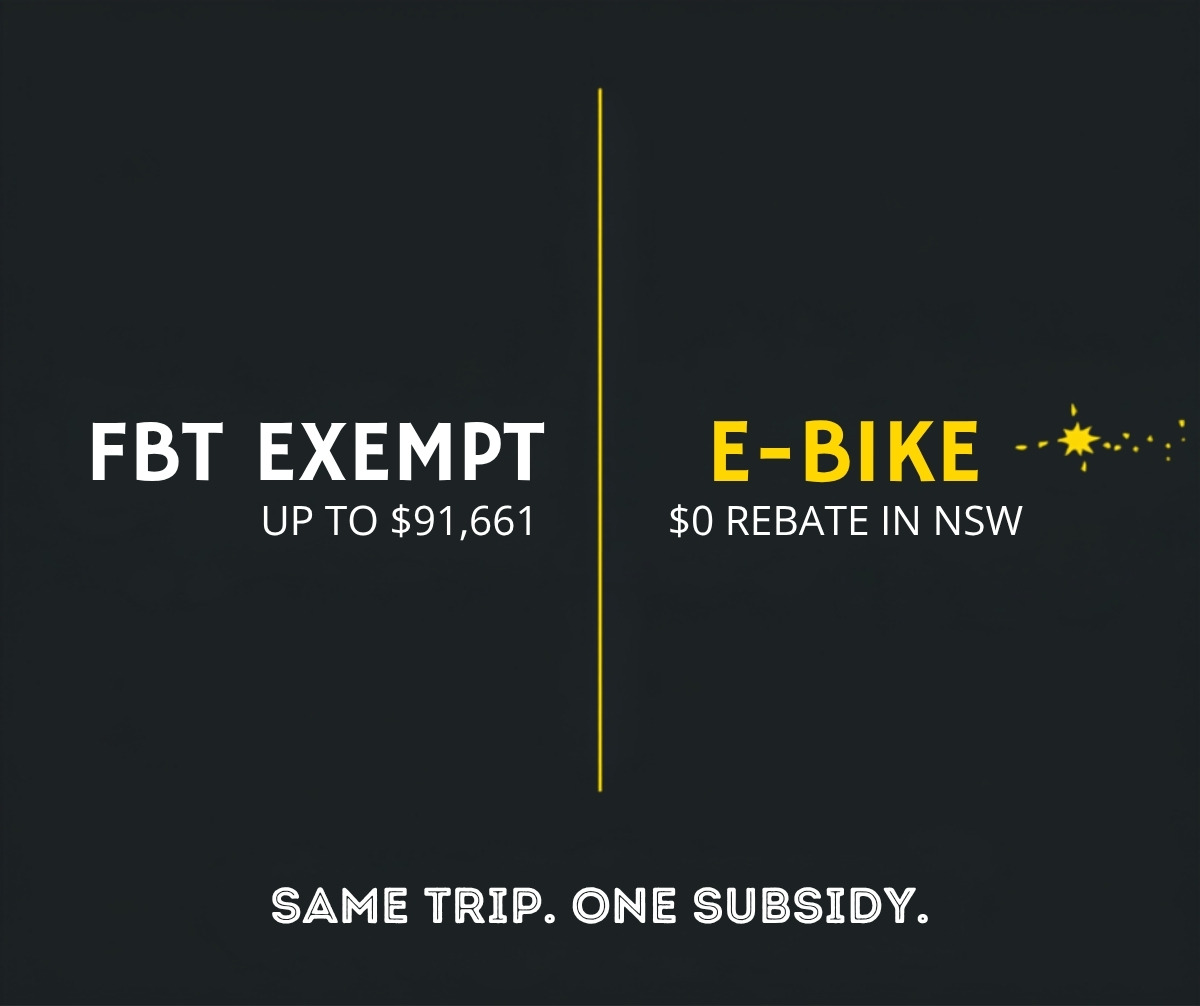
New South Wales has no e-bike rebate. None, at any price, in 2026. Tasmania has paid up to $500 towards an e-bike and up to $1,000 towards a cargo e-bike. Queensland put $2 million into an e-mobility rebate before it closed to new applications on 25 October 2024. NSW ended its own $3,000 electric car rebate on 1 January 2024 — while the federal tax break for electric cars worth up to $91,661 rolls on untouched. The cheapest, lightest, most parking-efficient way to remove a car trip from a Sydney road gets exactly nothing.
That is not a budgeting accident. It is a design choice in the tax and grant system — one that is very generous to a two-tonne vehicle and silent on a 30kg one.
Which Australian states actually pay you to buy an e-bike?
Two have tried, and neither of them is NSW.
- Tasmania ran the country’s first e-bike rebates: up to $500 for a standard e-bike and up to $1,000 for a cargo e-bike — around 12% of the cost of a bike — from a $200,000 pool split into four rounds of $50,000 opening 17 November, 17 December, 17 January and 17 February. You had to be a Tasmanian resident buying from a Tasmanian retailer, and businesses were excluded (Bicycle Network).
- Queensland went bigger: a $2 million E-Mobility Rebate Scheme for new e-bikes and e-scooters, administered by QRIDA for the Department of Transport and Main Roads under the state’s Zero Emission Vehicle Strategy 2022–2032. It closed to new applications on 25 October 2024 because the funds were fully allocated (QRIDA).
- NSW has considered it and said nothing. Reporting on an internal October 2024 document described two options on the table: a per-kilometre allowance for each bike commute, or a purchase rebate. The government has not indicated whether either is still alive (Bicycle Network).
Queensland’s scheme selling out tells you the demand was real. It closing and not returning tells you how micromobility is funded next to roads.
Why does a $91,661 electric car get a tax break when an e-bike gets none?
Because the incentive was written for cars, and nobody has written one for anything smaller. Under the federal fringe benefits tax exemption, an employer pays no FBT on an eligible electric car — plus its registration, insurance, servicing and charging — where the car is a battery electric or hydrogen fuel cell vehicle, was first held and used on or after 1 July 2022, and has never been subject to luxury car tax. The relevant ceiling is the fuel-efficient luxury car tax threshold: $91,661 for 2026–27. Plug-in hybrids stopped qualifying on 1 April 2025 (ATO).
Salary-package a $90,000 EV through a novated lease and the tax system hands you thousands. Buy a $3,000 e-bike that replaces the same school run, the same commute, the same supermarket trip, and you pay full retail. In NSW you don’t even get the old sweetener: the $3,000 rebate and the stamp duty exemption both ceased on 1 January 2024 (Revenue NSW).
Consider what each vehicle asks of the city. An electric car still needs a full lane, a parking space at both ends and roughly 2,000kg of structure to move one person. An e-bike takes a strip of road, leans against a wall, and runs on about a kilowatt-hour — the Cyberbikes Centauro carries a 48V 25Ah (1,200Wh) Samsung lithium-ion battery, cents of electricity per charge. Subsidising the heavy option and ignoring the light one isn’t neutral. It’s a thumb on the scale.
Do e-bike rebates actually get people out of cars?
Honestly: not on their own, and the evidence says so. An Australia-wide 2023 survey found 57% of respondents had access to at least one working bicycle at home, yet only 15% had ridden in the previous week and 36.7% in the past year; about 2.1% own e-bikes. Ownership is not the bottleneck, so rebate-induced ownership may not lift riding much by itself (The Conversation).
What does move people is paying for the trip and building somewhere safe to take it:
- The Netherlands’ B-Riders scheme paid riders €0.08–0.15 per kilometre and produced a 68% increase in e-bike use by former car commuters after one month, 73% after six months.
- Belgium has run a commuting payment since 1999, currently €0.24 per kilometre in tax credits for riding to work.
- Seville built a connected network and cycling rose 11-fold in a few years.
- Meanwhile, cycling gets around 2% of transport funding in Australia.
That is the honest case, including the part that cuts against us as a bike shop: a one-off rebate mostly buys a bike for someone already about to buy one. A per-kilometre allowance and a lane that doesn’t end at the next intersection buy trips.
What would a NSW e-bike incentive have to get right?
- Pay per kilometre, not per purchase. Belgium and the Netherlands have decades of data on it: it rewards the car trip you actually gave up, and only while you keep giving it up.
- Tie eligibility to the certification, not to a wattage number. In NSW a legal e-bike now means a maximum continuous rated power of 500 watts, motor assistance that stops at 25km/h, and throttle-only power that cuts out at 6km/h; from 1 March 2029 only EN 15194 certified e-bikes will be allowed on NSW roads, at a maximum of 250W (Transport for NSW). Tasmania wrote “200-watt or 250-watt” into its conditions and dated itself on day one; certification is the durable test, as our complete guide to e-bike laws in NSW and Australia sets out.
- Fund the network in the same breath. A rebate that delivers a rider into a painted lane that evaporates after 400 metres is money spent on a dead end — which is exactly why every Sydney bike lane just stops.
- Pay most for the bikes that replace the most driving. Tasmania doubled its cargo rebate for good reason: a cargo bike can retire a second car.
What does going car-lighter cost while NSW makes up its mind?
Less than waiting. With no rebate to claim in Sydney, the useful questions are what the bike costs per week and whether it will still be legal in 2029. At Cyberbikes in Leichhardt the Centauro goes out on rent-to-own from $99.99/week, and its build is already ahead of the rule change: a 250W rear hub motor, that 48V 25Ah (1,200Wh) Samsung pack, 4-piston hydraulic brakes with 180mm x 2.3mm rotors, a 150kg maximum rider and cargo load with a 50kg rear rack, and certification to UL 2849, UL 2271, ISO 4210 and EN 15194 — the standard NSW makes mandatory from 1 March 2029. Every number there is quoted from the Centauro product page.
For the full picture of what dropping a car involves here — costs, distances, weather — start with our car-free Sydney e-bike commuting and rent-to-own guide.
Swap one car trip a week for an e-bike ride and see what changes. Do it and you’ll have made the policy argument with your own legs before the brief gets read. We’re at Cyberbikes, 281 Parramatta Road, Leichhardt if you want to talk it through.
Frequently Asked Questions
Is there an e-bike rebate in NSW in 2026?
No. NSW has no e-bike purchase rebate. Tasmania offered up to $500 for an e-bike and up to $1,000 for a cargo e-bike, and Queensland’s $2 million E-Mobility Rebate Scheme closed to new applications on 25 October 2024. NSW’s own $3,000 electric vehicle rebate and stamp duty exemption ceased on 1 January 2024.
Which Australian states have had e-bike rebates?
Tasmania and Queensland. Tasmania ran a $200,000 e-bike and e-scooter rebate scheme in four rounds of $50,000 from 17 November, paying up to $500 for an e-bike and up to $1,000 for a cargo e-bike, restricted to Tasmanian residents buying from Tasmanian retailers. Queensland’s $2 million scheme was administered by QRIDA for the Department of Transport and Main Roads and closed on 25 October 2024 once funds were fully allocated.
Does the Australian government subsidise e-bikes?
No. The federal fringe benefits tax exemption applies to battery electric and hydrogen fuel cell cars first held and used on or after 1 July 2022 and priced below the fuel-efficient luxury car tax threshold, which is $91,661 for 2026-27. There is no equivalent exemption, rebate or per-kilometre allowance for e-bikes at the federal level.
#ebikeSydney #eBikeRebate #CyberbikesLeichhardt #CarFreeSydney #Micromobility #SydneyCycling #RentToOwnEbike #NSWTransport