Yes — fat, soft, knobbly tyres really do cost you e-bike range, but far less than speed does. Rolling resistance coefficients for bicycle tyres run from about 0.004 for a high-pressure road slick up to 0.012 for a low-pressure knobby wheel, according to the documentation behind the Grin Technologies motor simulator at ebikes.ca. On a loaded 110 kg e-bike rolling at a steady 25 km/h, that is the difference between roughly 30 watts and 90 watts of rolling drag — real, but smaller than the penalty you pay for riding faster.
At Cyberbikes in Leichhardt we get asked this constantly, usually by someone eyeing a fat-tyre bike and worrying they will be pushing it home. So let us do the actual sums, in watts and kilometres, instead of trading opinions.
What actually slows your e-bike down?
Three forces take power from your battery, and they behave completely differently.
- Rolling resistance — the tyre squashing and un-squashing against the road. It scales with weight and barely changes with speed. Force = Crr x weight x gravity.
- Aerodynamic drag — pushing air out of the way. It scales with the cube of speed, so it is almost nothing at walking pace and dominant at 30 km/h.
- Gravity — hills. Brutal and honest: no tyre choice saves you on the climb out of Rozelle.
Tyres only touch the first one. That is the whole reason this question has a bounded answer rather than a scary one. For the aerodynamic half, the same ebikes.ca documentation gives frontal-area values (CdA) from 0.2 for a streamlined recumbent up to 0.8 for a wide upright mountain bike with a puffy jacket — your jacket is a bigger aero decision than your tyre.
How much e-bike range do fat tyres really cost?
The watts at 25 km/h
Rolling force is Crr x mass x g. Take a realistic Sydney commuter: 85 kg rider, 25 kg of bike and cargo, so 110 kg all up. Multiply by gravity (9.81 m/s²) and you get about 1,079 newtons pressing down. Power is force x speed, and 25 km/h is 6.94 m/s.
- High-pressure slick (Crr 0.004): 4.3 N x 6.94 m/s = about 30 W
- All-round commuter tyre (Crr 0.008): 8.6 N x 6.94 m/s = about 60 W
- Low-pressure knobby (Crr 0.012): 13.0 N x 6.94 m/s = about 90 W
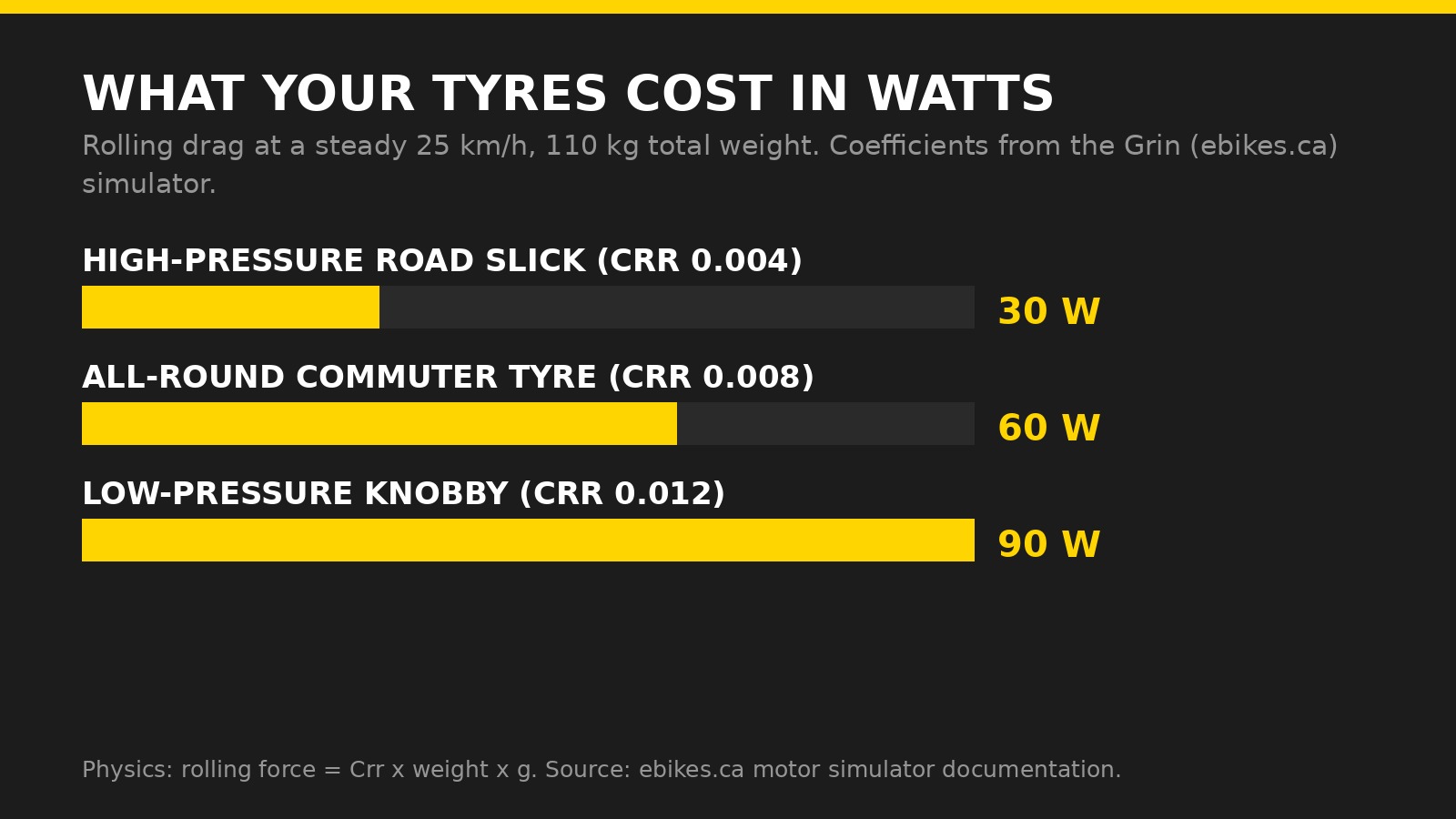
Now add the air. At 25 km/h with an upright riding position (CdA 0.6), aerodynamic drag costs roughly 123 W. So the slick bike needs about 153 W at the wheel and the knobby bike about 213 W — the tyres swing the total by around 39%.
Turning watts into kilometres
Watt-hours per kilometre is just power divided by speed. At 25 km/h, 153 W is about 6.1 Wh/km at the wheel and 213 W is about 8.5 Wh/km. Motors and controllers are not perfect, so assume roughly 80% efficiency from battery to road and call it 7.6 Wh/km versus 10.6 Wh/km drawn from the pack.
Battery capacity is volts x amp-hours. The Cyberbikes Centauro product page lists a 48V 25Ah (1200Wh) Samsung lithium-ion battery, UL 2271-certified. Divide 1200 Wh by those two consumption figures and you get roughly 158 km on slicks versus 113 km on soft knobbies.
Read that as physics, not as a spec. It assumes flat ground, no wind, no stopping, no hills and no pedalling from you. Real Sydney riding has all five, and every one of them takes range away. Cyberbikes does not publish a range number on that product page, and we are not about to invent one — but the shape of the answer holds: tyres move your range by tens of kilometres, not by half.
Does tyre pressure matter more than tyre width?
For most riders, yes. Notice that the ebikes.ca figures are not described as “thin tyre” and “fat tyre” — they are described as a high-pressure slick and a low-pressure knobby. Rolling resistance comes from the casing flexing as it rolls into and out of the contact patch. A wide tyre at a sensible pressure can roll beautifully; the same tyre 15 psi down turns your battery into a tyre-warming device.
Three practical things follow, and none of them cost money:
- Check pressure weekly. It is the cheapest range upgrade that exists, and e-bikes lose pressure faster because they carry more weight.
- Match tread to where you actually ride. Deep knobs earn their drag on dirt. On Parramatta Road they are just noise and watts.
- Do not chase the narrowest tyre you can fit. Comfort, grip and puncture resistance are safety features, and an e-bike carries far more mass into a corner than a pushbike does.
Weight works the same way — it multiplies rolling resistance directly, which is why extra weight cuts your e-bike range through exactly the formula above.
Why does speed punish your range harder than tyres?
Because air resistance grows with the cube of speed. Run the same 110 kg bike on mid-range tyres (Crr 0.008) and compare:
| Steady speed | Rolling drag | Aero drag | Total at the wheel |
|---|---|---|---|
| 25 km/h | 60 W | 123 W | 183 W |
| 32 km/h | 76 W | 258 W | 334 W |
There is a legal edge here too. Transport for NSW states that a permitted e-bike has a maximum continuous rated power of 500 watts (dropping to 250 W, with EN 15194 certification mandatory, from 1 March 2029), a motor that “does not provide power at speeds higher than 25km/h”, and any throttle-only function that “cuts out at 6km/h”. NSW is explicit that bikes exceeding those limits “are illegal, even if its power or speed is restricted by an app or switch”. Check the current rules on the Transport for NSW e-bikes page — they have changed recently, and a lot of older advice online is simply wrong.
Above 25 km/h you are on your own legs anyway, and that is precisely where the air starts charging rent. If you want the deeper mechanism, our guide to how e-bike motors, sensors and controllers actually work covers what the controller is doing while all this happens.
Why does the motor, not the tyre, decide how hard you can push?
Here is the part the spec sheets hide. Grin’s write-up on motor power ratings is blunt: there is “NO SUCH THING as a ‘rated watt'”, because the same physical motor can be sold as 250 W or 1000 W depending on the battery voltage and the controller’s current limit. Their example is a single Crystalyte motor producing 600 W peak on 36V/20A and 1,100 W peak on 48V/35A.
What actually limits a motor is heat, and heat follows I²R — double the current for double the torque and you generate four times the heat. As ebikes.ca explains, motors reach thermal equilibrium only after one to two hours, which is why a “continuous rating” is a marketing choice as much as an engineering one.
The practical link to tyres: draggy tyres mean more torque demanded at the same speed, which means more current, which means more heat in the windings. On a flat commute that is irrelevant. On a long grind up a hill with soft knobbies and a loaded rack, it is the difference between a warm motor and one that is quietly cooking. For the full picture on capacity and charging, see our complete guide to e-bike batteries and range.
What does this mean for a Sydney commute?
The Centauro’s product page lists 26 x 2.4 e-bike-ready tyres — comfortably in “wide” territory, and a deliberate choice. Sydney’s inner west is patched asphalt, tram tracks, driveway lips and shared paths. A 2.4″ tyre at proper pressure absorbs that without pretending to be a mountain bike, and it sits on a bike the page lists as having 100 mm front and 120 mm rear suspension travel, 4-piston hydraulic brakes with 180 mm x 2.3 mm rotors, a 150 kg maximum rider and cargo load, and an ISO 4210 MTB-compliant 6061 aluminium frame with UL 2849, UL 2271 and EN 15194 certification.
Pair those tyres with a 1200 Wh pack and the arithmetic stops being scary. You are trading some watts for grip, comfort and a bike that does not flinch at a pothole on Parramatta Road — and buying those watts back every time you inflate the tyres properly.
Frequently Asked Questions
Do fat tyres reduce e-bike range?
Yes, but less than most riders fear. Grin Technologies (ebikes.ca) puts bicycle rolling resistance coefficients at about 0.004 for a high-pressure road slick and up to 0.012 for a low-pressure knobby tyre. On a 110 kg loaded e-bike at a steady 25 km/h that is roughly 30 W versus 90 W of rolling drag — about 60 W of difference, or a third of the total power needed at that speed.
Does tyre pressure affect e-bike range more than tyre width?
Usually yes. Rolling resistance is driven mainly by how much the casing deforms, so an underinflated wide tyre is far worse than a properly inflated one. Checking pressure weekly is the cheapest range upgrade on an e-bike, and it costs nothing.
Are wide tyres worth it for a Sydney commute?
For most Sydney riding, yes. The Cyberbikes Centauro runs 26 x 2.4 tyres, and the grip and comfort on Sydney’s patched inner-west roads and shared paths is usually worth the extra watts — especially on a bike with a 48V 25Ah (1200Wh) battery, where the energy budget is large enough to absorb the difference.
Come and feel the difference yourself
Numbers are useful; a test ride settles it. Roll a Centauro on 26 x 2.4 tyres around the block and you will know in five minutes whether the comfort is worth the watts. Book a test ride at Cyberbikes, 281 Parramatta Road, Leichhardt, or call 0491 794 668, Tuesday to Saturday. Have a look at the 2026 Cyberbikes Centauro full-suspension e-bike before you come in.
#Cyberbikes #EbikeSydney #ElectricBikeLeichhardt #EbikeRange #RollingResistance #CentauroEbike #SydneyCommute #EbikeTech