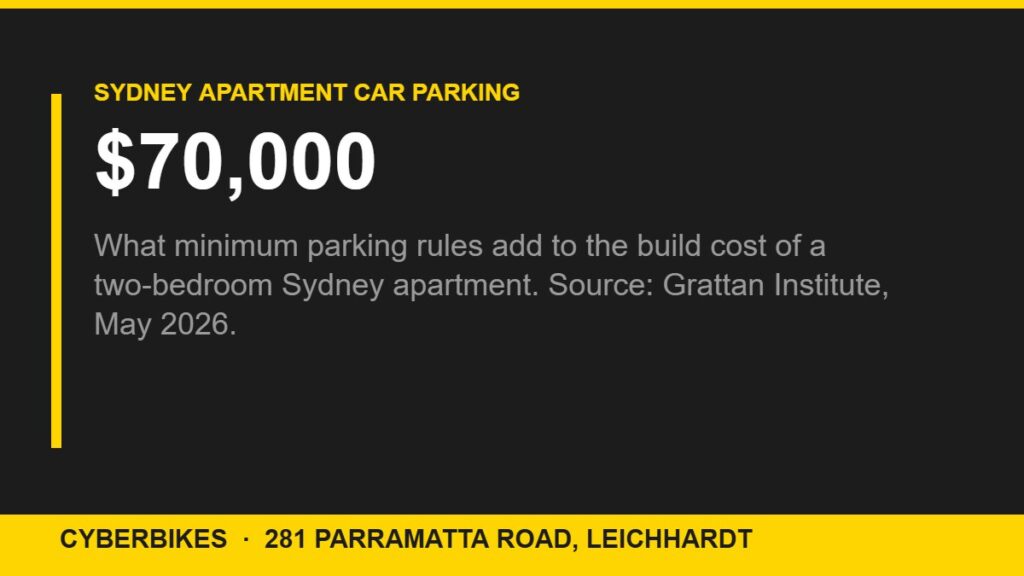
Sydney apartment car parking is not there because buyers asked for it. It is there because planning rules still order developers to build it — on average 0.6 spaces for a one-bedroom, 0.9 for a two-bedroom and 1.3 for a three-bedroom across Sydney councils. The Grattan Institute put a number on that in May 2026: mandated parking adds about $70,000 to the construction cost of a typical two-bedroom Sydney apartment. You pay it in the purchase price or the rent whether you own a car, a Corolla-sized pile of boxes, or an e-bike.
That is the quiet scandal under Sydney’s housing debate. We argue about height, heritage and interest rates, and barely mention the concrete box below the building that nobody voted for.
Why does every Sydney apartment come with a car space?
Because of a rule called a parking minimum. Most council development control plans set a floor — a number of car spaces that must be provided per dwelling before a development is approved. The rule was written decades ago on an assumption that has quietly expired: that every household will own at least one car, and that the road outside must never be asked to absorb a parked one.
Nobody re-tested the assumption. Grattan’s 2026 analysis found that in capital cities about 40% of studio and one-bedroom households own no car at all, and 19% of two-bedroom households own none. The rule keeps building spaces for cars that were never bought.
This is not a complaint about drivers. Plenty of Sydney households need a car and should be able to park it. The problem is a rule that removes the choice — it makes the car space compulsory and the housing optional.
What do Sydney’s parking minimums actually cost?
More than most people guess, because underground concrete is the most expensive floor space in a building. Grattan costed a single space at $55,000 to $178,000 underground, $29,000 to $115,000 in an above-ground structure, and $40,000 to $137,000 for a residential garage. Sydney’s $70,000 average per two-bedroom apartment sits in the middle of that range — and it is cheap compared with Perth ($137,000), Brisbane ($113,000) and Adelaide ($95,000).
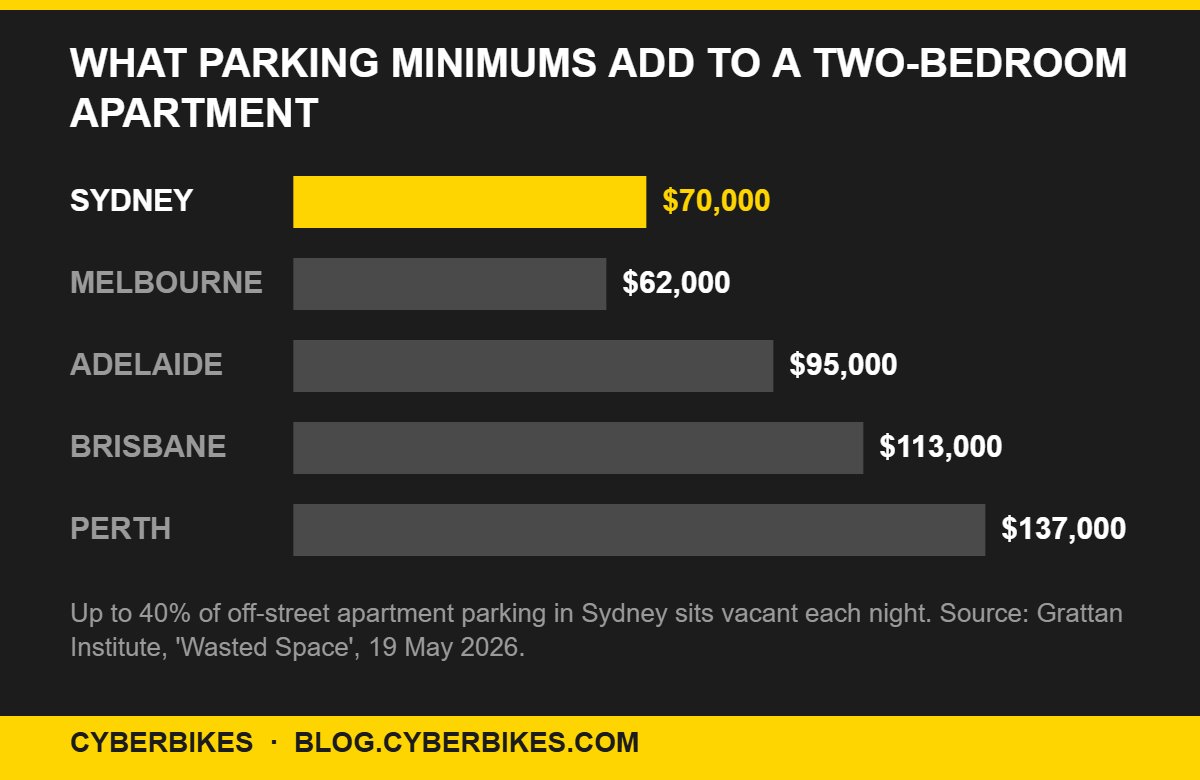
Scale it up and the numbers get hard to ignore. Grattan estimates Australia wastes over $1 billion a year on off-street spaces nobody uses, that abolishing minimums would save $5.2 billion over five years, and that it would unlock room for 140,000 additional dwellings across Sydney and Melbourne alone, as ABC News reported when the work landed.
Are Sydney’s mandated car spaces even being used?
Often, no. Grattan found that in Sydney and Melbourne as much as 40% of off-street apartment parking sits vacant each night, and that there are now more car spaces in Sydney and Melbourne apartments than there are cars. We have built a surplus of the most expensive thing in the building.
Worse, the surplus is self-fulfilling. If you have already paid for a space, the marginal cost of owning a car drops and the marginal case for driving improves. Mandated parking does not just respond to car dependency — it manufactures it, one basement at a time. That is the same induced-demand logic that governs motorways, only pointed downwards.
Is the City of Sydney doing anything different?
Yes — and it is the proof that the rest of Sydney’s rules are a choice, not a law of physics. The City of Sydney flips the logic and uses a maximum: in its own words, “the City’s parking control is a maximum parking rate. That means the rates in the local environmental plan are the maximum a development can provide.” Its parking rates update caps well-connected sites at roughly 0.1 spaces for a studio and 0.5–0.7 for a two-bedroom, rather than demanding a floor.
Cross a council boundary and the same apartment on the same bus route can trigger the opposite instruction. A developer in the Inner West can be required to dig out spaces a developer a few kilometres east would be forbidden from building. Renters and riders pay for that patchwork.
What could Sydney do with the space instead?
One car space is roughly the footprint of a small bedroom. Fill it with secure bike storage and it serves a whole stairwell instead of one household — and an e-bike does the trips that mandated parking was built to serve. Our customers in Leichhardt are not doing 400 km road trips on a weeknight; they are doing the 5 km school run, the shop, the station and the commute.
An e-bike is also the one vehicle that fits Sydney’s rules without a basement. Under Transport for NSW, a legal e-bike has a maximum continuous rated power of 500 W, motor assistance that cuts out at 25 km/h, and any throttle limited to 6 km/h; from 1 March 2029 only EN 15194 certified e-bikes will be allowed on NSW roads, and the power limit drops to 250 W. Transport for NSW is blunt about the grey imports: “E-bikes that exceed any of these limits are illegal, even if the power or speed is restricted by software.” If you want the full picture on what you can legally ride, our complete guide to e-bike laws in NSW and Australia covers it.
The Cyberbikes Centauro was built for exactly that job: a 250 W rear hub motor, a UL 2271-certified 48 V 25 Ah (1200 Wh) Samsung battery, an ISO 4210 MTB-compliant 6061 aluminium frame, 4-piston hydraulic brakes on 180 mm rotors, and a 150 kg maximum rider-and-cargo load with a 50 kg rear rack. It replaces car trips, not car spaces. If you are weighing up dropping a car entirely, our car-free Sydney e-bike commuting and rent-to-own guide runs the numbers properly.
None of this requires banning anything. Grattan’s recommendation is simply to abolish the minimums, let parking be “unbundled” so a space is bought or rented separately from the apartment, and manage kerbside with residential permits. Build the space if the market wants it. Just stop forcing a household that rides to pay $70,000 for a floor they will never use.
Frequently Asked Questions
How much do parking minimums add to a Sydney apartment?
The Grattan Institute’s May 2026 report estimates minimum parking requirements add about $70,000 to the construction cost of a typical two-bedroom apartment in Sydney. Individual spaces cost $55,000 to $178,000 to build underground.
Does the City of Sydney require minimum car parking?
No. The City of Sydney applies a maximum parking rate instead, meaning the rate in its local environmental plan is the most a development may provide, not the least. Many other Sydney councils still apply minimums.
How much power can a legal e-bike have in NSW?
Transport for NSW allows a maximum continuous rated power of 500 W, with motor assistance cutting out at 25 km/h and any throttle limited to 6 km/h. From 1 March 2029 only EN 15194 certified e-bikes will be allowed, at 250 W.
Swap one car trip a week for an e-bike ride and see what changes. We are at Cyberbikes, 281 Parramatta Road, Leichhardt, if you want to talk it through.
#EbikeSydney #CyberbikesLeichhardt #ParkingMinimums #SydneyHousing #CarFreeSydney #UrbanPlanning #InnerWest #RentToOwnEbike