A second motor roughly doubles the torque at your wheels, but it does not double your range, your battery or your legal power allowance — and in New South Wales a dual-motor e-bike is almost certainly illegal to ride on the road. The engineering case is genuinely good: two motors sharing one hill each work half as hard, and because copper heating rises with the square of current, each one runs dramatically cooler. The law is the problem here, not the physics.
We get asked about dual-motor builds at the Leichhardt shop most weeks, usually by riders hauling cargo up the Inner West’s short, nasty pinches. So let’s do the whole question properly — torque, heat, range, legality and cost — with the numbers coming from Grin Technologies’ engineering pages rather than marketing copy. If you want the foundations first, our guide to how e-bike motors, sensors and controllers actually work covers the single-motor basics this post builds on.
Does a second motor actually double your torque?
Yes — torque adds at the wheel. Two identical hub motors fed the same phase current at the same wheel speed produce roughly twice the thrust of one. That is why dual-motor builds exist at all: Grin Technologies points to cargo bikes and multi-person bikes as the main use case, “in situations where a single motor has insufficient torque”.
What a second motor does not do is change the relationship between torque and power. Grin’s motor power ratings page gives the formula plainly: Power in Watts = Torque × RPM × 0.104. At a given road speed, doubling the torque doubles the watts you are pulling out of the battery. There is no free lunch hiding in the second wheel — you are simply buying the right to ask for more power without cooking one motor doing it.
Riders feel that difference at the bottom of a climb and when moving off with a loaded rack, not at the top end. Top speed is set by battery voltage and the motor winding — and in NSW, by the 25 km/h assist cut-off long before the motors run out of anything.
Do two motors really run cooler than one?
They do, and this is the strongest honest argument for a dual build. Heat in a motor comes from current through copper windings, and it does not scale gently. Grin puts it this way: “if you double the current through the windings… you increase the amount of copper heat being generated by a factor of FOUR (the I²R relationship).”
Run that backwards and the dual-motor case appears. Split one hill’s work across two motors and each carries half the current — so each one generates roughly a quarter of the copper heat it would have made alone. Two of them together produce about half the total copper heat for exactly the same job.
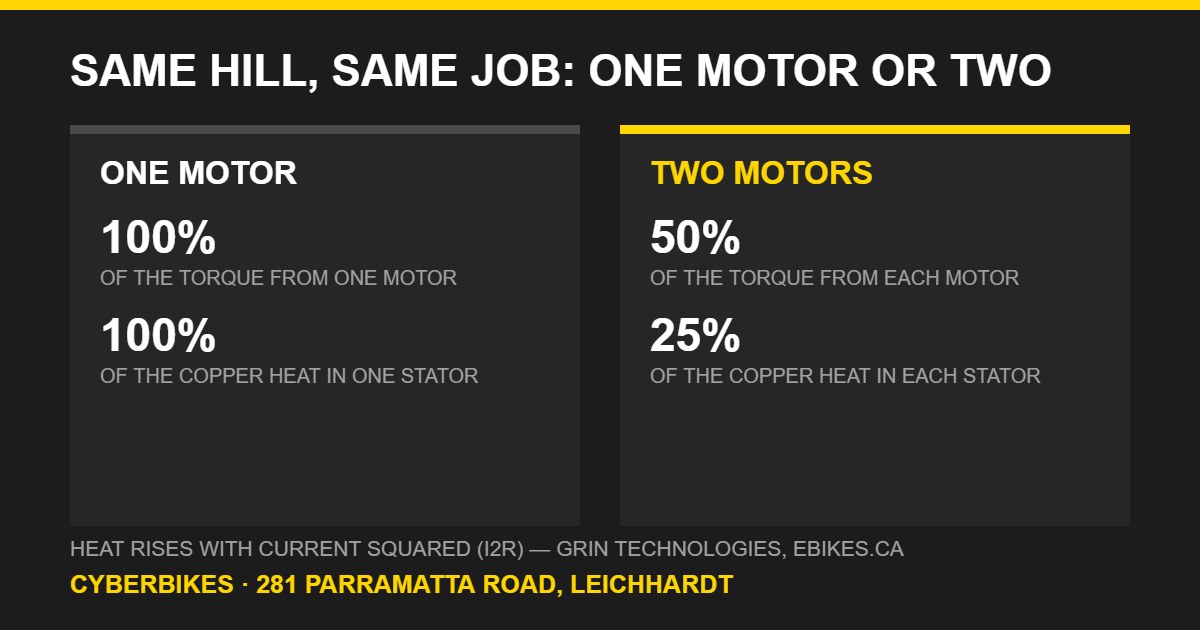
That matters more than it sounds, because motor thermal ratings are measured over timescales riders never experience. Grin notes that thermal equilibrium takes “upwards of 1-2 hours”, while a typical hill climb lasts “5-10 minutes” — which is why a motor can survive a burst that its continuous rating says it should not. Grin’s motor simulator makes this visible: it estimates the time until a motor overheats at your chosen grade and load, and it lets you open a second system and combine both motors to model a dual drive. If you are weighing motor types rather than motor counts, our breakdown of geared versus direct-drive hub motors is the companion read.
Does a dual-motor e-bike halve your range?
No. Range is set by the energy in your battery and the energy the road demands — not by how many motors are sharing the work. Your pack’s energy is simply watt-hours = volts × amp-hours. The 48V 25Ah Samsung pack listed on the Cyberbikes Centauro product page is 1200Wh, and it is 1200Wh whether one motor or two is drinking from it.
The number that turns watt-hours into kilometres is your consumption in Wh/km, which most displays will show you. The arithmetic is worth doing yourself rather than trusting a range claim: at 10 Wh/km, 1200Wh is about 120 km; at 20 Wh/km — loaded, into a headwind, up Norton Street — the same pack gives you about 60 km. Those are illustrative figures, not a Centauro claim; ride your own commute and read your own display.
Where a dual build does lose a little is at steady cruise: you are carrying a second motor’s weight, and each motor has its own idling and iron losses whether it is pulling hard or not. Expect a modest efficiency penalty on the flat, not a halving. The thing that actually destroys range is the same with one motor or two — speed, weight and how often you ask for full power.
Is a dual-motor e-bike legal in New South Wales?
Almost certainly not. Transport for NSW sets a legal power-assisted pedal cycle at a maximum continuous rated power of 500 watts, with a motor that “does not provide power at speeds higher than 25km/h” and any throttle-only function cutting out at 6 km/h. From 1 March 2029 the ceiling drops to 250W and only EN 15194 certified e-bikes will be allowed on NSW roads.
Read the wording carefully: the 500W limit describes the e-bike, not each individual motor. A bike carrying two 500W motors is a 1000W bike. And Transport for NSW closes the obvious loophole in one sentence — “E-bikes that exceed any of these limits are illegal, even if the power or speed is restricted by software (app, switch or code).” Dialling a dual-motor controller down in an app does not make it legal.
It is worth being honest about how soft the underlying number is. Grin’s position is that “there is NO SUCH THING as a ‘rated watt’ or any standardized method for rating ebike motor power” — the same motor is sold as 250W, 500W and 1000W by different vendors. That ambiguity does not help a dual-motor build; it just means the rider carries the risk of a roadside judgement call on a bike that visibly has two motors in it.
What does a second motor actually cost you?
More than most people expect, and not mainly in dollars. Grin is blunt about it: “With multiple motors also comes significant additional complexity and cost,” and recommends the approach “only for more experienced builders”. A dual drive means two controllers, and the throttle and brake-cutoff signals have to be split and shared so both motors respond together — Grin documents five separate wiring arrangements for doing exactly that.
Then there is everything downstream: two controllers drawing from one pack at once, two sets of phase and hall wiring to fail, more weight in the wheels, and a bike no shop can service from stock parts. For a Sydney commuter or a school-run cargo load, that is a lot of fragility bought to solve a problem a single well-matched motor and a big battery already solve.
That is the reasoning behind how the Centauro is specified. Its product page lists a 48V 25Ah (1200Wh) Samsung battery and a rear hub motor, 4-piston hydraulic brakes with 180mm × 2.3mm rotors, 100mm front and 120mm rear suspension travel, a 150kg maximum rider and cargo load, and UL 2849, UL 2271, ISO 4210 and EN 15194 certification. One motor, one controller, a pack big enough that you stop thinking about range — and a bike that stays inside the NSW rules. For the deeper picture of how those parts talk to each other, our complete guide to e-bike motors and controllers is the place to start.
Frequently asked questions
Is a dual-motor e-bike legal in NSW?
In practice, no. Transport for NSW sets a maximum continuous rated power of 500 watts for the e-bike, with assistance cutting out at 25 km/h and any throttle-only mode cutting out at 6 km/h. That limit applies to the bike, not to each motor, so two motors must fit inside the same 500W ceiling. Transport for NSW also states that e-bikes exceeding these limits are illegal even if the power is restricted by software.
Do two motors double your e-bike’s range?
No. Range comes from the battery’s watt-hours and how much energy the road demands, not from the number of motors. A 48V 25Ah pack holds 1200Wh whether one motor or two draws from it. A dual-motor bike is usually slightly less efficient at steady cruise because of the extra weight and each motor’s own idling losses.
Do two motors run cooler than one?
Yes. Copper heating rises with the square of current, so splitting one climb across two motors halves the current in each and leaves each motor generating about a quarter of the heat it would produce alone — roughly half the total copper heat for the same job. This is the strongest genuine engineering argument for a dual drive.
Ride one before you build one
Before you spend a weekend wiring two controllers together, come and ride a properly specified single-motor bike up a real hill. Cyberbikes is at 281 Parramatta Road, Leichhardt — book a test ride, browse the range at cyberbikes.com, or call 0491 794 668, Tuesday to Saturday. If you would rather not pay for it all at once, our rent-to-own plans start from $99.99 per week.
#Cyberbikes #DualMotorEbike #EbikeSydney #ElectricBikeLeichhardt #EbikeTech #HubMotor #NSWEbikeLaw #InnerWestSydney #CentauroEbike #RentToOwnEbike